
Product development runs on decisions, not on assets. A season is a sequence of commitments — this silhouette, this fabric, this colorway, this sample round — and the useful question about any new capability is whether it moved those decisions earlier or made them worse.
That is a different measurement problem from the one an imaging team has, and it becomes sharper on a free tier. Measure what they caused.
Track decisions, not images
An imaging team counts assets, attempts and correction hours because those describe their workload. A development lead has no use for any of them.
What matters is whether a visual existed at the moment a decision had to be made, and whether that decision held. Those two conditions are the whole of it, and neither is visible in any count of files produced. A colorway chosen in week three rather than week seven is four weeks of calendar recovered. A silhouette approved from an image and reversed after the sample arrives is a decision that was made twice, which is worse than having waited.
Both of those are countable without any tooling, using the same notes a development lead already keeps.
The distinction matters because the two measurement sets can point in opposite directions. An imaging team reporting rising output and falling correction time is describing a healthy pipeline, and the same period can contain a development calendar that moved backward because three approvals were overturned at sample stage. Neither team is wrong and neither is looking at the other's number.
Four numbers, recorded weekly
| Number | How to capture it | What it tells you |
|---|---|---|
| Decisions brought forward | Count decisions made before their usual gate | Whether the calendar actually moved |
| Decisions reversed after physical review | Count reversals traced to a visual approval | Whether early decisions are holding |
| Sample rounds avoided | Count rounds not requested because a visual settled it | The clearest saving available |
| Sample rounds still required | Count rounds requested despite a visual | Where visuals do not substitute |
Four lines in a weekly note, kept in whatever document already carries the development calendar rather than in a new one. The first two are a pair and the second two are a pair, and each pair only means something alongside its partner — a single figure from either pair can be moved in the right direction by a workflow that is quietly getting worse.
Decisions brought forward without reversals is the outcome worth having. Decisions brought forward with a rising reversal count is worse than the previous process, because a reversed decision consumes the work already built on top of it — the fabric booked, the colorway briefed, the assets produced against a style that has now changed.
Counting the second pair separately matters for the same reason. Rounds avoided is the number everyone wants to report and rounds still required is the number that keeps it honest, since a workflow that avoids rounds by deferring them will show a healthy first figure for two months.
The reversal count is the one to watch
Everything else can look good while this deteriorates, which is why it belongs in the same note rather than in a quarterly review.
A reversal happens when a decision made from a visual does not survive contact with the physical sample. Some of those are unavoidable and some indicate that visuals are being used past the point they can support — most commonly on fit, hand and true color, where the image was never able to answer the question.
The proportion between those two kinds is the actual finding. A workflow with a steady low reversal rate, all attributable to genuine surprises in the physical product, is working as intended. One where most reversals trace to the same three question types has a boundary problem that will not improve with time or with a better tool, because the questions were outside the medium from the start.
Record the reason alongside the count. Reversals traced to fit questions are a scope problem, not a quality problem, and they are fixed by deciding differently rather than by better imagery.
Reasons also make the number defensible. A reversal count with no attribution invites the interpretation that the technology is unreliable, which is usually not what happened; the same count with reasons attached shows that three reversals were fit judgments made from images and one was a genuine rendering error, and those lead to entirely different responses.
Free tiers change what you can measure
A free tier limits volume rather than record-keeping. The generation history keeps the asset that supported a decision retrievable, and a personal library keeps it reusable — so measuring the assets is not pointless, it is simply the wrong level for a development lead. Measure what they caused, and let the library carry the evidence.
There is a related discipline worth adopting regardless of tier. Note which decision each visual supported at the moment it was produced, in a line. Six weeks later nobody remembers whether a particular image informed a silhouette approval or was simply generated alongside it, and that ambiguity is what makes the reversal count unattributable.
What the numbers cannot tell you
The output is a visual asset. It does not predict fit, determine sizing, model how a fabric behaves in motion, or forecast returns. Those come from measurements, a graded pattern, a physical sample and your own data.
Screen color is not a physical reference either, which means a colorway decision made from an image is provisional until a strike-off, and counting it as brought forward is optimistic unless the strike-off subsequently confirmed it.
The numbers also say nothing about quality drift. Output can degrade or shift gradually while every count stays flat, so put a periodic visual comparison against assets from a few months earlier on the same rhythm as the note.
Reading the four together
One pattern is worth naming because it recurs.
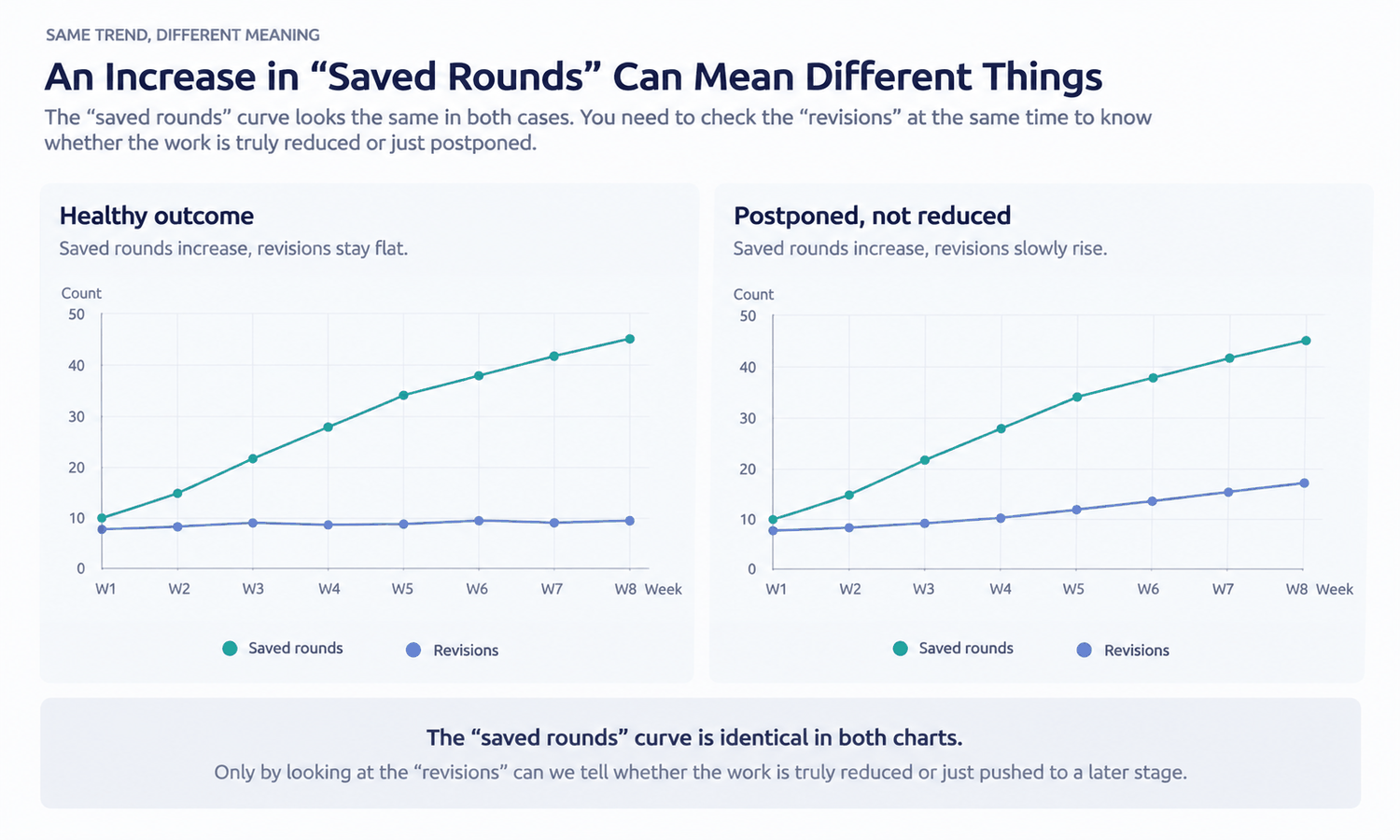
Sample rounds avoided rises, sample rounds still required stays flat, reversals climb slowly. That combination looks like a success in any single figure and describes a workflow that is deferring physical validation rather than removing the need for it. The saved rounds return later as reversals, usually at a worse moment.
The healthy pattern is avoided rounds rising while reversals stay flat, which means visuals are settling the questions they can settle and physical review is still handling the rest. That is the arrangement worth defending when someone proposes extending visual approval into fit or color, since it is exactly the extension that breaks it.
Where the pending question is a material or colorway rather than a construction, the substitution route is often quicker to explore than another round — swapping the fabric, color or style on the existing design — see Design with Purpose, and AI Virtual Try-On for the on-model output those decisions are made from.
Deciding whether to keep going
Six to eight weekly readings give a defensible view, and the decision follows from the pattern rather than from a total.
Calendar moved and reversals flat: continue, and consider whether the constraints of a free tier are now the limiting factor rather than the method. Calendar moved and reversals rising: narrow where visuals are allowed to settle decisions, particularly around fit and color. Neither moved: the capability is not being used at the point where it could matter, which is a workflow question rather than a tooling one.
Write the reading down with a date. The same conversation recurs annually, and a dated line describing what the numbers showed is worth more than a recollection of how it felt.
Include what you would need to see to change the reading. A conclusion recorded without its conditions gets treated as permanent, and the conditions here are unusually likely to change — a free tier may gain retention, a difficult category may become workable, and either would reopen a decision that was correct when it was made.
Questions development leads ask
Why not track the same numbers as the imaging team? Because attempts and correction hours describe their workload rather than your calendar. A development lead needs to know whether decisions moved earlier and whether they held.
What counts as a decision brought forward? One made before the gate it would normally wait for, with the visual as the reason. If it would have been made at that point anyway, it does not count.
How do I attribute a reversal? Record the reason at the time, not later. Reversals on fit, hand or true color indicate visuals were used beyond what they support, which is a scope fix rather than a quality fix.
Does a free tier make this measurement unreliable? It makes asset-level measurement unreliable and leaves decision-level measurement intact. Keep a dated screenshot wherever a decision is likely to be revisited.
How long before the numbers mean anything? Six to eight weekly readings, because a single week reflects whatever was in the development calendar rather than how the capability performs.
What if avoided rounds rise and reversals rise together? Treat that as deferral rather than saving. The rounds are returning later as reversals, and narrowing what visuals are allowed to settle is the correction.
What weekly tracking is protecting
The calendar, which is the only thing a development lead controls and the thing most easily damaged by a decision made twice. Four numbers, two pairs, recorded in the notes you already keep: decisions brought forward against reversals, and rounds avoided against rounds still required. Read the pairs rather than the totals, record reasons alongside reversals, and keep a dated screenshot wherever the free tier will not let you revisit what you saw. The saving is real where the pairs move in opposite directions and illusory where they move together.
Start the four-line note this week.
**Record decisions brought forward, reversals after physical review, sample rounds avoided and rounds still required, with a one-line reason beside each reversal and a note of which decision each visual supported. Six readings will show you whether the calendar genuinely moved or whether physical validation was simply postponed, and only one of those is worth continuing. The note takes two minutes a week and it is the only version of this evidence anyone will have. → **AI Virtual Try-On