
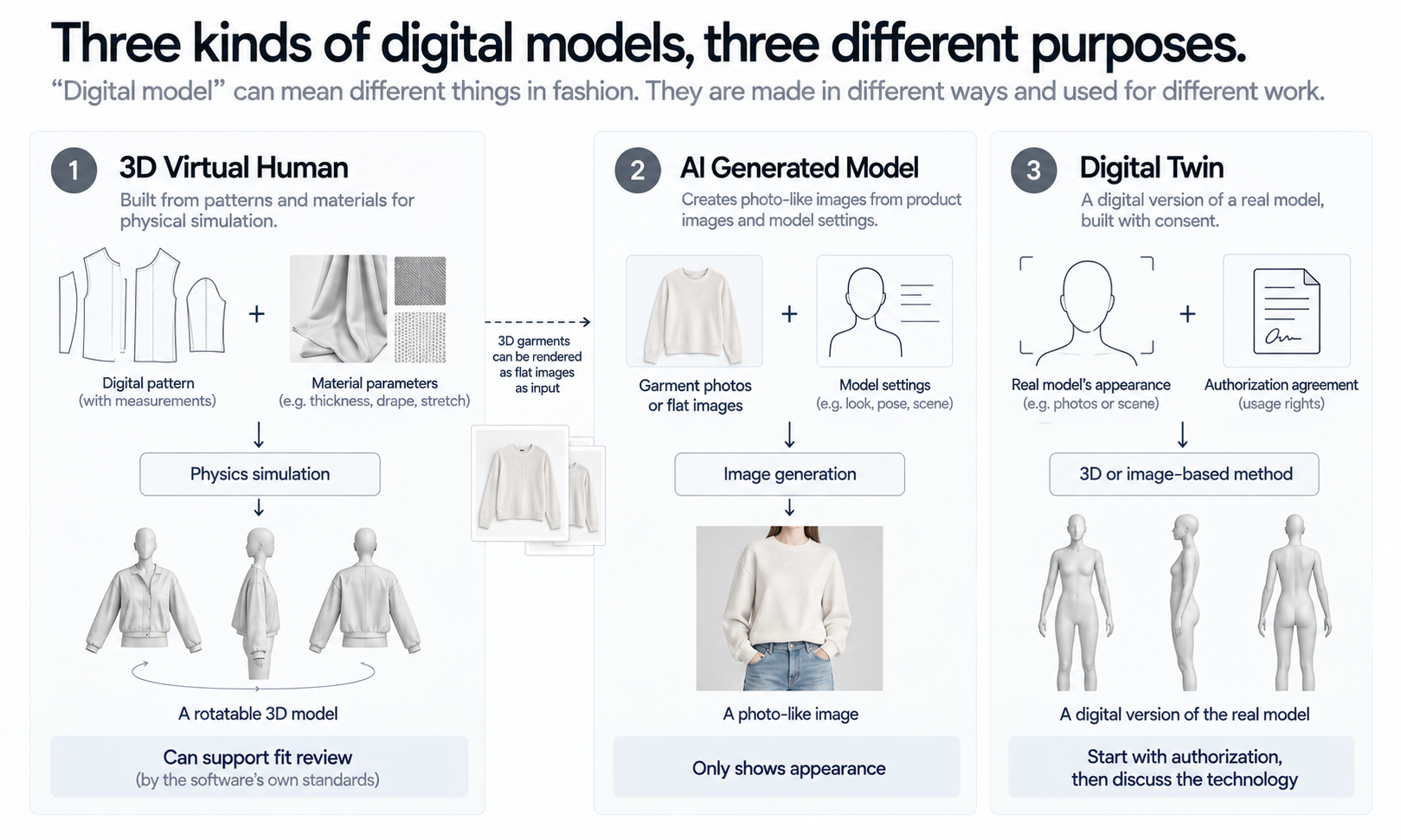
A digital model in fashion is any model who wears clothes on a screen rather than in a studio. The phrase sounds like one thing, and it is often used as if it were. In practice it covers at least three different things, built in different ways, suited to different jobs and raising different questions before anything is published.
The first is a 3D avatar: a body built in three-dimensional software, dressed in garments made from digital patterns. The second is an AI-generated model: a person produced by image software, dressed from garment photos. The third is a digital double: a digital version of a real, identifiable model, made with that person's permission.
Mixing them up causes real problems. A team expecting fit information from an image that only shows appearance will be misled. A team using a real person's likeness as if it were a generated face will run into rights questions it did not plan for. This article explains what each kind is, what it is good for, what it can and cannot tell you, and how to choose.
| Question | 3D avatar | AI-generated model | Digital double |
|---|---|---|---|
| How it is made | Built and rigged in 3D software | Produced by image generation | Made from a real person's likeness |
| What it needs from you | Digital patterns and fabric data | Garment photos or flat-lays | The person's permission and source material |
| What it is good for | Development and fit review | Product and campaign imagery at volume | A continuing face tied to a real person |
| What it can say about fit | Can support fit review, on the software's own terms | Nothing — appearance only | Only what the method beneath it supports |
| First question to settle | Is the digital pattern and fabric data ready? | Does every garment detail match its source? | What exactly does the license allow? |
3D Avatars: Built, Rigged and Simulated
A 3D avatar is a body modeled as geometry. It is usually built from measurements or from a standard size set, and it is rigged so it can be posed or animated. Garments reach it through a separate pipeline: pattern pieces are drawn digitally, assigned fabric properties such as weight and stretch, and then draped over the body by physics simulation. The software calculates how the cloth should hang given those properties.
That calculation is what makes 3D avatars valuable in development. A technical designer can check whether a waistband sits correctly, whether a sleeve pulls, or how a change in grading affects the silhouette, all before a sample is sewn. Because the avatar and garment are true 3D objects, they can be viewed from any angle and stay consistent while doing so. The same assets can also be rendered into imagery, animated, or used for virtual characters in marketing.
The cost is upstream. The simulation is only as good as its inputs: accurate digital patterns and reliable fabric data. Building those takes skill and time, and photorealistic rendering adds more. Fit evaluation in these tools carries its own validation requirements, and it should be judged by those standards, by people who know the software, rather than by the standards of any image tool. For teams that already develop products in 3D, the avatar is a natural extension of work they are doing anyway.
AI-Generated Models: Produced From Images
An AI-generated model is a person produced by image software. There is no geometry and no simulation. The software produces a picture of a person wearing the garment, guided by a written brief, a reference image or a saved model, and by a photo or flat-lay of the garment itself.
Its strengths are speed and range. A team with product photos can have on-model imagery without building patterns, fabric libraries or a 3D pipeline, and creating models across a range of ages and builds takes a change in the brief rather than a new booking. The results are photographic in character, which suits product pages and campaigns.
Its limits follow from how it works. The software does not build a body or calculate how fabric behaves. The drape in the image is rendered, not computed, so it is evidence about the picture rather than about the fabric. The output is a visual asset: it does not predict fit, determine sizing or model how a fabric moves. Those come from measurements, a graded pattern and a physical sample, or from a simulation tool built for the purpose.
Two practical cautions come with it. Garment details are reconstructed, so logos, printed text, stitching, trims and print placement must be checked against the source on every image, because reconstructed detail tends to come back almost right. Complex prints, lace and openwork, sheer fabrics and layered styling remain current weak areas; route those styles to photography and record why. And because each image is a new production, the same person has to be held on purpose across a set, and checked side by side.
Digital Doubles of Real Models
A digital double is different in kind from the other two, because it is defined by who it depicts rather than how it is made. It is a digital version of a real, identifiable person, built from that person's likeness with their permission. The method underneath can be a 3D scan and model, an image-generation workflow trained on photos of the person, or a combination.
The appeal is continuity. A brand that works with a particular model, or has a recognizable ambassador, can keep that face in its imagery without booking a shoot for every update. The person remains recognizably themselves across seasons and channels.
That recognizability is also what makes digital doubles the kind that needs the most care before anything is made. The likeness belongs to a real person. The agreement behind a digital double usually needs to cover where the images may appear, for how long, whether the person can review or withdraw them, how they are paid for ongoing use, and what happens to the digital version when the agreement ends. Those terms are for the people who manage talent agreements to settle, and they should be settled first.
What a digital double can say about fit depends on the method used to build it. A double built as a 3D avatar from the person's measurements can take part in simulation. A double produced through image generation shows appearance only, like any AI-generated model.
Choosing the Right Kind for the Job
The useful question is not which kind of digital model is better. Each is suited to a different job, and many brands will use more than one.
For product development and fit review, a 3D avatar dressed from digital patterns is the tool built for the question. It answers fit on its own terms, with its own validation, and it belongs with the technical team.
For product and campaign imagery at volume, starting from garments that already exist, an AI-generated model is usually the practical choice. It needs only garment photos, produces photographic results quickly and makes range cheap. It needs review of every image against its garment source, and it says nothing about fit.
For a continuing face that is tied to a real person, a digital double is the option, and the license comes before the technology.
Most problems come from asking one kind to do another kind's job. An AI-generated image brought into a sample review as if it showed fit will lead the room to judge a drape that was drawn, not calculated. A 3D render placed on a product page without the rendering work that makes it photographic can look like a game asset next to photographed products. A face built to resemble a known model, without an agreement, borrows a likeness nobody licensed. In each case the tool worked as designed. The mistake was in the job it was given, which is why the choice is worth making explicitly, and writing down, before production starts.
The kinds can also meet. A garment that already exists as a 3D asset can be rendered as a flat-lay and used as the input for AI-generated imagery. That is a handoff between two workflows, not a merger of them: the 3D tool keeps doing the simulation, and the image tool keeps producing pictures.
Working in the Image-Based Category
Lightchain AI (apparel AI) works in the second category. It does not build 3D avatars or simulate fabric, and it is not a tool for fit review. It is built to produce on-model imagery from the garments you already have.
-
Model Studio creates generated models and adjusts face, body, size, pose, scene and angle.
-
AI Virtual Try-On puts garments on those models from flat-lays or garment photos, including on a saved model set.
-
A 3D-to-flat-lay conversion tool turns an existing 3D garment render into a flat-lay input, so teams that develop in 3D can hand garments into the image workflow.
For teams producing on-model imagery across many styles and markets, Scale E-commerce is the Lightchain AI solution built for that work.
Frequently Asked Questions
What is a digital model in fashion?
It is a model who wears clothes on a screen rather than in a studio. The term covers 3D avatars built in modeling software, AI-generated models produced by image software, and digital doubles of real people made with their permission.
Which kind of digital model can show how a garment fits?
A 3D avatar dressed from digital patterns with fabric data can support fit review, judged by the simulation software's own validation standards. An AI-generated model shows appearance only. A digital double can do only what the method beneath it supports.
Is an AI-generated model the same as a virtual influencer?
Not necessarily. Many virtual characters used in marketing are built as 3D avatars, while an AI-generated model is produced from images. The label describes a use, while the method determines what the model can and cannot do.
Do we need permission to create a digital double?
Yes. A digital double depicts a real, identifiable person, so the agreement should cover where the images appear, for how long, review or withdrawal, payment for ongoing use and what happens when the agreement ends. Settle it with whoever manages talent agreements before anything is made.
Can 3D garment assets be used for AI-generated imagery?
Yes, as an input. A 3D garment can be rendered as a flat-lay and passed to an image workflow. The 3D tool still handles simulation, and the image tool still produces pictures rather than calculating drape.
Which kind should a small brand start with?
Start from the job. If the need is product and campaign imagery from existing garments, an AI-generated model is usually the most direct route. If the need is fit review during development, a 3D avatar is the tool built for that question.
Which kind of digital model does Lightchain AI provide?
AI-generated models. Lightchain AI (apparel AI) does not build 3D avatars or simulate fabric, and for on-model imagery from existing garments Scale E-commerce is the solution to use. Teams that develop in 3D can hand garments in as flat-lays.
In Closing
"Digital model" names three different things. A 3D avatar is built and simulated, and it belongs in development, where it can support fit review on its own terms. An AI-generated model is produced from images, and it belongs in product and campaign imagery, where it is fast and flexible but shows appearance only. A digital double is a real person's likeness, and it starts with a license. Knowing which one you are using tells you what the image can claim, what needs checking and which questions to settle before publishing.
Start Here
If your need is on-model imagery for existing garments, across many styles and markets, Scale E-commerce is the solution to use. It is built around AI-generated models: you create models that reflect your customers, put your garments on them through virtual try-on from flat-lays or garment photos, and control pose, scene and styling for each image. Start with a small set of styles, check every garment against its source, and extend to the rest of the line once the results hold.
**Explore Scale E-commerce → **https://www.lightchainai.com/global/solutions/scaleECommerce