
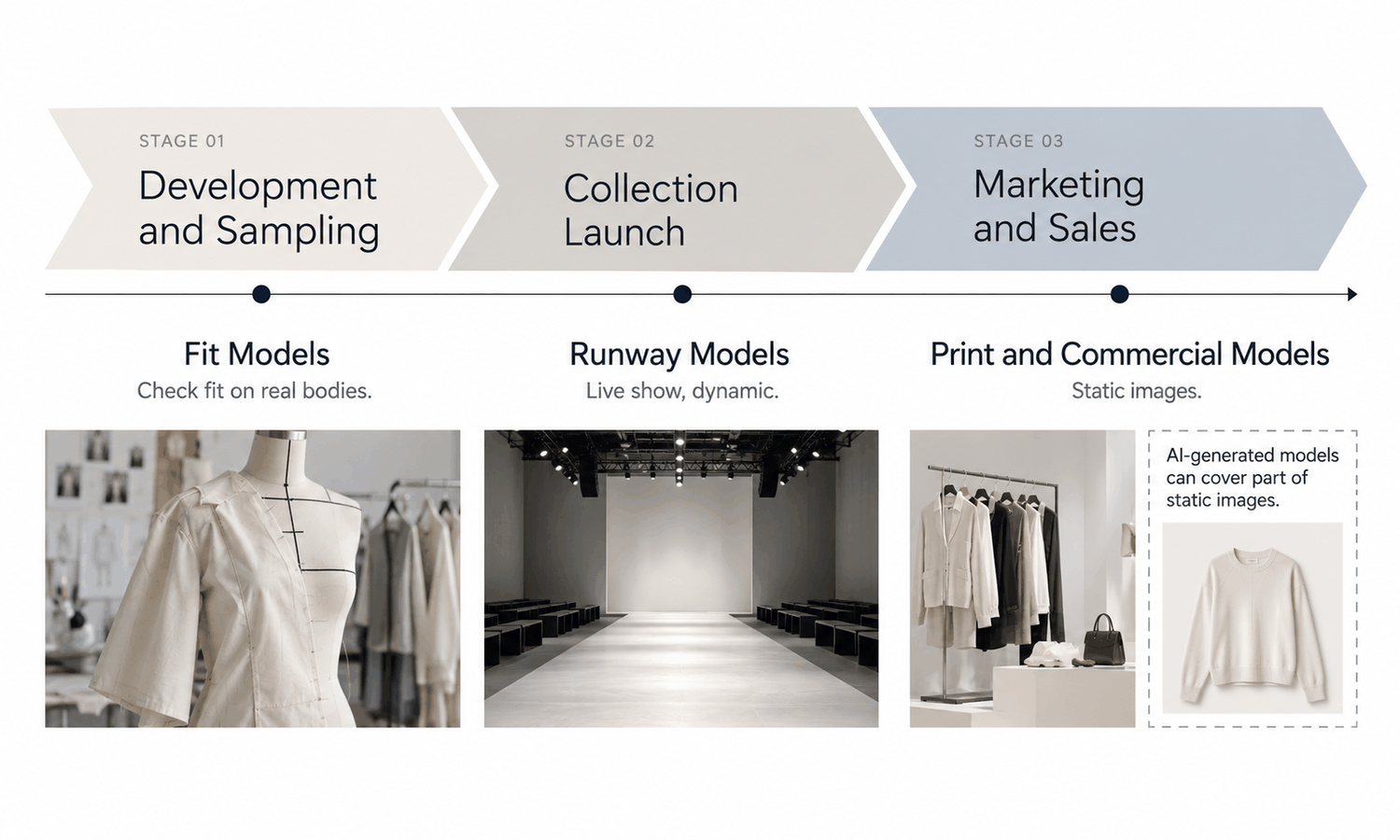
What are print models? In fashion, print models are the people whose images carry garments into still media: catalogs, lookbooks, advertising, product pages, packaging and in-store displays. The name comes from printed catalogs and magazines, but today most print work ends up on screens as well as paper. If a garment is shown on a person in a still image, a print model was usually involved.
The term causes confusion because the fashion industry uses several kinds of models for very different jobs. A print model, a runway model and a fit model may all be called models, but they are hired for different reasons, do different work and matter at different points in a garment's life. For a brand team briefing a shoot, planning a collection or deciding where generated imagery belongs, the differences are practical, not academic.
This article explains what print models do, how print differs from runway work, why fit models matter even though customers never see them, where AI-generated models fit in and how to choose the right kind of model for each job.
| Type of model | Where their work appears | What the job asks for | Can an AI-generated model cover it? |
|---|---|---|---|
| Print model | Catalogs, lookbooks, ads, product pages | Holding poses that show the garment, working to a layout | Partly, for still imagery produced from garment sources |
| Commercial model | Everyday advertising and brand campaigns | Relatable presence, expression, storytelling | Partly, for still images |
| Runway model | Live fashion shows | Movement, presence and timing in front of an audience | No |
| Fit model | Sample fittings during development | A body matching the brand's base size, and honest feedback | No |
What Print Models Do
A print model's job is to make a garment readable in a still image. That sounds simple and takes real skill. The model has to hold poses that show the garment's shape and details, move between looks quickly, keep a consistent presence across dozens of outfits and work to a composition someone else has planned, such as a catalog grid, a lookbook spread or a banner with space for text.
Print work covers a wide range.
-
Catalogs and lookbooks, where many looks must be shown consistently and comparably.
-
E-commerce product images, where the same pose and framing are repeated across a whole category.
-
Advertising and campaigns, where mood and story matter as much as the garment.
-
Packaging, in-store displays and trade materials, where images are fixed in print and cannot be changed after production.
Across all of these, the print model is serving the garment. Strong print work makes the clothes easy to see and easy to want, and it does so over many images that have to look as if they belong together.
How Print Differs From Runway
Runway models work live. Their job is to show a collection in motion, in front of an audience, often at a single show where timing, walk and presence carry the designer's intent. A runway appearance cannot be reshot, and it communicates things a still image cannot: how a garment moves, how fabric swings and settles, how a collection feels as a sequence.
That makes runway work different in kind from print work. A print model is building a record of how garments look, image by image. A runway model is delivering a performance of how a collection feels, once. The skills overlap, and many models do both, but a brand hiring for one is not hiring for the other.
The distinction also clarifies what still images can and cannot show. A still, whether photographed or generated, captures a moment. It can suggest movement, but it does not show how a fabric actually behaves in motion. When movement is the selling point, a runway show, a video or a photograph of the real garment in motion tells the truth more directly.
Commercial models sit between the two. Their work appears in everyday advertising and brand campaigns, where the aim is less to show a garment's construction than to show a person customers can relate to, in a moment that tells a story. Expression, warmth and the ability to look natural in an ordinary setting matter more than precise, repeatable poses. Commercial and print work overlap heavily, and in practice the same shoot often produces both: clean product images for the catalog and more candid images for the campaign.
Fit Models: The Role Nobody Sees
Fit models are the least visible and, for product quality, perhaps the most important. A fit model is a real person whose body corresponds to the brand's base size. During development, samples are made and tried on that person, and the fitting shows whether the pattern works: whether the shoulders sit correctly, whether the waist is in the right place, whether the garment allows the wearer to sit, reach and walk.
A fit model contributes more than a body. Experienced fit models report how a garment feels, where it pulls or gapes and how it moves, feedback a pattern maker cannot get from a dress form. The brand's grading, the scaling of the base pattern into its full size range, depends on the base size being right, and the fit model is how the base size is checked.
Customers never see a fit model, and most of them never know one existed. They see the result: garments that fit the way the size chart suggests they will.
This is also the clearest place to state what an image cannot do. An image of a garment on a body, however realistic, shows appearance. It does not predict fit or determine sizing. Fit comes from measurements, a graded pattern and a physical sample tried on a real person, which is exactly the fit model's role.
Where AI-Generated Models Fit In
AI-generated models have become part of how still imagery is made. A garment photographed as a flat-lay can be placed on a generated model, posed and set in a scene. That places generated models in the print category: they can produce some of the still imagery that print models produce, particularly repeatable product and catalog images made from existing garments.
They do not cover the other roles. They cannot walk a runway. They cannot stand in for a fit model, because fit is a physical question that only a real body and a real sample can answer. And they are one option for print work, not a replacement for it. Many brands continue to use print models for campaigns, lookbooks and product imagery, and the choice between photography and generation depends on the job, the garment and the brand's standards.
When generated models are used, the practical responsibilities are the same ones that apply to any on-model imagery, plus a few of their own. Every image is checked against its garment source for construction, trims, printed text and print placement, without exception, because reconstructed detail tends to come back almost right. Complex prints, lace and openwork, sheer fabrics and layered styling remain current weak areas for generated imagery and are better photographed. A generated face is checked so that it does not closely resemble a real, identifiable person. And a digital version of a real print model is a separate matter altogether: it depicts that person and starts with their agreement.
Choosing the Right Model for Each Job
The useful question is not which kind of model is better, but which job needs doing.
For development, the answer is a fit model. No image substitutes for a real fitting.
For a live show, the answer is runway models.
For still imagery, both print models and generated models are options, and the choice depends on the job. Campaigns built around a particular personality, story or real-world setting often suit photography with print models. Large sets of consistent product and catalog images made from existing garments often suit generated models, provided every image is checked against its garment source. Many brands use both: photography where presence and authenticity lead, generation where consistency and volume lead.
For the still imagery that suits generated models, Lightchain AI (apparel AI) covers the workflow from garment to on-model image.
-
AI Virtual Try-On places garments on generated models from flat-lays or garment photos, including on saved model sets for consistent product images.
-
Model Studio creates models and sets face, body, size, pose, scene and angle, so catalog and product images can follow one standard.
-
The Omni-Marketing Workbench includes an offline scenario for printed materials such as posters and in-store displays.
For brands producing catalog and product imagery across many styles, Scale E-commerce is the Lightchain AI solution built for that work.
Frequently Asked Questions
What are print models?
Print models are models whose images carry garments into still media such as catalogs, lookbooks, advertising, product pages and in-store displays. The name comes from printed media, but most print work now appears on screens as well.
How is a print model different from a runway model?
A print model builds still images of how garments look, often across many looks that must be consistent. A runway model shows a collection live, in motion, in front of an audience.
What is a fit model?
A fit model is a real person whose body corresponds to the brand's base size, on whom samples are tried during development. The fittings show whether the pattern works, and the fit model's feedback on comfort and movement guides corrections.
Can an AI-generated model replace a fit model?
No. Fit is a physical question answered by measurements, a graded pattern and a sample tried on a real body. An image shows appearance, not fit.
Are AI-generated models replacing print models?
They are one option for some still imagery, particularly consistent product and catalog images made from existing garments. Many brands continue to use print models, and the choice depends on the job and the brand's standards.
What should be checked when generated models are used for print work?
Every image against its garment source, the generated face for resemblance to a real person and the labeling rules for AI-generated imagery where the image will appear. Weak-area styles such as complex prints and sheer fabrics are better photographed.
Where does Lightchain AI fit among these kinds of models?
In still imagery made from existing garments: AI Virtual Try-On and Model Studio produce consistent on-model product and catalog images. Scale E-commerce is the solution to use for that work; fit and runway remain with real models.
In Closing
Print models make garments readable in still images. Runway models show collections live and in motion. Fit models, unseen by customers, make sure the garments fit before they are ever photographed. AI-generated models belong in the print category as one option for still imagery, especially consistent product and catalog images, and they do not replace runway or fit work. Choose the kind of model by the job, check every generated image against its garment source and leave fit to real bodies and real samples.
Start Here
If your brand produces catalog and product imagery across many styles and wants a consistent option alongside print photography, Scale E-commerce is the solution to use. It is built for on-model imagery made from existing garments: you place garments on generated models from flat-lays, keep one standard across a category and use saved model sets for consistent product pages. Start with one category, check every image against its garment source, and extend from there.
**Explore Scale E-commerce → **https://www.lightchainai.com/global/solutions/scaleECommerce