
A studio of four adopts virtual tryon and the early weeks go the way the early weeks usually go. Output arrives faster than it used to, the client presentations look better, and somebody says out loud that this is going to change how the studio works. Three months later the studio is busier, the work is not obviously better, and nobody can point to where the time went.
Nothing went wrong in the tool. What happened is that a small studio carries a set of assumptions into the decision, most of them reasonable, and one of them expensive enough to swallow the others. The useful exercise is not weighing whether to adopt. It is working out which assumption you are making and what it will cost you.
The five assumptions, ranked by what they cost
| The assumption | Why it feels safe | What it actually costs |
|---|---|---|
| More options are more value | Options present well and clients enjoy them | Decision capacity, which is the studio's product and does not scale |
| The time saved becomes capacity | The production step really did get shorter | Work taken on against capacity that never arrives |
| Our source photos are already a standard | Nobody has complained about them before | Outputs that stop being comparable, with the cause invisible at review |
| A client reads the image the way we meant it | The image is unambiguous to whoever made it | An impression treated as an approval, discovered at the sample |
| One person can hold the workflow | In a studio of four, one person usually can | Everything stopping when that person is on holiday |
The ranking is what matters here. Four of the five are ordinary operational problems that a studio will find and fix within a season. The first one is different, because it attacks the thing a small studio sells.
The costliest: that more options is more value
Small studios win work on judgment. Not on capacity, not on price, and rarely on speed — on somebody being reliably right about which of several plausible directions is the good one. That judgment is the product. It sits in one or two heads, it does not distribute, and it has a daily limit that nobody measures because it was never the constraint before.
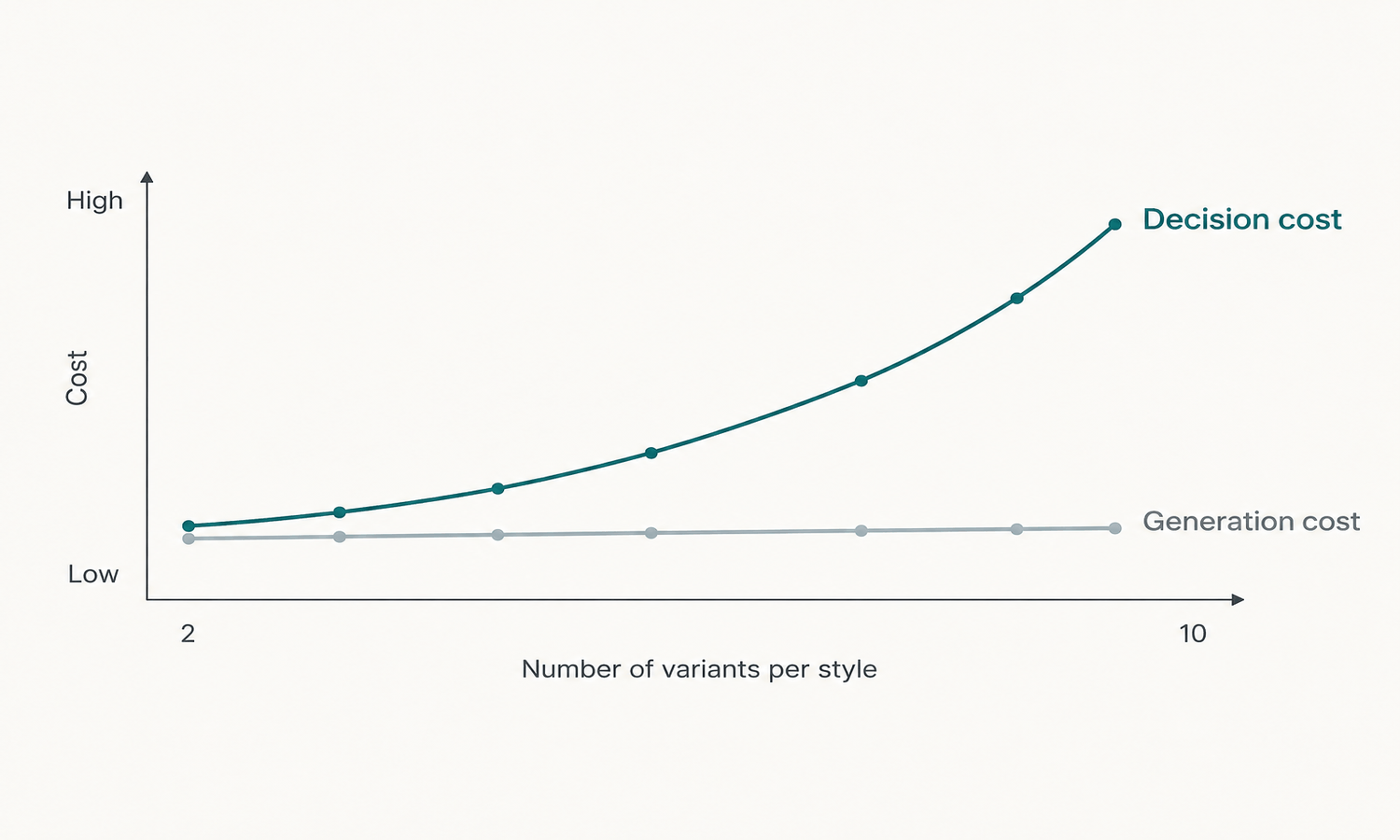
Cheap generation moves the constraint directly onto it. Producing eight colorway directions instead of two costs almost nothing in production and a great deal in selection, because every additional option has to be held against the others by the same person. Ten minutes of generation buys an hour of deciding, and the hour comes out of the studio's scarcest supply.
The trap is that the extra options genuinely look like value. They present well, clients enjoy them, and refusing to produce them feels like withholding effort. What actually happens is that decision quality degrades across a day the way any judgment does under load, so the fifth review of the afternoon is worse than the first, and the studio has arranged for there to be a fifth.
The correction is a fixed variant budget per style, decided before generating rather than during. Two options with a stated basis for choosing between them is a different product from eight with none, and it is the one the studio was hired for.
That the time saved becomes capacity
In a studio of four, the person generating the images is also briefing them, approving them, and taking the client call about them. Removing the production step does not free that person. It moves them to the next queue, and the next queue is review, which now has more in it.
So the honest expectation is a change in what the day contains rather than a reduction in how full it is. That is still worth having, since review is closer to the work the studio is paid for than file preparation is. It is not the same as capacity, and a studio that took on more clients on the strength of expected capacity will find out during the busiest month of the year.
Working with Lightchain AI (apparel AI), or with any workflow that shortens production, the number to watch is not turnaround. It is whether the studio's decision hours went up, because that is the queue everything now flows into.
That your source photos are already a standard
This is the assumption that costs the most to discover late. A studio shooting flat lays on a table by a window has a source set that varies by hour, by season, and by whoever held the camera, and that variability travels forward into every on-model output generated from it.
The consequence is specific: outputs stop being comparable to each other. Two styles from the same collection come back looking like they belong to different brands, and nobody can say why, because the difference entered at the input and is invisible by the time anyone is reviewing a result. A studio then spends its review time on a problem it created before generating anything.
Fixing it is unglamorous and cheap. One position, one distance, one background, one light, written down and taped to the wall. Holding the output side constant matters as much — one model direction and one scene per collection in Model Studio, so that a set looks like a set. Neither of these is a creative decision and both get treated as one, which is why they stay unfixed for a year.
The tell that a studio has this problem is a review conversation about whether an image is good, that keeps circling without resolving. When the inputs vary, there is no stable reference for good, so the conversation cannot land.
That a good enough image can settle a fit question
Every studio meets this eventually, usually as a client asking whether a sleeve looks too long. The picture is right there and the question feels answerable from it.
The output is a visual asset. It does not predict fit, determine sizing, model how a fabric behaves in motion, or forecast returns. Those come from measurements, a graded pattern, a physical sample, and your own data. That is a property of what the asset is, not a limitation of any particular result, and no improvement in how the picture looks moves it.
For a small studio the practical risk is not a wrong answer given knowingly. It is a maybe. A client asks, the studio says the proportion looks fine, and a sentence that was meant as an aesthetic impression becomes the basis for skipping a fit session. Answer the question that was asked and say where the real answer comes from, in the same breath, every time.
Color has the same shape and comes up more often. Screen color is not a physical reference, exact code matching is not something to promise, and the gap between a monitor and a roll of cloth does not close with a better display. Colorways get settled by strike-offs against an agreed standard, and values must never be read off a generated asset and sent onward. A studio that lets a client approve a color from a screen has moved a risk onto itself that it has no way to control.
What a four-person studio should change first
The list is short because a small studio can only sustain a short list.
-
Set a variant budget per style before generating, and write down what will decide between them
-
Fix the source standard — one position, one distance, one background, one light — and hold it for a season before changing anything
-
Check logos, printed text, care labels, and small hardware against the source image on every single output, without exception, since reconstructed detail lands almost right and almost right is what reaches a client. A targeted rebuild of the failed region against the source — Partial Redraw — costs one correction; regenerating costs another pass through the review the studio was trying to avoid, which is why the check is worth defending when it gets negotiated away.
-
Track decision hours rather than turnaround, because that is where the load moved
-
Keep one sentence ready for fit and color questions, so nobody has to improvise it in front of a client
The detail check is the one that gets negotiated away first in a small team, on the grounds that everybody is looking at the images anyway. Looking is not comparing. A letterform slightly off, a stitch count wrong, or a zipper pull the wrong shape survives an appreciative look and fails at the client's, and in a four-person studio the client relationship is not a line item.
None of this requires more process than a studio of four can carry. It requires deciding these things once rather than repeatedly, which is the actual difference between a studio that gets faster and one that just gets busier. Going from an idea to a finished asset quickly is worth very little if the studio cannot say which asset it meant. Whether the work runs through Lightchain AI or a camera, the constraint that binds a small studio is the same one it always was: how many good decisions the people in the room can make in a day.
Frequently asked questions
How do we set a variant budget without limiting the work?
Set it per style and per stage rather than globally, so exploration gets more room than a confirmation pass does. The budget is a limit on what gets reviewed rather than on what gets tried, and anything beyond the budget stays unreviewed until something is chosen. Studios that try this usually find the number they need is smaller than the number they were producing.
Our clients ask for more options. Do we refuse?
Reframe rather than refuse, since what a client wants is confidence in the direction and options are their proxy for it. Present two with the reasoning that separated them from the rest, and offer to show what was set aside if they want it. Clients who see the reasoning ask for fewer options, not more.
We shoot on a phone by a window. Is that disqualifying?
No, and the equipment matters much less than the consistency. A phone at a fixed distance, on a fixed background, at the same time of day will outperform a better camera used differently each time. Write the setup down, because the failure is variation rather than quality.
How do we know if decision hours actually went up?
Log time in two buckets for four weeks: making and deciding. Most small studios have never separated them and are surprised by the split. The absolute numbers matter less than the direction of change after adoption.
A client approved a color from a screen. What now?
Get a strike-off against an agreed standard before anything is cut, and reframe the screen approval as a shortlist rather than an approval. Say it in writing, because the version everyone remembers later is whichever one was written down. This is worth doing even when it feels like reopening a settled question.
Is this different for a studio doing its own line rather than client work?
The assumptions are the same and the feedback is slower. With client work, a bad decision gets challenged in the next meeting. With an own line, it gets challenged by the sell-through six months later, which means the variant budget and the source standard matter more rather than less.
In closing
The expensive assumption in a small studio is not about the tool. It is that more options are more value, when the studio's actual product is the decision that narrows them. Everything else on the list — capacity that does not appear, source photos that were never a standard, a fit question answered too casually — is fixable in a week once somebody names it. The first one is not fixable at all if the studio keeps arranging its days so that the scarcest thing it has gets spent on choosing between pictures it did not need to make.
Start here
Take the last three projects and count two things: how many outputs were generated, and how many were shown to the client. The gap is what the studio paid for in decision time and got nothing for. Then set a variant budget for the next project before you generate anything, write down the one criterion that will separate the options, and see whether the presentation gets worse. In most studios it does not, which settles the argument faster than any policy would.
**Start with the on-model workflow → **https://www.lightchainai.com/global/solutions/aiVirtualTryOn