
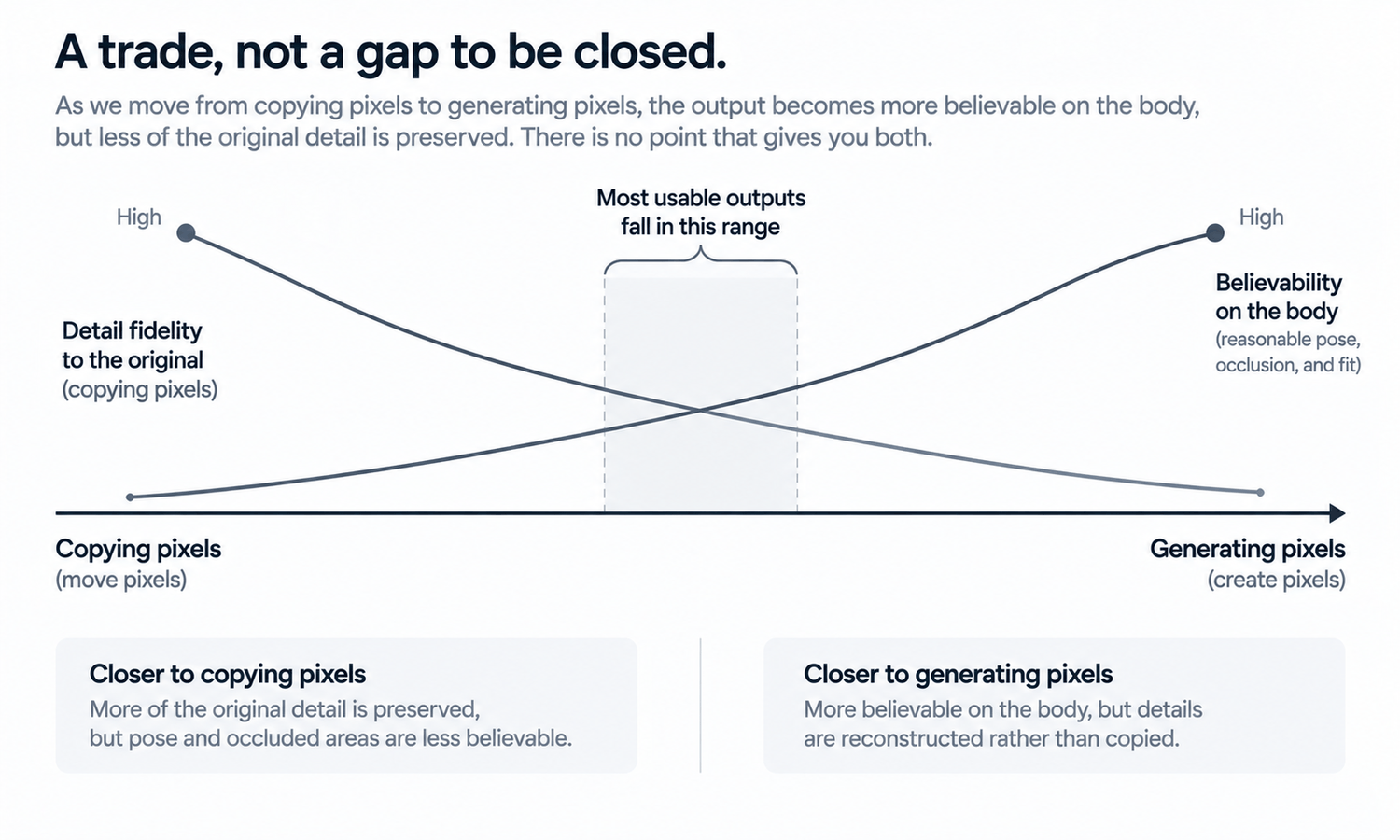
Two broad technical approaches sit behind virtual try-ons, and they have close to opposite strengths. Understanding which is which explains something that otherwise looks like an arbitrary rule: why the detail on a generated garment has to be compared against its source every single time.
The short version is that one approach moves the garment's own pixels and the other produces new ones. Everything else follows from that difference, including what each one is good at, what each one gets wrong, and why the thing that looks most convincing is also the thing that requires the most checking.
What follows describes the approaches as a field rather than any particular implementation.
Two families, opposite characteristics
| Warping-based approaches | Generative approaches | |
|---|---|---|
| What the output contains | The garment's own pixels, deformed toward a target figure | New pixels produced to be consistent with the garment photograph |
| Fine detail | Carried forward. A logo is there because it was moved there | Reconstructed. A logo is there because it was produced to match |
| Pose, occlusion and folds | Weak. Deformation cannot supply what the flat image never contained | Strong. A fold absent from the source can be produced |
| Characteristic failure | Implausible where information was missing, and visibly so | Almost right, and not visibly so |
| What it needs from the source | Everything. It carries the source forward | Everything. It conditions on the source |
Read the two columns as a trade rather than as a ranking. Each family is strong precisely where the other is weak, and the reason is the same in both directions: preserving pixels and inventing pixels are opposite operations.
Warping: moving the garment's own pixels
The older approach treats the problem geometrically. Given a photograph of a garment and a target figure, it estimates how the garment would have to deform to sit on that figure, then applies that deformation and blends the result.
The consequence that matters is that the output largely contains the garment's actual pixels, moved. A logo that was in the source is in the output because it was carried there, not because it was reproduced. Printed text stays legible because it was never re-drawn. That is a real property and it is why this family remains useful for flat, frontal presentations where the garment is unoccluded.
Where it struggles is anything that requires information the source photograph does not contain. A garment must fold somewhere the flat image had no fold. An arm crosses the body and something has to be behind it. A collar turns and reveals a facing nobody photographed. Deformation cannot supply what was never there, so the output becomes implausible in exactly the places where a real garment would be most interesting.
Diffusion: producing an image conditioned on the garment
The generative approach reframes the problem. Rather than deforming the source, it produces a new image, conditioned on the garment photograph and on a target figure, so that the result is consistent with both.
That handles the cases warping cannot, because a fold that was not in the source can be produced, and a region behind an arm can be filled with something consistent. The output reads as a photograph rather than as a composite, which is why this family is behind most of what people now recognize as convincing.
The cost is structural. The output does not contain the garment's pixels; it contains pixels consistent with them. A logo in the output was produced to be consistent with the logo in the source, and consistent is a looser relationship than identical. Most of the time the difference is imperceptible. Sometimes a letterform is slightly off, a stitch count is wrong, a zipper pull is the wrong shape — and the result still looks correct, because it was produced to look correct.
Why the trade explains the detail check
Put those two together and a rule that sounds like bureaucratic caution turns out to be a direct consequence of the method.
Anything convincing enough to sit on a body across poses and occlusions is doing some amount of producing rather than moving. Producing is what makes it convincing. Producing is also why fine detail is a reconstruction rather than a copy. You cannot have the first without accepting the second, and no amount of quality improvement converts a reconstruction into a copy — a better model produces a more convincing reconstruction.
So: logos, printed text, care labels, and small hardware get compared against the source image on every single on-model output, without exception. Not because failures are frequent, but because the failure mode is almost right rather than obviously wrong, and almost right is what survives a look and fails at a customer.
The same reasoning explains why a defect can be regional. If one area was reconstructed poorly and the rest is sound, a targeted correction to that region addresses the actual problem, whereas a full rerun produces a different image and puts the rest of a set out of alignment.
It also explains where each family's weak spots come from. Lace, open work and sheer fabrics are hard because what shows through has to be consistent with what is behind it. Complex prints are hard because a repeat is a global structure being produced locally. Layered looks are hard because occlusion boundaries are where the least information exists. These are documented weak spots, and they are the same list either family would struggle with for related reasons.
Where fit is in neither pipeline
The third term in the title deserves a direct answer, because it is the one people most expect the technology to have solved.
Neither approach contains fit at any step. Warping deforms a garment image toward a depicted pose; nothing in that operation consults a measurement. Generation produces an image consistent with a garment photograph; nothing in that operation consults a graded pattern or a body measurement either. There is no stage in either pipeline where the quantities fit is made of are present.
That is why the boundary is stated the way it is. The output is a visual asset. It does not predict fit, determine sizing, model how a fabric behaves in motion, or forecast returns. Those come from measurements, a graded pattern, a physical sample, and your own data. It is not a limitation awaiting a better model; it is a description of what the pipeline operates on.
Material behavior is outside it for the same reason. Neither family simulates physics: drape in an output is produced or deformed rather than computed, so it is evidence about the image and not about the cloth. Existing 3D assets can be converted into flat garment images that enter as inputs, which is a different thing again from simulating anything.
Color sits outside both as well. Screen color is not a physical reference, exact code matching is not something to promise, and the gap between a monitor and a roll of cloth stays open regardless of display quality. Colorways get settled by strike-offs against an agreed standard. And footwear is not covered by this class of workflow at all, structurally: a shoe has no flat-lay equivalent to serve as the garment input either family requires.
What the mechanism means for how you use the output
The technical picture translates into a few operational positions that hold regardless of which approach is behind a given tool.
-
Treat the source photograph as load-bearing, since both families depend on it entirely and neither can supply what it does not contain
-
Expect detail to need verification rather than treating verification as a sign of low quality, because reconstruction is how convincing output is produced
-
Read weak spots as consequences of information availability rather than as gaps to retry, since occlusion and transparency are cases where the required information is genuinely absent
-
Keep fit, sizing, and physical color in the systems that hold those quantities, because no pipeline stage touches them
-
Judge quality improvements as improvements to plausibility, which is what they are, rather than as movement on the boundary
In Lightchain AI (apparel AI) the uploaded source stays beside every AI Virtual Try-On output derived from it, which is the practical expression of the first two points: verification is only sustainable across a catalog when the thing being verified against is one click away. Whether the work runs through Lightchain AI or a camera, the source is the reference and the check is the method.
Frequently asked questions
Which approach is better?
They trade rather than rank: one preserves detail and struggles with occlusion and pose, the other handles those and reconstructs detail. Most convincing output involves generation, which is why the detail check exists. Judge a tool on results with your own garments rather than on which family it belongs to.
Does a better model remove the need to check details?
It makes reconstructions more convincing, which makes an error less likely to be noticed rather than less likely to occur. The check is a response to the method rather than to the current quality level. Improvements move the ceiling and not the requirement.
Why are sheers and lace consistently difficult?
Because what shows through has to be consistent with what is behind it, and that information is the least available part of the scene. It is an information problem rather than a resolution problem, which is why retrying rarely resolves it and photography does.
If nothing computes fit, why do outputs look like they fit?
Because a plausible image of a garment on a figure is what both approaches are built to produce, and plausibility is not measurement. The appearance is real and the inference from it is not supported. Fit answers come from the chart, the grade and a fit session.
Does the source photograph matter more for one family than the other?
It is load-bearing for both, in different ways: warping carries its pixels forward and generation conditions on it. A poor source limits both, and neither can supply what was never captured. That is the strongest practical argument for a consistent capture standard.
Can regional corrections fix a reconstruction problem?
For a localized one, yes, and that is usually the cheaper path since a full rerun produces a different image. For a problem spread across the garment, no, and rerunning or reshooting is the honest answer. Judge by whether the failure is local.
In closing
One family moves the garment's pixels and one produces pixels consistent with them, and their strengths are near mirror images. Convincing output on a body requires producing, producing means fine detail is reconstructed rather than copied, and that is the mechanical reason the comparison against source is not optional. Neither pipeline contains a measurement or a graded pattern at any stage, which is why fit sits outside both, and no improvement in either family moves that.
Start here
Take one output you consider excellent and one you consider poor, and look at the same four elements on each: a logo, any printed text, a label, and a piece of hardware. The exercise usually shows that quality and detail accuracy vary independently, which is the whole argument for checking both rather than inferring one from the other. If the excellent one has a wrong detail, that is the mechanism described here, working exactly as it does.
**Start with the on-model workflow → **https://www.lightchainai.com/global/solutions/aiVirtualTryOn