
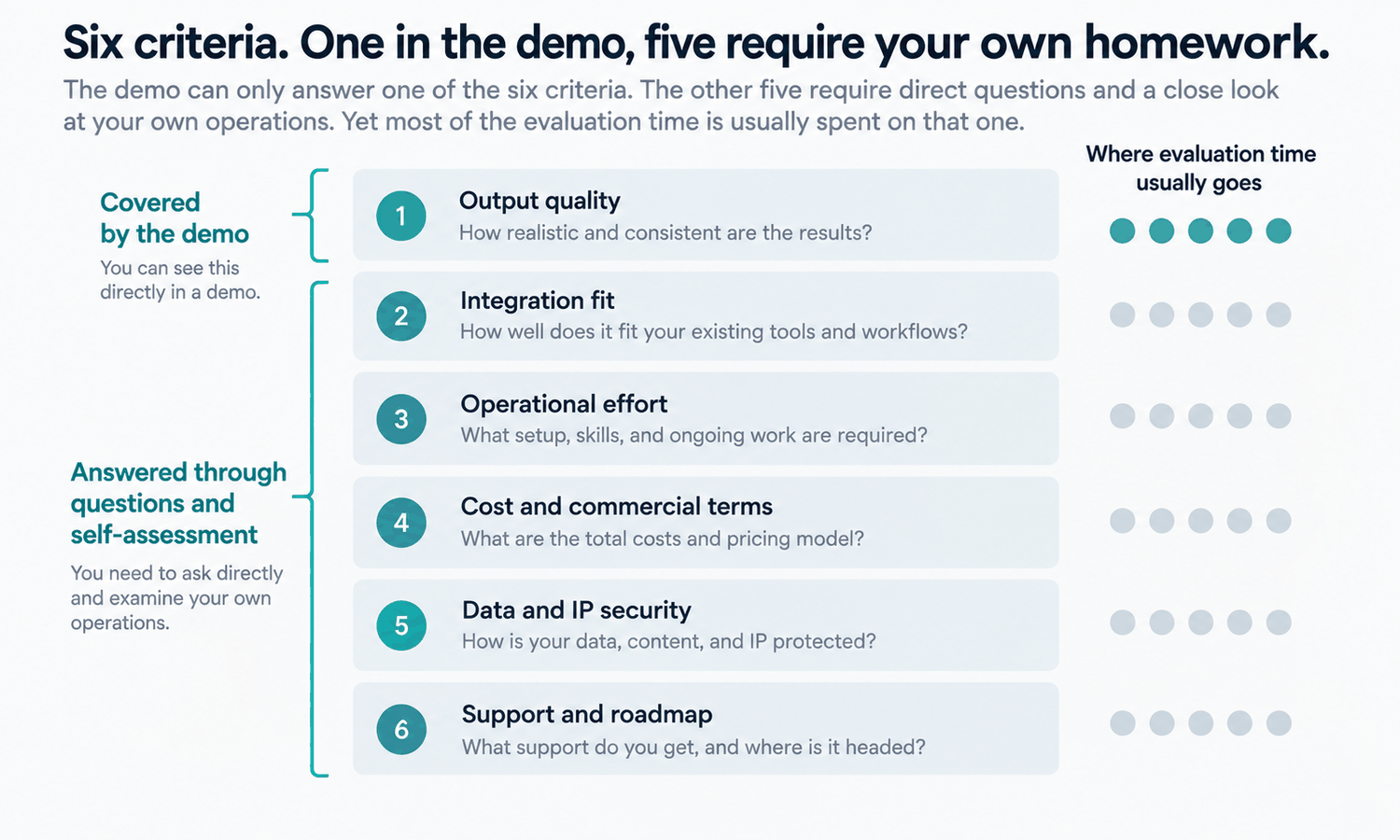
Most evaluations of ai powered virtual try on tools spend their effort on the one criterion that is easiest to check and least predictive of the outcome, which is how good the output looks.
Output quality is genuinely worth checking, and a demonstration will answer it in about ten minutes. The trouble is that everything else determining whether a workflow succeeds — whether your own photography can meet the input requirement, whether outputs stay traceable to what produced them, who will run the comparison check once volume arrives, and whether the stated limits are ones you can plan against — is invisible in a demonstration and knowable before you look at a single result.
A useful review is therefore mostly not about the pictures. It is about the conditions attached to them.
Why output quality is the weakest criterion
A demonstration is built from inputs chosen because they work. That is not dishonest; it is what a demonstration is. It does mean the result tells you about a garment somebody selected, photographed carefully, and probably ran more than once.
Your catalog is not that. It contains the difficult categories, the pieces photographed by whoever was free, and the styles that recur across seasons with slightly different trims. The gap between a demonstration and your range is not a quality gap, and no amount of looking at demonstration output narrows it.
There is a second reason to discount this criterion. Output quality moves. A category that renders poorly now may read differently after a product update, so a verdict formed on today's output has a shelf life. The criteria below do not move, which is what makes them worth the evaluation time.
The criteria that actually decide the outcome
| Criterion | How to check it | What a demonstration tells you |
|---|---|---|
| Output quality on your difficult categories | Run your own hardest style, prepared to a single standard, three times unchanged | Something, but about a garment somebody else selected |
| Whether your own capture can meet the input requirement | Pull twenty existing source photographs and check whether they share a standard | Nothing. This is a fact about your operation |
| Traceability from an output back to its source and settings | Ask directly, and try to answer which input produced a given result | Nothing, since a demonstration has one input and no history |
| What a partial failure costs | Ask whether one region can be corrected without regenerating the image | Nothing, because demonstrations rarely show a failure |
| Who owns the comparison check at volume | Name the person before adopting, and separate the check from the judgment pass | Nothing. This is a staffing decision you make |
| Whether the stated limits are ones you can plan against | Check any claim against what a visual asset is able to be | Nothing useful, and an overstated limit is itself a finding |
Read the third column and the pattern is hard to miss: a demonstration answers one row and gestures at another. The remaining rows are answerable, and mostly answerable without any output at all, by asking direct questions and looking at your own operation.
Evaluate your own inputs before evaluating anything else
Every generated image is a derivation from a source photograph. That makes the input standard the first thing to review, and it is a review of your own operation rather than of any tool.
Pull twenty source photographs from your existing library and check whether they share a position, a distance, a background, and a light. Most teams find they do not, and that finding is more consequential than anything a demonstration could show, because inconsistency entering at capture cannot be corrected downstream and will produce a range that reads as three different brands.
If the answer is no, the honest sequence is to fix the capture standard first and evaluate tools second. A tool evaluated against inconsistent inputs is being blamed for your photography, and a tool adopted on the strength of one carefully prepared test will disappoint against the rest of the library.
Evaluate the workload you are signing up for
The second thing a demonstration cannot show is what the workflow costs in attention once it is running.
Generation gets cheap, which moves the constraint onto review rather than removing it. Two activities have to be separated and staffed differently: the conformity check, which asks whether an output matches its source, has a right answer and can never be sampled; and the judgment pass, which asks whether an image is good and can be sampled or delegated. Merging them is how the check quietly stops happening in month three.
-
Ask who will own the conformity check by name before adopting, not after
-
Ask what a partial failure costs: whether a single bad region can be corrected on its own with a targeted correction or whether the whole image has to be regenerated, since regenerating one style inside a set is how a set stops matching itself
-
Ask whether outputs stay linked to the source and settings that produced them, because a defect shared across a batch is one fix if you can trace it and an excavation if you cannot
-
Ask what the variant discipline will be: the number per style has to be decided before generating, since output volume rises on its own and review capacity does not
-
Ask how a category that fails gets recorded, so the decision to route it to photography stops being reopened every season
In Lightchain AI (apparel AI) the uploaded source stays beside the on-model outputs derived from it in AI Virtual Try-On, which is the specific property that makes the third question answerable. Whatever you evaluate, ask that question directly rather than assuming it, because it does not appear in any output.
Check every claim against what a visual asset can be
The output is a visual asset. It does not predict fit, determine sizing, model how a fabric behaves in motion, or forecast returns. Those come from measurements, a graded pattern, a physical sample, and your own data. That is a property of the category of thing rather than of any particular result, and no improvement in image quality moves it.
This makes a useful review instrument. Any claim that a workflow of this kind predicts fit, tells a shopper their size, cuts returns, or removes the need for a physical sample is a claim to check carefully, because those answers do not live in an image regardless of how the image was produced. A size guide assembled from pictures is a sizing claim with no measurement behind it. A return rate sits at the end of a chain running through sizing, price, assortment, and traffic.
Color has a limit of the same kind. Screen color is not a physical reference, exact code matching is not something to promise, and the gap between a monitor and a roll of cloth stays open regardless of display quality. Colorways get settled by strike-offs against an agreed standard, so a promise of precise color matching is a promise about a thing that is not settled on screen.
Two scope answers save evaluation time. Footwear is not covered by this class of workflow, and the reason is structural: a shoe is a rigid object built on a last, with no flat-lay equivalent to serve as the input the method depends on. And there is no physical simulation involved — no geometry is built and no material behavior is predicted, so the drape in an output is rendered rather than computed. Existing 3D assets can be converted into flat garment images that enter as inputs, which is a different thing from producing or simulating 3D.
Give the evaluation a fixed shape
An evaluation without a written shape becomes an accumulation of impressions, and impressions are decided by whoever is most enthusiastic.
Decide the categories first, one per part of the range that matters, chosen for difficulty rather than convenience. Prepare the source photographs to a single standard so the test measures the workflow rather than your photography. Run each input three times unchanged, since a single output cannot show consistency and consistency is what breaks sets in production. Check details against the source before forming an overall impression, because a good impression ends reviews early.
Then write the finding as a sentence about a category rather than a verdict about a tool. Placement prints came back with the motif low in two of three runs. Plain bodies were stable. That kind of statement survives being repeated to somebody who was not in the room, and it stays useful when the colorway and fabric work moves to a different part of the range next season.
Frequently asked questions
Should we compare several tools side by side?
For an internal decision, yes, provided the garment, the source photograph, the preparation, and the reviewer are identical across every option. Keep the results internal, since a comparison worth publishing needs a stated method, a defined evaluation set, and a date. An informal run does not meet that standard and should not be presented as though it did.
How long should an evaluation take?
Two weeks is usually enough if the categories are chosen in advance and the source photographs are prepared before anything is generated. Most of the elapsed time goes into preparation rather than into generation. An evaluation that runs longer is usually one where nobody decided what would count as a pass.
What if we cannot fix our capture standard first?
Then evaluate with the understanding that you are measuring a combination of the workflow and your photography, and record which is which where you can. Prepare a small consistent set for the test even if the wider library stays inconsistent. Adopting without the standard is possible and produces a range that does not read as a set.
Who should run the evaluation?
Whoever would approve images in production, rather than whoever proposed the trial. The checks are comparisons against a source rather than aesthetic judgments, so they need somebody who knows the product well enough to catch a wrong stitch count. Enthusiasm produces optimistic evaluations reliably.
How do we weigh a claim we cannot verify?
Ask what evidence would settle it and whether that evidence is available to you. Claims about output quality can be checked in an afternoon. Claims about fit, sizing, or returns cannot be settled by any test of imagery, so treat them as claims about something outside the asset rather than as features to score.
What should we write down at the end?
The category verdicts with their reasons, the source photographs and outputs from the test, the name of whoever will own the conformity check, and the trigger for retesting a failed category. That set makes the next evaluation a comparison rather than a fresh start, which is worth more than the current verdict. Whether the work eventually runs through Lightchain AI or a camera, the record is what stops the same evaluation being run from scratch a year later.
In closing
The picture is the part of a tool review that takes care of itself and the part that predicts least. What predicts is whether your own capture can meet the input requirement, whether a defect can be traced back to what caused it, who will run the comparison check when volume arrives, and whether the limits you are given are ones you can plan against. Those four are answerable before any output exists. Answer them first, then look at the images, and the images will tell you something you can use.
Start here
Before booking a single demonstration, do the twenty-photograph check on your own library and write down whether those images share a standard. That answer determines whether you are evaluating a tool or evaluating your photography, and it changes what any subsequent result means. It takes an afternoon, it costs nothing, and most teams find it reorders their whole evaluation plan. Do that check before the shortlist rather than after, since the answer changes which criteria are worth spending the trial on.
**Start with the on-model workflow → **https://www.lightchainai.com/global/solutions/aiVirtualTryOn