
Three questions get asked about virtual try on software, and they are not equally difficult. Features can be established in an afternoon. Pricing takes one calculation nobody usually runs. Integration is where projects stall, and it stalls for a reason that has almost nothing to do with connectors.
The integration question people ask is whether the tool connects to their systems. The question that decides the outcome is different: after it connects, can anybody say which source photograph produced the image currently live on a given product page.
That question is answerable or it is not, and no amount of connector documentation settles it.
Three questions, unequal difficulty
| The question | What is actually being asked | How hard it is to answer |
|---|---|---|
| Features | Which capability categories exist, and whether they match the range you sell | An afternoon. Documentation plus one test on your own hardest style |
| Pricing | Not the rate, but your cost per accepted output in your categories | One calculation, rarely run, and answerable from a small test |
| Integration | Not whether it connects, but whether provenance survives the connection | The hard one. It depends on how your own systems are arranged, so nothing you read settles it |
The pattern is that the first two rows are answerable from documentation and a test, while the third depends on how your own systems are arranged. That is why it gets deferred: it cannot be resolved by reading anything.
Deferring it is also why it surfaces in month three rather than in week one, at which point the assets exist and the record does not.
Features: check the categories, not the list
A feature list is a poor comparison instrument because everything on it sounds similar. The useful version is a short set of capability categories, applied to your own range.
-
On-model generation from a garment photograph, which is the core and the thing to test on your own hardest style rather than on a demonstration
-
Colorway and fabric exploration, useful for narrowing directions before committing to cloth, and producing candidates rather than approvals
-
Correction of a single region rather than regeneration, since targeted correction is what keeps a set comparable when one item fails
-
Control over model direction, pose, and scene, held constant across a category so a collection page reads as one set
-
Conversion of a look into a line drawing or tech-sheet draft in the Design & Production Workbench, which matters if anything is heading toward a factory, and which produces drafts a technical designer still reviews
-
An input path for existing 3D assets, converted into flat garment images that enter as sources, which is a different thing from producing or simulating 3D
Check those categories against what you actually sell rather than against each other. A capability you will never use in your fabric mix is not an advantage, and the categories that matter to you are decided by your range rather than by a table.
Pricing: one number, briefly
The published rate is the smallest component of what this costs. The number that decides a budget is cost per accepted output, which is your spend divided by the images that passed the comparison and went somewhere, and it moves with your categories rather than with any tariff.
For the platform's own figures, point packages start at $9.90 for 600 points, described by the company as roughly 20 images, with further tiers published alongside; read those from the current pricing page rather than from an article, since terms change. Treat that as a floor. It describes what this costs if every attempt succeeded and nobody spent time reviewing, which has never happened.
Integration is a question about where truth lives
Here is the shape of the problem. After connecting, two systems each hold half of the story.
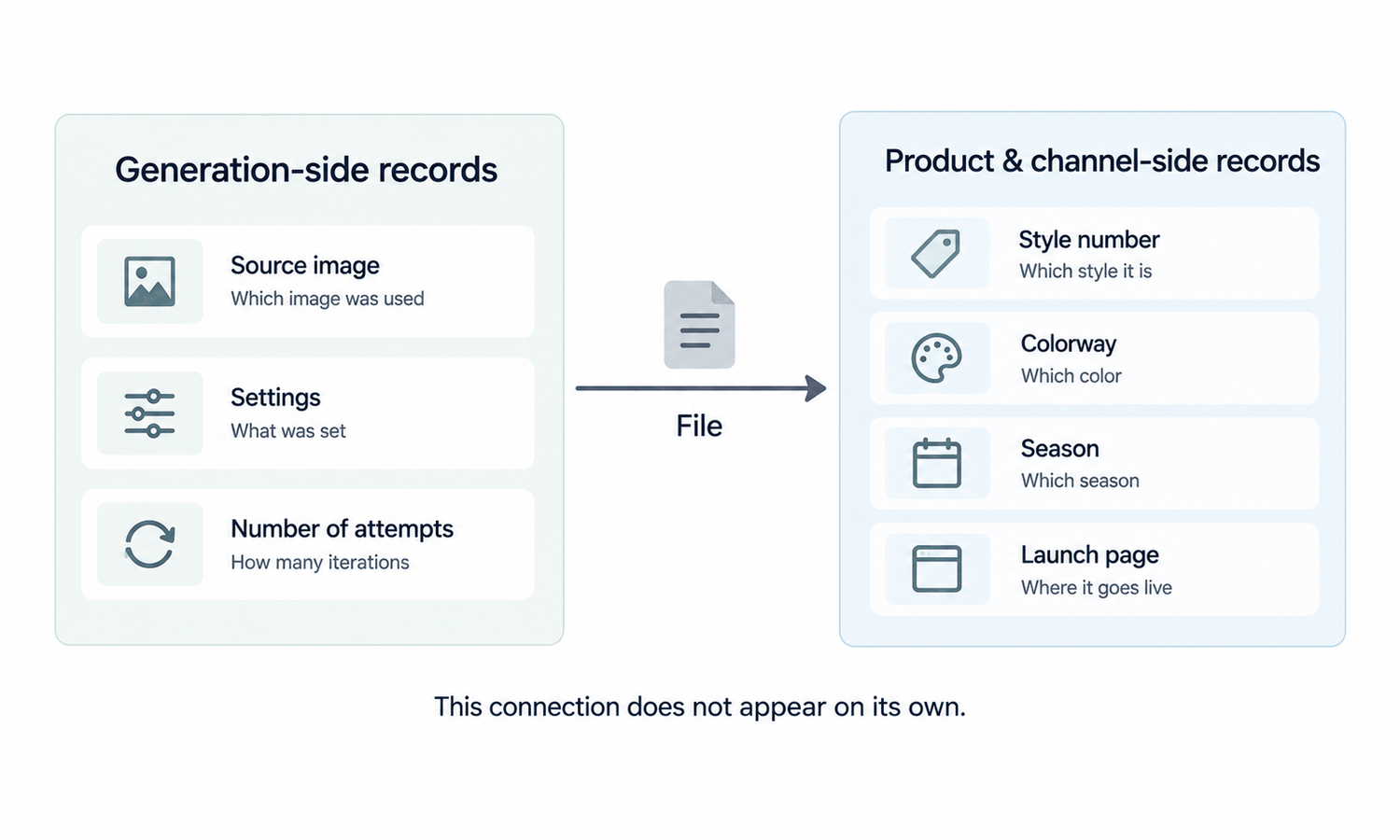
The generation environment knows which source produced which output, which settings were used, and how many attempts it took. The commerce or product system knows the style code, the colorway, the season, and which page an asset is live on. Neither knows the other half, and a connector that moves files between them does not create the join.
So the failure is not a broken integration. It is a working integration that transfers images and leaves provenance behind. Three months later somebody finds a wrong detail on a live page and asks which source it came from, and the honest answer is that the file arrived from a folder.
-
Ask whether the four identity fields — style code, colorway, season, and state — travel with the asset or get re-entered on arrival, since anything re-entered by hand is a field that will be wrong on some percentage of items
-
Ask whether an asset on a live page can be traced back to its source, and have somebody demonstrate it rather than confirm it
-
Ask what happens to that trace when a file is edited downstream, resized for a channel, or replaced during a launch
-
Ask who performs the comparison against source after integration, since a connected pipeline often moves the check out of anybody's job description
-
Ask how a batch is reprocessed when a defect is traced to a shared input, because that is the operation the whole trace exists to enable
Where the source stays attached to the on-model output it produced, half of this is solved before any connector exists. In Lightchain AI (apparel AI) the uploaded source and the generation history sit together, and for storefront-side deployment Lightchain AI Virtual Try-On for Shopify exists as one route; what still has to be checked in either case is whether the identity fields survive the crossing into your commerce system, since that half belongs to your setup rather than to any tool.
What integration cannot connect you to
Some things are not on the other side of any connector, and it is worth saying so before a scoping conversation implies otherwise.
The output is a visual asset. It does not predict fit, determine sizing, model how a fabric behaves in motion, or forecast returns. Those come from measurements, a graded pattern, a physical sample, and your own data. No connection to a product system changes that, because the limit is in what the asset is rather than in what it is connected to.
So a size chart cannot be populated from an imagery pipeline, and fit copy on a page has to trace back to the measurement chart rather than to the assets feeding the page. No integration can be justified on a return-rate or conversion outcome either, since both sit at the end of a chain running through sizing, price, assortment, and traffic.
Color has a limit that no pipeline crosses. Screen color is not a physical reference, exact code matching is not something to promise, and the gap between a monitor and a roll of cloth stays open regardless of display quality. Colorways get settled by strike-offs against an agreed standard, which is a physical step outside any system.
Footwear is not covered by this class of workflow at all, and that is structural rather than a gap waiting to close. Lace and open work, sheer fabrics, complex prints, and heavily layered looks are documented weak spots, and a connector does not change a category verdict.
What to ask before signing
Scoping conversations tend to cover features thoroughly, pricing adequately, and provenance not at all. Redressing that costs four questions.
Ask for a demonstration of tracing one live asset back to its source, end to end, in the buyer's own systems rather than in a sandbox. Ask what the identity fields look like after a channel resize. Ask who owns the comparison check once the pipeline is running and whether that person has access to the sources. And ask what the reprocessing operation looks like when a defect turns out to be shared across a batch.
Whether the work runs through Lightchain AI or a camera, those four answers describe how the thing will behave in month six, which is the period a contract covers and a demonstration does not.
Frequently asked questions
Is a native commerce integration better than files in a folder?
It is better at moving files and neutral on provenance, which is the part that matters later. A folder-based workflow with disciplined identity fields outperforms a slick connector that drops them. Judge the integration on what survives the crossing rather than on how few clicks it takes.
We already have a product information system. Does that solve it?
It solves the commerce half and holds nothing about which source produced an image or which settings were used. The join between the two halves is the thing to specify, and it is usually nobody's default. Write down which system holds which field before connecting anything.
Should we compare several products on integration?
For an internal decision, yes, provided you ask each one the same four provenance questions and require a demonstration rather than an assurance. Keep the results internal, since a published comparison needs a stated method and a defined evaluation set that an informal scoping call does not provide.
What is the most common thing that gets lost?
State — whether an image is a proposal, a selection, or a confirmation. It is rarely carried by connectors, it is not visible in a file, and its absence turns a proposal into something that goes live. Ask about it specifically, because it is not usually on anybody's field list.
Does a Shopify-side deployment change any of this?
It changes where the shopper-facing experience runs and leaves the provenance question exactly where it was. The same four questions apply, and the accuracy obligation is unchanged: what the storefront shows has to be something the shipped garment will recognizably match.
How long should integration scoping take?
Longer than feature evaluation and shorter than most teams fear, provided the four questions are asked early. What extends it is discovering in month three that the join was never specified. An afternoon spent on provenance at the start replaces a quarter spent reconstructing it later.
In closing
Features are checkable, pricing reduces to one calculation, and integration is where the difficulty actually sits. The question is not whether a tool connects but whether provenance survives the connection: whether an image on a live page can be traced to the source that produced it, whether the identity fields cross intact, and whether anybody still owns the comparison once the pipeline is automated. Ask for a demonstration rather than an assurance, and ask it before the assets exist rather than after.
Start here
Take one image currently live on a product page and try to answer, without asking the person who made it, which source photograph it came from and what state it was approved in. If you cannot, that gap already exists in your current setup and will be inherited by whatever you connect next. Fixing it is a specification question rather than a software question, and it is cheaper to specify now than to reconstruct later.
**Start with the on-model workflow → **https://www.lightchainai.com/global/solutions/aiVirtualTryOn