
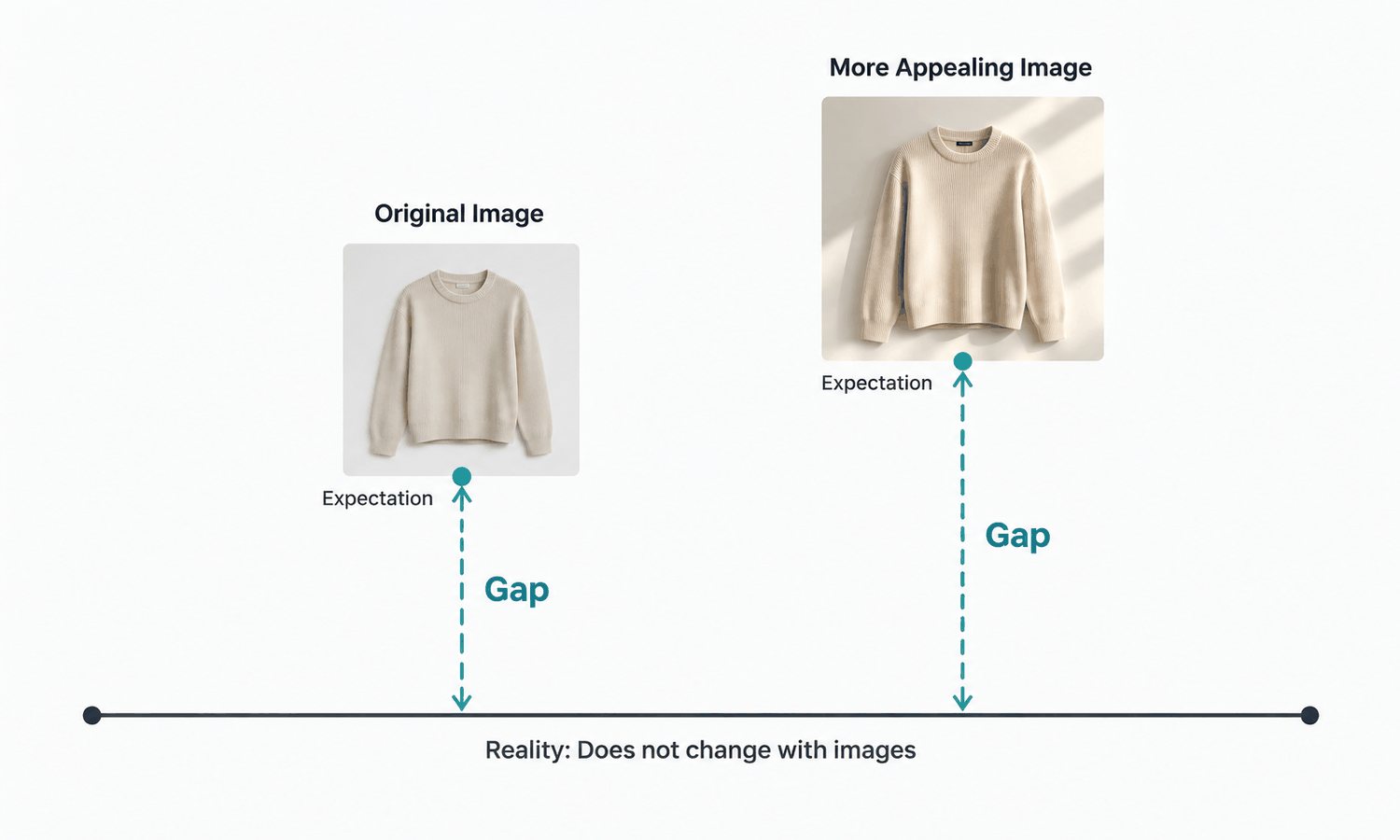
Two questions get asked as one and they are not the same question. The first is whether try-on imagery helps somebody decide what to buy. The second is whether it moves your cart rate and your return rate. The first is about a shopping experience. The second is about a chain with several links in it, most of which have nothing to do with pictures.
Conflating them produces the most common bad decision in this area: a team improves its imagery, watches its numbers, and attributes whatever happened next to the change it made. Sometimes the numbers move. The attribution is almost never available.
There is a more useful way to think about it, and it starts from what a return actually is.
What a return is, mechanically
A return happens when a garment fails to meet the expectation a shopper had when they bought it. That is the whole mechanism, and it has two sides. There is the garment, which is what it is. And there is the expectation, which was assembled from the size selected, the size guide, the description, the price, the reviews, and the images.
Imagery contributes to one side of that equation and touches the other side not at all. It cannot change how the garment is cut, graded, or sewn. What it can do is shift the expectation the shopper arrives with, in either direction.
That direction is the part teams get wrong. Better imagery does not automatically narrow the gap between expectation and garment. It raises expectation, and whether the gap narrows or widens depends entirely on whether the garment was already meeting the old one.
The levers, and how much imagery touches them
| Lever | Who owns it | How much imagery reaches it |
|---|---|---|
| Whether the garment matches its published measurements | Production and quality control | None |
| Grading consistency across styles and seasons | Technical design | None |
| Which size a shopper selects | The size guide, the reviews, and the shopper's own history with you | Very little, and any of it is inference the shopper made rather than information you gave |
| Accuracy of what the page led the shopper to expect | Whoever approves the images | All of it. This is the one lever imagery owns outright |
| Price, assortment, promotion, and traffic mix | Merchandising and marketing | None, and each of them can move the same numbers further than imagery would |
Reading down the third column is uncomfortable and useful. The levers with the most influence on returns are the ones imagery cannot reach, and the lever imagery does reach — accuracy of representation — is the one most teams are not managing deliberately. They are managing attractiveness instead, which is a different variable that sometimes moves the same number in the wrong direction.
Flattering imagery is a returns risk
A shopper who receives a garment that looks less good than the page did has learned something about your brand, and the thing they learned is not about that garment. This is why imagery that outperforms the physical product is a problem rather than a win, and it is a specific risk of generated output, which can be made consistently more appealing than a rushed studio shot of the same piece.
So the accuracy standard on on-model output matters more in a shopping context than in a wholesale one. A buyer sees the sample. A shopper sees only the picture, and the picture is the entire basis of the expectation you will later be judged against.
That makes the conformity check a commercial control rather than a quality-assurance chore. Logos, printed text, care labels, and small hardware get compared against the source image on every single output, without exception. Reconstructed detail lands almost right — a letterform slightly off, a stitch count wrong, a zipper pull the wrong shape — and a customer holding the garment is the most thorough reviewer in the chain and the most expensive one to be corrected by. Working in Lightchain AI (apparel AI) or anywhere else, this check is the part of the workflow with a direct line to the return rate, and it works by preventing a gap rather than by closing one.
What you can honestly attribute
Suppose the imagery changes and the numbers move. What can you say?
Very little, unless the test was built for it. Cart rate and return rate respond to season, assortment, traffic mix, price, promotion, sizing changes, and whatever competitors did that month. Any of those can produce a movement larger than the one imagery would.
-
A holdout: the same styles, in the same period, with and without the change, split by traffic rather than by time
-
Style-level rather than site-level measurement, since a site aggregate mixes categories that behave differently
-
Return reasons captured at the level of too small, too large, not as pictured, and changed my mind, because those four move for different causes and a single return figure hides all of it
-
A stated method written before the test, so the result cannot be reinterpreted afterwards
-
Enough volume in the styles tested that a difference is distinguishable from noise
Most teams cannot run that, and the honest position when you cannot run it is to say the numbers moved and the cause is not established. That sentence is more defensible than any inference, and it protects you the season the numbers move the other way. Not as pictured is the one reason code worth watching regardless, because it is the only one that points at imagery directly, and it can be read without any of the machinery above.
What the imagery cannot do
The output is a visual asset. It does not predict fit, determine sizing, model how a fabric behaves in motion, or forecast returns. Those come from measurements, a graded pattern, a physical sample, and your own data.
Two consequences matter for a shopping context specifically. A size guide cannot be built from generated imagery, however much of it exists — a size guide is a measurement document, and one assembled from pictures is a sizing claim with no measurement behind it. And no asset can be presented as the reason a return rate or a conversion figure moved, because both sit at the end of a chain running through sizing, price, assortment, and traffic, and the asset touched one link of it.
Color belongs here too, since a colorway dispute is a return in progress. Screen color is not a physical reference, exact code matching is not something to promise, and the gap between a monitor and a roll of cloth stays open regardless of display quality. Colorways get settled by strike-offs against an agreed standard, and values must never be read off a generated asset and sent onward to a product page.
What actually moves the numbers
The levers that reach returns are unglamorous and they sit outside the imagery workflow entirely.
-
Measurement accuracy: the garment measurements published on the page matching the garment that ships, checked against production rather than against the tech pack
-
Grading consistency, so that a shopper who knows their size in one style is right about it in the next
-
Style-specific size guidance written from your own return reason data rather than a generic chart applied to every body shape
-
Variance control between the sample that was photographed and the goods that shipped, which is where a technically accurate image becomes a misleading one
-
Reason-code discipline at the point of return, since you cannot fix what you cannot separate
Imagery has a real job in this list, and it is narrower than the one usually assigned to it: represent the garment accurately, including the colorway and fabric character, so the expectation the shopper builds is one the garment can meet. Doing that job well across a catalog is a merchandising operation rather than a creative one, and it is the version of this work that has any relationship to the numbers at all. For teams running a shopper-facing experience, Lightchain AI Virtual Try-On for Shopify exists as a storefront-side option — confirm its current name, availability and trial terms against the live listing before publishing, and the same standard applies to it: what it shows has to be something the shipped garment will recognizably match.
Frequently asked questions
Does letting shoppers see themselves in a garment reduce returns?
There is no version of that claim this workflow can support, and a return depends on the garment matching the expectation rather than on how the expectation was formed. A shopper-facing experience can make a page more engaging and more informative, and both are worth having on their own terms. Treat any effect on returns as unestablished unless you have run a test built to establish it.
Our returns dropped after we improved our photography. What happened?
Something changed, and photography was one of several things. Check whether the assortment, the price architecture, or the size range moved in the same period, and look at whether the not as pictured reason code specifically fell. If that one code fell and the others held, you have the closest thing to evidence available without a holdout.
Should we make our imagery less flattering?
Make it more accurate, which is a different instruction and usually a more demanding one. Accurate imagery of a good garment is flattering; accurate imagery of a garment that photographs poorly is a product conversation rather than a photography one. The failure to avoid is a picture the shipped item cannot live up to.
What is the single highest-value change for returns?
Publishing garment measurements that match what ships, verified against production output rather than against the specification. Most size-related returns come from the gap between those two rather than from a shopper misreading a chart. It is dull, it is unglamorous, and it outperforms anything available on the imagery side.
Can we use try-on imagery to explain fit to shoppers?
Use it to show what a style looks like, and use the measurement chart to answer fit. Mixing the two on a product page invites a shopper to read a fit answer out of a picture, which is exactly the inference that produces a return. Keep them visually and structurally separate on the page.
How should we report this internally?
Report what changed and what moved, in separate sentences, without a connecting word implying causation. If somebody asks for the link, say what a test that established it would require. That answer is unpopular once and useful every season afterwards.
In closing
Try-on imagery in a shopping context does one thing to the numbers, and it does it through a mechanism worth being precise about: it shapes the expectation a shopper brings to the parcel. Returns are the gap between that expectation and the garment. So imagery can widen the gap by flattering, or narrow it by representing accurately, and it cannot touch the garment, the grading, or the measurement chart, which is where most of the gap actually comes from. Improve the representation because it is the part you control. Fix the measurements because that is the part that moves.
Start here
Pull your return reason codes for one season and separate not as pictured from too small and too large. Most teams have never looked at that split and find the imagery-attributable share smaller than expected and the sizing share larger. Then take the ten styles with the highest too small or too large rate and compare their published measurements against goods that actually shipped. Whatever that comparison turns up is a bigger opportunity than anything on the imagery side.
**Start with catalog-scale asset work → **https://www.lightchainai.com/global/solutions/scaleECommerce