
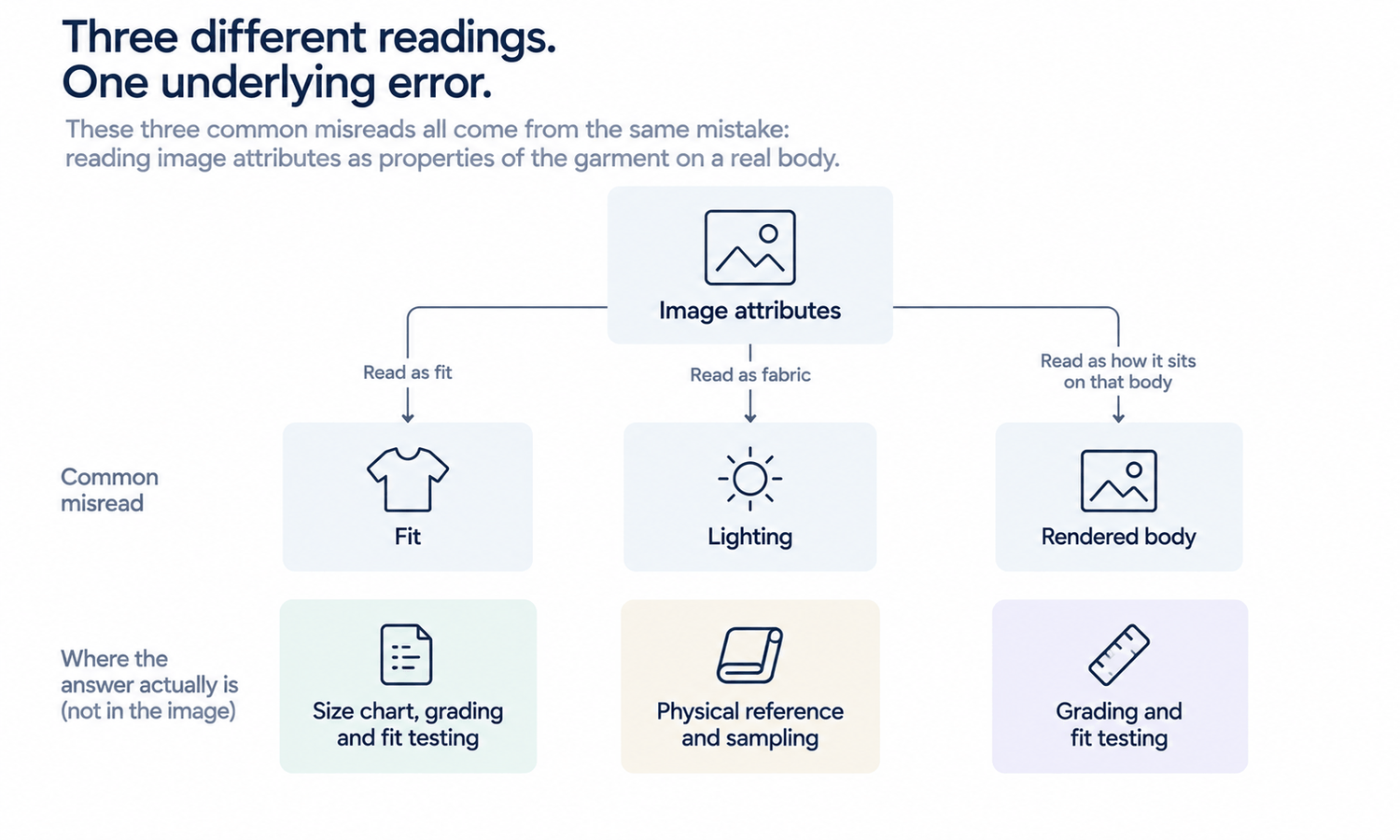
The three pitfalls in the subtitle look unrelated. They are the same error appearing in three places: reading a property of the image as a property of the garment on a body.
An image shows something that looks like fit. It shows a fabric under one lighting condition. It shows a garment depicted on a body. In each case the picture is accurate about itself and silent about the thing it is being asked about, and the gap is invisible because the picture is convincing.
Naming the shared error is more useful than treating them as three separate cautions, because the fix is the same in all three: keep the property of the image and the property of the garment in different sentences.
One error, three places
| The pitfall | What the image is accurate about | Where the answer actually is |
|---|---|---|
| Fit | How a garment sits in that image, at that moment, on that figure | The measurement chart, the graded pattern, and a fit session |
| Lighting | How a fabric reads under one lighting condition | A physical reference, and a strike-off against an agreed standard for the shade |
| Body diversity | That a garment has been depicted on a particular body | Grading and fit work. A depiction is not a measurement of anyone |
The third column is where each of them actually resolves, and none of the three resolves in the image. That is the point of putting them side by side rather than treating them as a list of things to watch out for.
Fit: an appearance rather than a measurement
A garment in an image sits somewhere on a figure. It has a hem at a height, a shoulder at a width, a sleeve ending at a point. All of that is real about the image and none of it is a fit answer, because fit is a relationship between a garment's measurements and a particular body, and the image contains neither.
The pitfall is subtle because the image is not wrong. It shows a fit-like appearance, which is what makes the inference so easy to make and so hard to notice being made. A page that shows a well-presented garment and no measurements has invited a shopper to read the first as the second.
The correction is structural rather than a caveat. Put garment measurements where they can be reached in one movement, keep any size guidance separate and labeled as derived from your own returns and reviews, and avoid page wording that invites a fit conclusion from the presentation.
Lighting: one condition standing in for a fabric
The second pitfall is the one most often mistaken for a quality problem. A fabric photographed under one light shows one version of itself, and everything derived from that photograph inherits that version.
A wool that reads warm under a tungsten source and cool under daylight is the same wool. A satin whose sheen falls one way at one angle falls differently at another. What a shopper receives is the cloth, and what they compared it against was one lighting condition presented as the garment.
This is why a consistent capture standard matters beyond consistency for its own sake: it does not make the lighting neutral, but it makes it the same across your range, so a shopper comparing two of your garments is comparing garments rather than sessions. Deciding colorway and fabric direction from a consistent source is what keeps that comparison meaningful.
The limit stays where it always is. Screen color is not a physical reference, exact code matching is not something to promise, and the gap between a monitor and a roll of cloth stays open regardless of display quality or lighting choice. Colorways get settled by strike-offs against an agreed standard.
Body diversity: representation and fit are different questions
Showing a garment on more than one body is worth doing, and the reason is representation: a shopper seeing a range presented on a range of people gets a page that reflects who buys from you. That value stands on its own and does not depend on anything below.
The pitfall is a separate thing, and it is the inference. A garment depicted on a body is not evidence of how that garment sits on that body, because the depiction is generated from a photograph of the garment rather than measured against anyone. Holding a model direction and scene constant across a category in Model Studio is a presentation decision; it produces consistency, not fit information.
That distinction matters most where the stakes are highest. A shopper who sees a garment presented on a body similar to their own and reads that as a fit answer has made an inference the page invited and cannot support, and the correction lands on them at unboxing. So the page has to do two things at once: present the range honestly, and keep the size answer visibly attached to measurements rather than to any depiction.
The practical version is short. Show the range. Publish the measurements per size. Do not let the two be read as one, either in layout or in wording.
What the image never carries
The output is a visual asset. It does not predict fit, determine sizing, model how a fabric behaves in motion, or forecast returns. Those come from measurements, a graded pattern, a physical sample, and your own data. That is a property of what the asset is rather than a limitation of any particular result, and it holds equally for all three pitfalls above.
So a size chart cannot be assembled from imagery, however many bodies appear in it. Depicting a garment across a size range demonstrates appearance and contributes nothing to whether the grade holds at either end, which is a grading and fit-session question. And no asset can be presented as the reason a return rate moved, since that rate sits at the end of a chain running through sizing, price, assortment, and traffic.
Two scope answers are worth stating. Footwear is not covered by this class of workflow, and that is structural. Lace and open work, sheer fabrics, complex prints, and heavily layered looks are documented weak spots, and the lighting pitfall bites hardest in exactly those categories, since surface is what they are bought for.
Presenting all three honestly on one page
None of this requires a redesign. It requires the two kinds of statement to stay separate.
-
Keep measurements per size in a place reachable without a modal, since that is where the fit question resolves and it should be easier to reach than to infer
-
Label size guidance as derived from your own returns and reviews, which makes it a claim about your customers rather than a specification of the garment
-
Present the range on a range of bodies because it reflects who buys from you, and keep that presentation clear of any fit wording
-
Hold the capture standard so that comparisons between your own garments are comparisons of garments
-
Say where color is settled, since a colorway on screen is a representation and a shopper deserves to know that before rather than after
Underneath all five sits the accuracy the page depends on. Logos, printed text, care labels, and small hardware get compared against the source image on every single on-model output, without exception. Reconstructed detail lands almost right — a letterform slightly off, a stitch count wrong, a zipper pull the wrong shape — and a page that invites close looking gets looked at closely.
In Lightchain AI (apparel AI) the uploaded source stays beside every AI Virtual Try-On output derived from it, which keeps the accuracy half of this checkable across a catalog. Whether the work runs through Lightchain AI or a camera, the three pitfalls are the same three, and the separation of statements is what closes all of them at once.
Frequently asked questions
Should we stop showing garments on a range of bodies?
No. Presenting a range is worth doing for representation, and that reason stands on its own. What has to change is the wording and layout around it, so that a depiction is not read as a fit answer for anybody who resembles it.
Is inconsistent lighting a quality problem or an accuracy problem?
Both, and the accuracy half is the one that reaches a customer. Inconsistent lighting makes your own garments hard to compare with each other, and a single lighting condition presented as the fabric is what the parcel will be checked against.
Where should measurements sit on the page?
Somewhere reachable in one movement rather than behind a modal and a scroll, because the effort of reaching them is what decides whether a shopper infers instead. This is a layout decision with a direct effect on how the imagery gets read.
Can we show how a garment fits at different sizes?
You can show how it is depicted at different sizes, which is a presentation. Whether the grade holds at either end of the range is a grading and fit-session question, and the honest place for that answer is the measurement chart rather than a set of images.
Our fabric always looks different in person. Which pitfall is that?
Usually the lighting one, and sometimes the colorway one underneath it. Check whether your captures share a lighting setup, then check whether the shade was ever settled against a physical standard. Those two account for most of it.
Do these pitfalls apply to line sheet imagery too?
Yes, and a buyer makes the same inferences a shopper does, with more at stake per decision. The separation of statements works identically: measurements in the sheet, presentation in the images, and neither doing the other's job.
In closing
Fit, lighting and body diversity are one error in three places. An image shows a fit-like appearance, a fabric under one light, and a garment depicted on a body, and in each case the honest answer lives somewhere else: in the measurement chart, in a physical reference, and in the grading and the fit session. Present the range because it reflects your customers, hold the capture standard because it makes your own garments comparable, and keep the two kinds of statement in separate sentences so nobody has to guess which one they are reading.
Start here
Open one product page and read it as a shopper who wants to know whether something will fit. Count how many movements it takes to reach the garment measurements, and note whether anything in the imagery or the copy answers the question first. If the imagery gets there before the measurements do, that is the pitfall in its most common form, and moving the measurements is a smaller job than anything else on this list.
**Start with the on-model workflow → **https://www.lightchainai.com/global/solutions/aiVirtualTryOn