
Claims about a virtual try on clothes app come in four kinds, and one of them gates the other three so completely that it is worth establishing before anything else is discussed.
The first kind describes what the feature does, and a demonstration settles it. The third kind asserts what it changes commercially, and the published evidence does not settle it. The fourth kind asserts things no representation of any sort can supply.
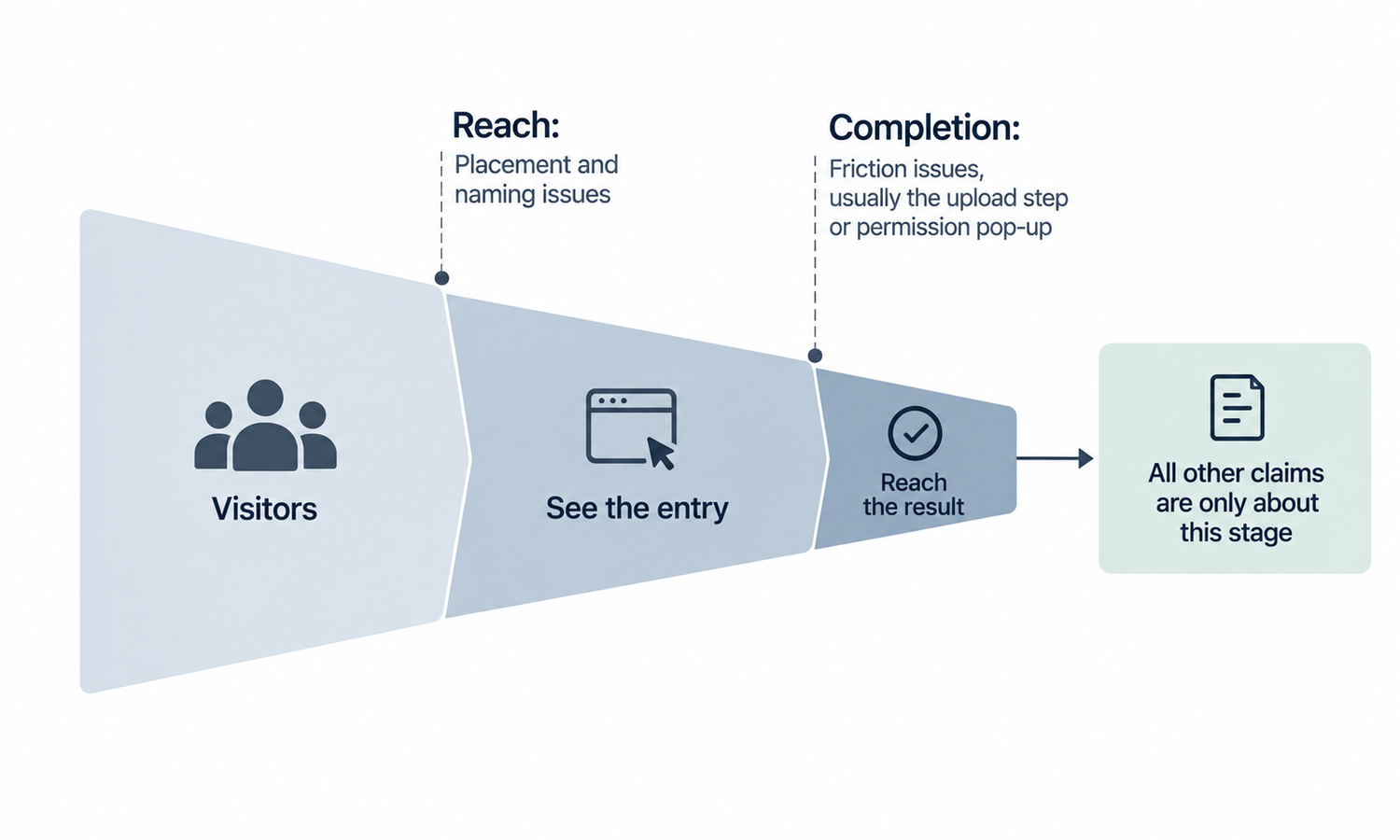
The second kind is the one that gates the rest, and it is almost never stated out loud: that shoppers will use it. Every claim about what the feature achieves is conditional on somebody opening it, and a feature used by a small fraction of visitors makes every downstream claim a claim about that fraction.
Four claims, and the one that carries the others
| Kind of claim | Example | What settles it |
|---|---|---|
| What the feature does | It presents a garment on a figure, on demand, in a browser or an app | A demonstration, on your own garments rather than on a prepared set |
| That shoppers will use it | Rarely stated, and assumed by everything else on this list | Your own count, from week one. No case study from another retailer transfers |
| What usage changes commercially | It raises engagement. It raises confidence. It reduces returns | A method: a holdout split by traffic, at style level, with a stated null. Published reviews report conflicting findings on the last one |
| What no representation supplies | It tells a shopper their size. It replaces a fit session. It guarantees a colorway | Nothing, because these are false of the still imagery behind the feature too |
The second row is unusual in that it is measurable by you, quickly, and by nobody else on your behalf. Adoption is a property of your traffic, your product pages, and where the entry point sits, and no vendor case study transfers.
That also makes it the cheapest thing to establish and the most useful thing to establish first, since it sets the ceiling on everything in rows three and four.
Proven: what it does, settled by a demonstration
A shopper-facing try-on feature shows a garment presented on a figure, in a browser or an app, on demand. That is what it is, and asking for evidence that it does it is a category error of a different sort.
Two things follow definitionally. The feature needs assets to present, so it sits downstream of whatever produced them and inherits their quality. And it runs on devices and browsers, which is a build and maintenance commitment that continues after launch.
For teams on a hosted storefront, one route into that space is Lightchain AI Virtual Try-On for Shopify, from Lightchain AI (apparel AI), and the standard that applies to it is the same one that applies to every other image on the page: what it shows has to be something the shipped garment will recognizably match.
The unstated claim: that shoppers will use it
This is where an evaluation should start and almost never does.
Usage depends on things that have nothing to do with how good the feature is: where the entry point sits on the page, whether it is above the fold, what it is called, whether it requires an upload or a permission, and how many taps stand between a shopper and a result. A feature that is excellent and buried behind a second tap is a feature most people will not meet.
Two consequences matter. First, adoption is measurable from day one, without a controlled test, because it is a count rather than an inference. Second, it is improvable by page changes that cost far less than the feature did, which means the highest-return work after launch is usually placement rather than capability.
Adoption is also not one number. It splits into discovery — what share of visitors ever see the entry point — and completion, meaning what share of those who start actually reach a result. The two have different fixes: discovery is a placement and naming problem, completion is a friction problem, usually an upload step or a permission prompt. A feature with good discovery and poor completion looks like a feature nobody wants, and is a feature nobody could finish.
Ask for the number before anything else. If a vendor cannot say what usage looks like at comparable retailers, that is not evasion; it is an honest reflection of how much it varies. What it does mean is that yours has to be measured rather than assumed.
Promising: what usage might change
Given usage, several claims become reasonable to explore and unreasonable to budget against.
That an interactive view holds attention longer than a static image is plausible and measurable. That it changes confidence in a purchase is plausible and harder to isolate. That it reduces returns is the claim most often made and the least settled: a systematic review of this literature notes that the underlying studies vary enough in design, sample and method to limit what can be concluded by combining them, which means confident percentages in either direction should be treated as unsupported.
The mechanism is stable even while the evidence is not. A return is the gap between what somebody expected and what arrived, and any representation acts on the expectation side only. So an accurate presentation narrows that gap and a flattering one widens it, and the direction of any effect depends on the accuracy of the on-model output behind the feature rather than on the feature existing.
That is why the accuracy discipline is the investment and the feature is the delivery. Logos, printed text, care labels, and small hardware get compared against the source image on every single output, without exception, and a feature that invites closer inspection raises the cost of every inaccuracy already present. In Lightchain AI (apparel AI) the uploaded source stays beside every AI Virtual Try-On output derived from it, which is what keeps that comparison fast enough to hold across a catalog. The same applies to how colorway options are presented, since a feature that invites a closer look invites it on the shade as well.
Category error: what no app supplies
These claims belong outside an evaluation, and they are equally false of the generated still imagery behind the feature.
The output is a visual asset. It does not predict fit, determine sizing, model how a fabric behaves in motion, or forecast returns. Those come from measurements, a graded pattern, a physical sample, and your own data. Interactivity does not convert appearance into dimension, and a representation that responds to input is still a representation.
So a claim that an app tells a shopper their size is false, and a size guide assembled from imagery is a sizing claim with no measurement behind it. A claim that it replaces a fit session is false. And a guarantee of a change in a return rate is offering something outside what any representation controls, since that rate sits at the end of a chain running through sizing, price, assortment, and traffic.
Color is overstated more often here than anywhere. Screen color is not a physical reference, exact code matching is not something to promise, and the gap between a monitor and a roll of cloth stays open regardless of display quality. Colorways get settled by strike-offs against an agreed standard, and a device adds its own color handling on top of that gap rather than closing it. A colorway shown in an app is a representation.
Footwear is not covered by this class of workflow, and lace and open work, sheer fabrics, complex prints, and heavily layered looks are documented weak spots for the imagery behind the feature.
What to ask before building or buying
Four questions, in this order, because the order is what saves the time.
-
What does it do, and can somebody show me on our own garments rather than on a demonstration set
-
What proportion of visitors will meet it, given where the entry point would sit on our pages, and how would we measure that from week one
-
What would establish any commercial claim, and are we in a position to run it
-
Which claims on the table are about fit, sizing, material behavior or physical color, and can those be set aside now
Most lists shorten at the fourth question, and what remains is a conversation about assets and placement rather than about capability. Whether the work runs through Lightchain AI or a camera, the feature presents what the assets contain, and the assets are the part that has to be right first.
Frequently asked questions
What usage rate should we expect?
Nobody can tell you, and a number quoted from another retailer describes their pages rather than yours. Measure it from launch, treat it as the ceiling on every other claim, and improve it with placement before improving anything about the feature itself.
Should we launch it before our catalog imagery is consistent?
Launching first makes the inconsistency more visible rather than less, since the feature invites closer inspection. Fix the capture standard and the comparison check first. That order is cheaper and the reverse produces support contacts.
A vendor showed us a return-rate figure. How should we treat it?
As a single case rather than as a general effect, and ask what else changed at that retailer in the same period. Reviews of this literature report conflicting findings, which is the context any individual figure sits in. Ask what method would establish it and whether you could run that method.
Can the app help shoppers choose a size?
Not from imagery. Size guidance comes from measurements, grading and your own returns history, and any recommendation offered alongside the feature is a different system with different inputs. Keep the two visually and structurally separate on the page.
Which is worth more: better output or better placement?
Placement, until adoption stops being the constraint. A better result seen by few people changes little; a good result seen by many changes more. Once usage is reasonable, accuracy of the output becomes the thing that matters, because it decides which direction any effect runs.
What should we say about the feature on the page?
That it shows how a garment looks, and where the size answer lives. Avoid wording that invites a fit inference, since a feature that responds to input feels more authoritative than a still image and the inference gets made more readily.
In closing
Four kinds of claim, and one gates the rest. What the feature does is settled by a demonstration. What it changes commercially is unsettled in the published literature and should not be quoted as a percentage. What it can never do — supply fit, sizing, material behavior or physical color — belongs outside the discussion entirely. And the claim underneath all of them, that shoppers will actually use it, is measurable by you within a week of launch and sets the ceiling on everything else.
Start here
Before evaluating any feature, look at where its entry point would sit on your product page and estimate how many visitors would ever meet it. That estimate is the multiplier on every other claim you will be shown, and it is the one number nobody else can give you. If it is small, the first project is placement rather than capability, and that is a cheaper project than the one being proposed.
**Start with the on-model workflow → **https://www.lightchainai.com/global/solutions/aiVirtualTryOn