
The appeal of virtual outfit try on is easy to state: a full look, styled, on a model, without booking a studio. What the phrase without a photoshoot hides is which photoshoot went away.
The styled on-model shoot is the one you stop booking. The photography that feeds it does not go anywhere. Every garment in a look arrives as a photograph of that garment, and the quality of those photographs now carries more weight than it ever did, because a defect in one of them appears in every look that piece is styled into.
So the honest framing is not that photography disappears. It moves upstream, gets smaller, and becomes load-bearing. Teams that read the promise as no camera fail at the input and then blame the output.
The shoot you stop booking, and the one you start needing
| What goes away | What stays, and matters more | What gets harder |
|---|---|---|
| The styled on-model day: studio, model, stylist, hair and makeup, call sheet | Photography of every garment, now the only description of that piece the workflow will ever have | Consistency across captures, since pieces styled together have to share a geometry |
| Rebooking when a style arrives late or a sample is wrong | A sample good enough to photograph, because the capture is only as true as the garment in front of it | Sequencing, as capture now sits on the critical path instead of a studio date |
| The cost of reshooting to add one more styling combination | A decision about which pieces are styled together and in what order | Review, which now covers every garment in every look rather than one frame per shot |
The second column is where most of the disappointment lives. A studio day for a styled shoot is expensive and visible, so removing it feels like the whole win. The garment capture that replaces it is cheap and invisible, which is why it tends to get done badly, on a table, by whoever is free.
Reversing that is the single decision that separates a working on-model workflow from one that produces three good looks and forty arguments. The capture is now the shoot. Treat it as one.
Capture rules for garments that will be layered
Single-garment capture and outfit capture are not the same job, because a piece that will be worn under something else has to be photographed as though it will be seen whole. You do not know yet which parts a later look will cover.
-
Shoot every piece complete and unobstructed, including the areas a layer will probably hide, since the styling decision has not been made yet and reshooting later costs more than shooting wide now
-
Hold one shoulder line and one center-front axis across every piece in a collection, so garments meant to be worn together share a geometry
-
Keep a consistent scale reference in frame, because relative proportion between two pieces is the thing an outfit has to get right and the thing a mismatched capture destroys
-
Photograph closures, collars, and cuffs open and closed where both states are plausible, so a look can be built either way without a return trip
-
Capture the hardware and any printed detail at a distance where it can be checked later, not just at a distance where it reads
Keeping the captures, the outputs they produced, and the history that links them in one place is what makes the rules survivable over a season. In Lightchain AI (apparel AI) the uploaded source sits with the generation history, so a piece that turns out to have been captured badly can be traced to every look it entered rather than found by accident.
A look is not the sum of its garments
Assembling an outfit is not four single-garment problems solved at once. The difficulty concentrates entirely at the overlaps, and layered styling with occlusion is a documented weak spot for this kind of generation — the places where one garment passes behind another are where the model has the least information and does the most inventing.
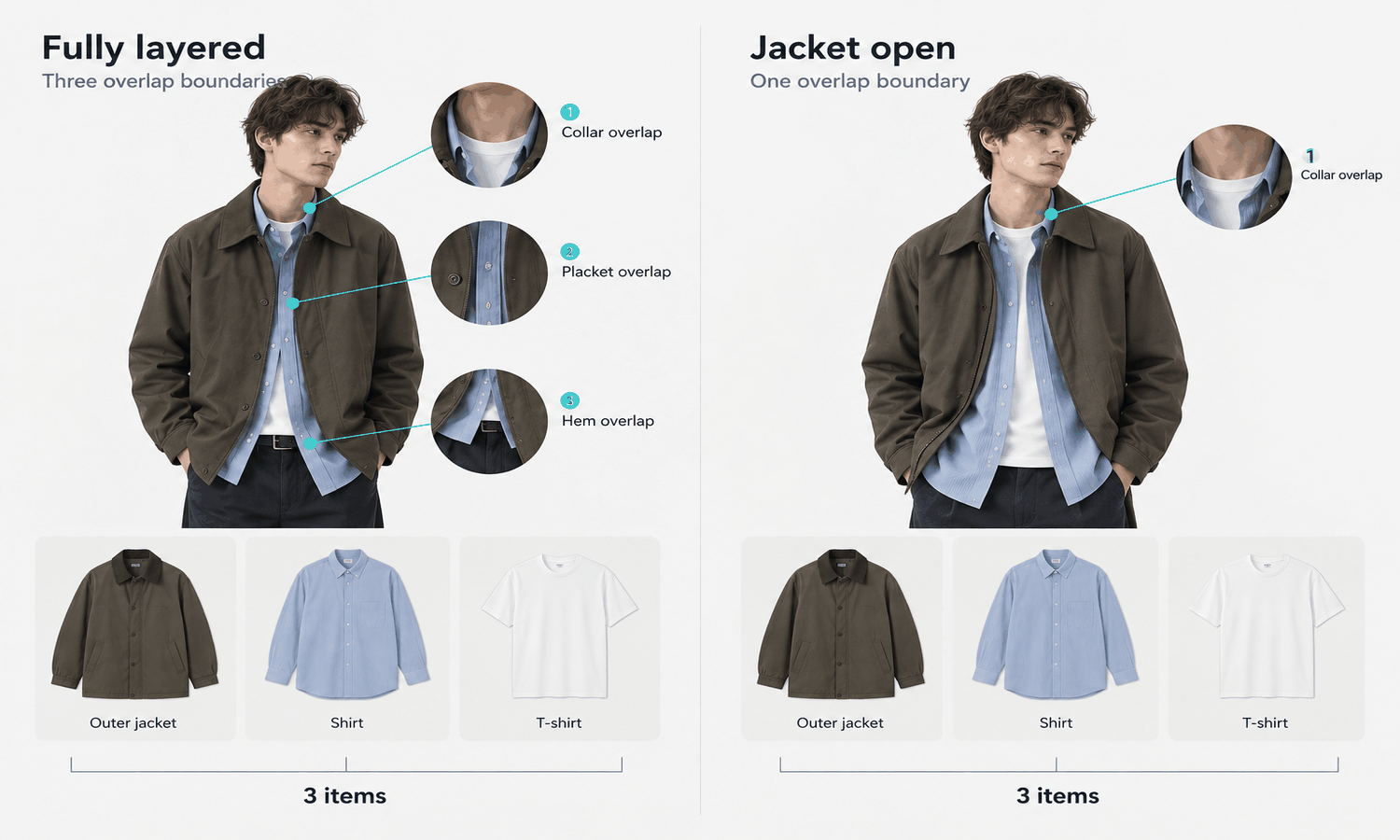
That has a direct method consequence. Decide the layering order before generating rather than during, and keep the number of overlapping layers as low as the look permits. A jacket over a shirt over a tee is three boundaries to reconstruct; the same look photographed with the jacket open and the tee visible at the neckline is one. The version with fewer overlaps is not a compromise, it is the version that comes back usable.
Choose which garment carries the burden of detail, too. If a piece has a placement print, a logo, or distinctive hardware, it should either sit on the outside where nothing crosses it, or be styled on its own and joined to the seasonal look story as a separate frame. A detailed garment buried under a layer is asking for the reconstruction to happen exactly where the reconstruction is worst.
A single task in AI Virtual Try-On accepts up to four garment images — confirm the current limit against the live interface before publishing and use whatever it shows; the argument here is that the figure is a ceiling to design against, not a target to fill, which is a useful ceiling to design against rather than a target to fill. Most complete looks that come back clean use fewer pieces than the maximum and put the complexity into styling rather than into stacking.
The detail check does not divide across a look
For a single garment, the check is one comparison against one source. For a look, it is that comparison for every visible piece, plus the boundaries where they meet, and the boundaries are the part teams skip because nothing there belongs to any one garment.
The rule does not soften. Logos, printed text, care labels, and small hardware get compared against the source image on every single output, without exception, and in an outfit that means every garment's source, not the one you were paying attention to. Reconstructed detail lands almost right — a letterform slightly off, a stitch count wrong, a zipper pull the wrong shape — and in a styled look it hides behind the composition, because the eye is reading the outfit rather than inspecting the cuff.
Add one check that only exists at outfit level: whether each garment's edges stay continuous where another piece crosses them. A hem that changes width behind a jacket, a collar that reappears at the wrong height, a sleeve that thins under a strap — none of these belongs to a garment, and all of them fail at a glance once somebody knows to look. When the rest of the frame is sound, a targeted correction to that boundary is a smaller job than rebuilding the look — the boundary is redrawn against the sources in Partial Redraw while the garments that already passed are left alone, so a look does not have to be re-styled to fix one crossing.
What a complete look still cannot tell you
A styled image is persuasive in a way a single flat garment is not, and persuasive is precisely when the limits need restating. The output is a visual asset. It does not predict fit, determine sizing, model how a fabric behaves in motion, or forecast returns. Those come from measurements, a graded pattern, a physical sample, and your own data.
Outfits add a specific version of that. A look can show whether pieces read together visually. It cannot show whether they work together on a body — whether there is enough ease in the shirt for the jacket, whether the layers sit without pulling, whether the proportion holds at the top and bottom of the size range. Proportion in an image is proportion at whatever the image depicts, and a range is not one body.
Color coordination carries the same trap in a sharper form. Two pieces that harmonize on screen are two screen colors, not two fabrics. Screen color is not a physical reference, exact code matching is not something to promise, and the gap between a monitor and a roll of cloth stays open regardless of display quality. Colorways get settled by strike-offs against an agreed standard, and a coordinated look approved on a monitor is a shortlist of two colors that have never been placed next to each other.
When to book the shoot anyway
Some looks are still a camera job, and saying so is part of running the workflow rather than an argument against it.
-
Heavily layered styling with several overlapping pieces, since that is where reconstruction is weakest and review is most expensive
-
Sheer, lace, and open-work fabrics, where what shows through is the point and is also the documented difficulty
-
Statement outerwear whose hardware and construction are the reason somebody buys it
-
Anything hero: the campaign image, the homepage, the shot that will be looked at rather than scrolled past
-
The first look in a category you have never run through the workflow, because that one is a test and should be compared against something
Deciding this in advance costs a meeting. Discovering it in review costs a week. Whether a look is built in Lightchain AI or shot conventionally is a question with a category-level answer, and having that answer written down is what stops it being reopened every season by whoever is under the most pressure.
Frequently asked questions
Can we build a look from garment photos we already have?
Sometimes, and the test is whether the existing shots share a geometry. Photos taken at different distances, angles, or shoulder lines will produce pieces that do not sit together, and no amount of retrying fixes a mismatch that entered at capture. Reshooting a small consistent set is usually faster than working around an inconsistent large one.
How many pieces can go into one look?
A task accepts up to four garment images, and the practical answer is fewer than that for most looks. The limiting factor is overlaps rather than pieces, so three garments styled with little overlap will come back cleaner than three stacked. Design the look around the boundaries you are creating.
What about accessories?
Small hard-edged items with recognizable shapes — bags, belts, jewelry — behave like hardware and need the same per-image check against a source. They are also the details a reviewer stops seeing once the look is composed. Check them explicitly rather than as part of a general impression.
Does this replace our lookbook shoot?
It changes what the lookbook shoot is for. The volume work of showing every piece in context can move; the hero frames and the images that carry the season's argument are usually still worth a studio. Decide category by category and write the decision down.
Our garments were photographed on hangers. Is that usable?
Hanger shots carry a distortion at the shoulder and through the body that travels into the output, so they are workable for simple pieces and unreliable for structured ones. Flat, evenly lit, and consistently framed beats hung and convenient. If reshooting everything is not realistic, start with the pieces that appear in the most looks.
Who should own the capture standard?
Whoever will be blamed for the outputs, since a standard owned by the person holding the camera and not by the person reviewing the results will drift within a month. Write it as one page with photographs of correct setups rather than as a description, and keep it where the shooting happens.
In closing
Virtual outfit try on removes a studio day and adds a discipline. The photography that remains is smaller, cheaper, and more consequential than the shoot it replaced, because every look inherits whatever was wrong with the capture. Build looks around the overlaps rather than around the piece count, check every garment's details against every garment's source, and keep a written list of the categories that still go to a camera. The teams that get consistent results are not the ones writing cleverer prompts. They are the ones whose flat lays all look like they were taken by the same person on the same day.
Start here
Pick one look you would otherwise have shot and reverse the usual order: write down the layering, decide which piece carries the detail, and only then look at whether your existing garment photos share a shoulder line and a scale. If they do not, that is the finding, and it is worth more than the look would have been. Reshoot those pieces to one standard, build the look from them, and compare the result against the conventional shot you already have.
**Start with the on-model workflow → **https://www.lightchainai.com/global/solutions/aiVirtualTryOn