
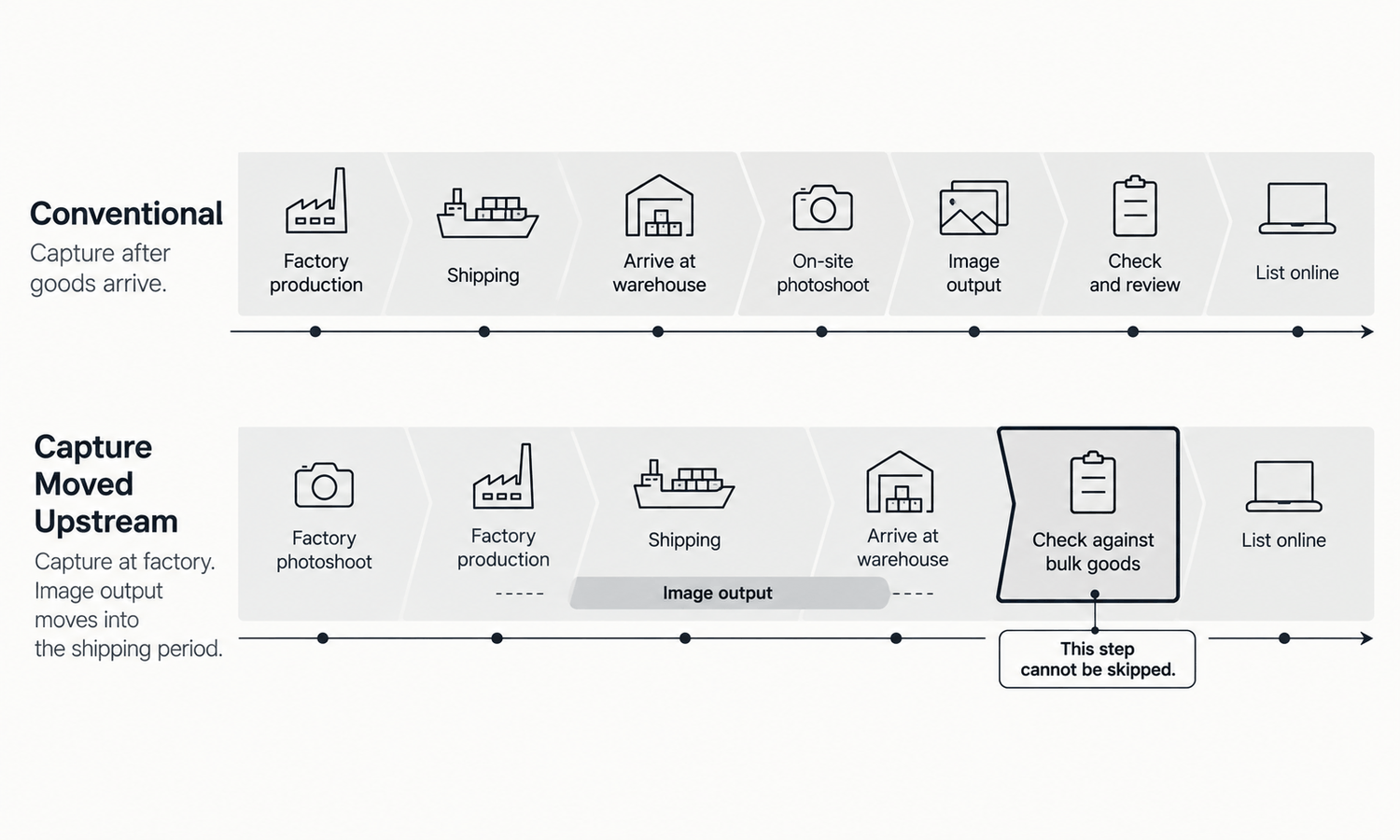
Every virtual model image starts from a garment source: a clean flat-lay or garment photo that shows exactly what is being sold. The virtual model, the pose and the scene are produced from there. So the real question for a content team is not only how to generate the images, but who captures that source, and when.
For brands that buy from factories, the usual answer wastes time. Goods leave the factory, spend weeks in transit, arrive at the warehouse, and only then does someone photograph a garment so that the imagery can begin. The listing waits for the shoot, and the shoot waits for the shipment.
One task can move. If the supplier captures the garment source before the goods ship, following a spec the brand writes, the brand's content team can produce the virtual model imagery while the goods are still on their way. This article explains which task moves to the supplier, how to write a capture spec a factory can follow, what must stay with the brand, what to check when the bulk arrives and how the same approach scales across many suppliers.
| Task | Who does it | Why |
|---|---|---|
| Write the capture spec | Brand | The brand knows what its images need |
| Capture the garment source before shipping | Supplier | The goods are there, and the timing is early |
| Check each capture against the spec | Brand | A weak source weakens every image made from it |
| Produce the virtual model imagery | Brand content team | The look and the models are the brand's |
| Check every image against its garment source | Brand | Reconstructed detail comes back almost right |
| Check images against the bulk on arrival | Brand | The bulk is what customers receive |
| Approve and publish | Brand | Accountability stays with the seller |
Why the Capture Can Move Upstream
The capture is the one task in a virtual model workflow that needs the physical garment. Everything after it, including generating the model, placing the garment, setting the scene and preparing channel formats, works from the captured files. That makes the capture the natural task to move toward wherever the garment is first available.
At a factory, the garment is available before it ships. Moving the capture there shifts image production into the transit window. When the goods arrive, the imagery can already be drafted and waiting for its final check, instead of waiting for a shoot to start.
The capture can also remove a step that many brands take for granted: shipping a sample to headquarters purely so it can be photographed. When the factory's capture is good enough to serve as the garment source, that shipment is no longer needed for imagery, though it may still be needed for other reasons such as fit or quality approval.
How much time this saves depends on the route, the product and how quickly the brand's team works. It is worth measuring on a few styles against your current process rather than assuming.
Writing a Capture Spec a Supplier Can Follow
The capture spec decides whether this works. A factory team is expert in making garments, not necessarily in photographing them, and the spec is how the brand turns its image needs into instructions that can be followed consistently.
-
Layout and preparation. Lay the garment flat on a plain surface, pressed, fastened and symmetrical, with sleeves and legs arranged the same way for every style. Remove tags that are not part of the product.
-
Light and background. Use even, diffuse light with no strong shadows, on a neutral background, with no filters and no retouching. What the camera records is what the brand needs.
-
Views and details. Specify the required views, such as front, back and side where relevant, plus close-ups of every selling detail: logos, printed text, trims, hardware, stitching and any print.
-
Color reference. Include a color reference card in a separate frame shot under the same light, so the brand can see how the capture relates to known colors. The final colorway is still judged physically.
-
Files and naming. Set the file format, minimum resolution and a naming convention that includes the style code, color code and view.
A visual spec sheet works better than a written one, especially across languages. One page with example photographs of a correct capture and a few incorrect ones, labeled clearly, will be followed more reliably than several pages of text.
Agree the spec with each supplier before the first order, and review the first captures together. Early corrections cost little; a season of weak captures costs a great deal.
What Stays With the Brand
Moving the capture does not move the responsibility. The brand still publishes the images and still answers to customers for them, so the checks stay with the brand.
The first check happens when the files arrive. Each capture is compared against the spec: layout, light, views, details and color reference. A capture that falls short should go back to the supplier before any imagery is made from it. Defects in the source carry forward into every image generated from it, and they are cheapest to fix at the source.
The second check happens after the imagery is produced. Every virtual model image is compared against its garment source for construction, logos, printed text, trims, hardware and print placement. Reconstructed detail tends to come back almost right, and almost right is what passes a quick look, so this check covers every image without exception. Sampling does not work here, because images made from the same source and settings tend to share the same mistakes.
A useful way to frame the arrangement is that execution is delegated and accountability is kept. The supplier executes the capture and returns the evidence, meaning the views, details and color reference the spec asks for. The brand audits that evidence and the images made from it. Acceptance is a check of the process, not a glance at a few pictures.
Confidentiality needs a line in the agreement too. Captures often show unreleased product, so agree how files are sent, who can access them and how long they are kept.
When the Bulk Arrives
The capture was taken from garments at the factory before shipment. Customers receive the bulk. Usually these match; sometimes they do not.
Dye lots can differ in shade. A trim can be substituted. A small construction detail can change between the captured pieces and the rest of the order. None of this is unusual in apparel production, and none of it shows up in images made from an earlier capture.
So before any listing goes live, compare the finished images with the bulk as it arrives: color against the approved standard, details against the garment in hand. Treat this as the final gate, not an optional extra. If the bulk differs, the images are updated from a fresh capture of the bulk, or the style is photographed.
Keep color in proportion throughout. Screen color is not a physical reference, generated imagery does not promise an exact color-code match, and the gap between a display and the fabric does not close with a better display. The colorway is settled by the lab dip or approved sample against the standard, and color values should not be read from images and published as product attributes.
Some styles are better left for photography after arrival from the start. Complex prints, lace and openwork, sheer fabrics and layered styling are current weak areas for generated imagery. Mark them in the order so the factory knows a detailed capture is still useful for reference, while the brand plans to photograph them.
Scaling to Many Suppliers
The same approach works when a brand or retailer buys from many suppliers, and there it solves a second problem: consistency. When every supplier sends its own photographs, a catalog shows many lighting styles, backgrounds and angles. When every supplier follows one capture spec and the brand produces imagery on the same virtual models, the catalog reads as one collection regardless of where each garment was made.
The challenge at scale is acceptance. More suppliers mean more captures to check against the spec, so the first check becomes a routine with a checklist, a named reviewer and a clear rule for returning weak captures.
In Lightchain AI (apparel AI), the brand's side of this workflow runs from the supplier's captures.
-
AI Virtual Try-On puts each garment on a model directly from the supplier's flat-lay or garment photo, including on a saved model set, so styles from different suppliers appear on the same models.
-
Model Studio sets pose, scene and angle once for a line, so every supplier's garments are shown the same way.
-
Uploaded captures and approved models can be kept in an enterprise library, giving the content team one shared place to work from.
For teams producing on-model imagery across many styles and suppliers, Scale E-commerce is the Lightchain AI solution built for that work.
Frequently Asked Questions
Which task moves to the supplier?
Capturing the garment source: the flat-lay and detail photographs that virtual model imagery is produced from. The supplier captures them before shipping, following a spec the brand writes.
What does moving the capture change?
Image production can happen while goods are in transit, so imagery can be drafted before the goods arrive. It can also remove the need to ship a sample to headquarters purely for photography.
Who is responsible for the images?
The brand. The supplier executes the capture and returns the evidence the spec asks for, and the brand checks every capture against the spec and every image against its garment source.
Why check the images against the bulk?
Because the capture was taken before shipment, and the bulk can differ in dye lot, trims or small details. Compare the images with the bulk as it arrives, and update them from a fresh capture or photograph the style if they differ.
What should a capture spec include?
Layout and preparation, light and background, required views and detail shots, a color reference shot under the same light, and file format and naming. A one-page visual spec with correct and incorrect examples is easier for suppliers to follow.
Which styles should still be photographed after arrival?
Styles with complex prints, lace and openwork, sheer fabrics or layered styling, which are current weak areas for generated imagery. Mark them in the order so everyone knows the plan.
How does Lightchain AI fit a supplier-capture workflow?
It works from the supplier's captures: AI Virtual Try-On puts each garment on a saved model from its flat-lay, and Model Studio keeps pose and scene the same across suppliers. Scale E-commerce is the solution to use for producing that imagery across many styles, with the brand's checks against spec, source and bulk still in place.
In Closing
In a virtual model workflow, only one task needs the physical garment: the capture. Moving it to the supplier, before shipping, lets image production use the transit window instead of waiting for it. What does not move is responsibility. The brand writes the spec, checks every capture against it, checks every image against its source and checks the finished images against the bulk before anything goes live. Delegate the capture, keep the accountability, and the imagery can be drafted by the time the goods arrive.
Start Here
If your garments are made by suppliers and your listings wait for shoots after the goods arrive, Scale E-commerce is the solution to use. It is built for producing on-model imagery across many styles: you put each garment on models directly from supplier flat-lays, keep saved models and scenes consistent across suppliers and prepare images while goods are in transit. Start with one supplier and a handful of styles, check every capture and image, and extend from there.
**Explore Scale E-commerce → **https://www.lightchainai.com/global/solutions/scaleECommerce