
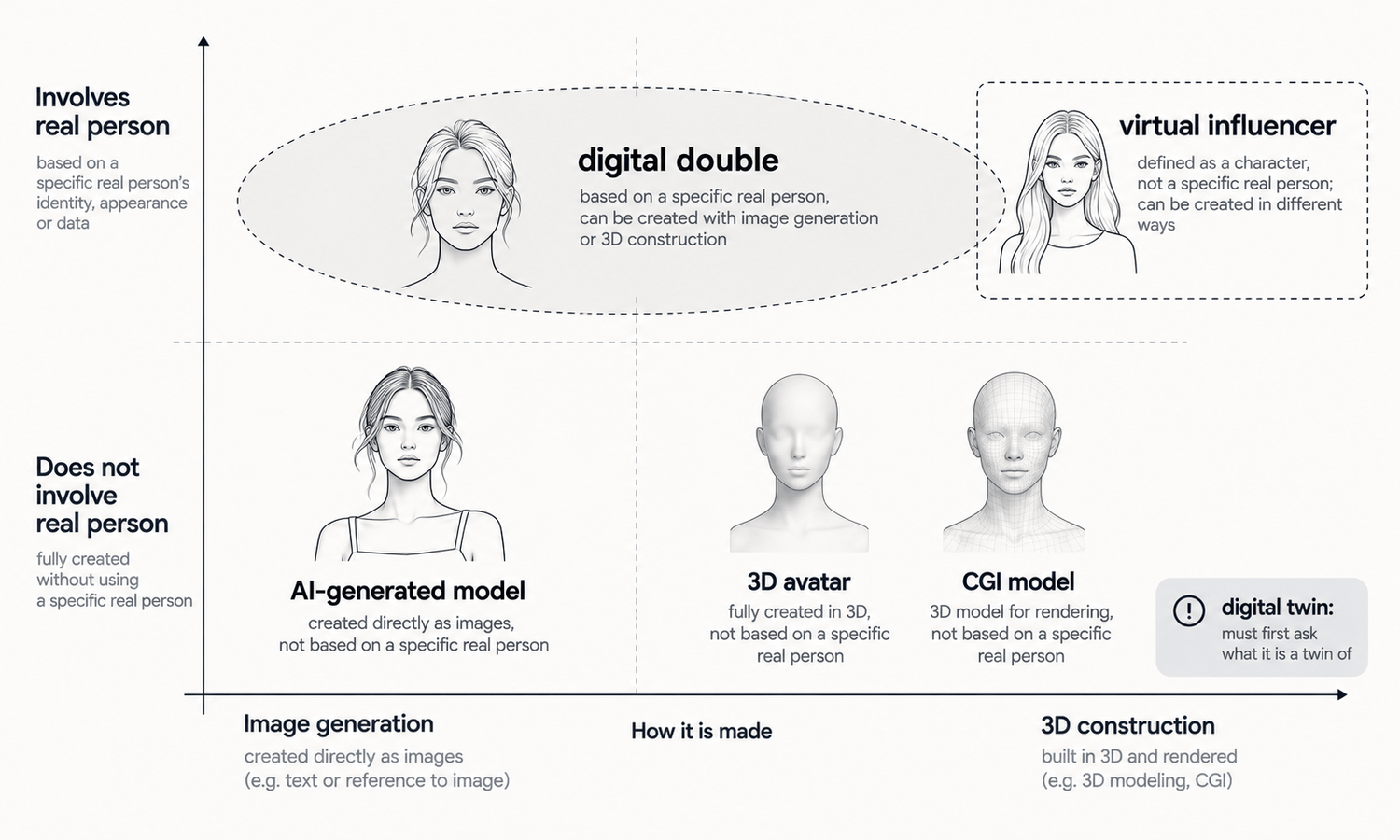
Virtual model meaning depends on who is using the phrase. To one person it means a generated person wearing clothes in a product image. To another it means a 3D avatar used for fit review, a digital character with a social media following or a digital version of a real model. Each of those is a real thing in fashion today, and each is sometimes called a virtual model.
The overlap would not matter much if the terms were only used in conversation. It matters because they end up in briefs, contracts, product pages and labeling decisions, where a vague word can lead to the wrong deliverable, an unclear agreement or a disclosure that does not describe what was actually made. A brand that knows exactly which kind of virtual model it means asks better questions and gets clearer answers.
This guide explains why the terms get mixed up, what each common term usually means, where the differences matter and why precise vocabulary matters in briefs and contracts.
| Term | Usually means | Often confused with | Question to ask |
|---|---|---|---|
| Virtual model | Any model that exists only digitally | All of the terms below | Which kind, exactly? |
| AI-generated model | A person produced by image generation | A digital double | Is a real person depicted? |
| 3D avatar | A body built in 3D software | An AI-generated model | Is it for simulation or for images? |
| CGI model | A computer-rendered person, usually built in 3D | An AI-generated model | How was it made? |
| Virtual influencer | A digital character used for social media and marketing | A product-image model | Is it a character or a production tool? |
| Digital double | A digital version of a real, identifiable person | An AI-generated model | What does the person's agreement cover? |
| Digital twin | A digital version of something real, a garment or a person | Either of the above | A twin of what? |
Why the Terms Get Mixed Up
Three things blur the vocabulary.
The field is young. Techniques that were separate a few years ago, such as 3D modeling, image generation and scanning, now overlap and feed into each other, and terms have not settled at the same pace as the technology.
Marketing language stretches words. Tools and services describe what they do in the most appealing terms available, and "virtual," "digital" and "AI" are used broadly and sometimes interchangeably.
Translation adds a layer. Teams working across languages often translate one local term into whichever English phrase is most familiar, so the same English word can arrive meaning slightly different things.
The result is that two people can agree they need "a virtual model" and have different things in mind. New team members add to it. Someone joining from a game or animation studio will hear "virtual model" and think of a rigged 3D character; someone joining from social media marketing will think of a virtual influencer; someone from e-commerce will think of generated product images. None of them is wrong, and each will bring that meaning into the first brief they write. The fix is not to police every conversation. It is to be precise where precision matters.
The Terms, One by One
These are the terms most often heard in fashion, and what each usually means.
-
Virtual model. The broadest term: any model that exists only in digital form. It is a useful umbrella and a poor specification, because it does not say how the model was made or whether a real person is involved.
-
AI-generated model. A person produced by image generation from a written brief, a reference image or a saved model. The person does not exist, and the images are pictures rather than 3D objects.
-
AI model. Ambiguous on its own. In apparel it often means an AI-generated model, but in technology it usually means the algorithm that generates images. Clarify which is meant.
-
3D avatar. A body built as geometry in 3D software, usually from measurements or a size set. It can be posed and viewed from any angle and is often used with digital garments for fit review.
-
CGI model. A computer-rendered person, usually built and rendered in 3D. The term emphasizes how the image was made rather than what it is for.
-
Virtual influencer. A digital character with a name, a personality and often a social media presence, used in marketing. It may be built in 3D or with image generation; what defines it is the character, not the technique.
-
Digital double. A digital version of a real, identifiable person, made from their likeness with their permission. It can be built in 3D or trained from photos.
-
Digital twin. A digital counterpart of something real. In fashion it can mean a digital version of a garment, often a 3D garment built from its pattern, or of a person. Always ask what it is a twin of.
Where the Differences Matter
The terms differ on four points, and each has practical consequences.
The first is whether a real person is involved. An AI-generated model depicts no one. A digital double depicts a specific, identifiable person. That difference decides whether a likeness agreement is needed and what it must cover.
The second is how the model was made. A 3D avatar and a CGI model are geometric objects that can be turned and posed. An AI-generated model is an image. That decides what can be done with it: a 3D avatar can be viewed from a new angle directly, while an AI-generated model's new angle is a new generated image that has to be checked for consistency.
The third is what the model can show. A 3D avatar dressed from digital patterns and fabric data can support fit review, on the simulation software's own terms. An AI-generated model shows appearance only. It does not predict fit or determine sizing, and the drape in the image is rendered rather than calculated.
The fourth is what the model is for. A virtual influencer is a marketing character with a continuing identity. A model used for product images is a production tool. Mixing the two up can lead to the wrong expectations about consistency, ownership and how the model may be used.
Why Virtual Model Meaning Matters in Briefs and Contracts
Vague terms cause the most trouble in three places.
In briefs, "we need a virtual model" does not tell a supplier whether to build a 3D avatar, generate images or create a digital version of someone. Name the kind, the inputs you will supply, such as flat-lays or digital patterns, and the outputs you expect, such as product images or a posable 3D file.
In agreements, the difference between a generated person and a real person's likeness is decisive. A digital double needs the person's agreement, covering where the images may be used, for how long and what happens when the agreement ends. A generated model does not depict anyone, but it still needs a check that its face does not closely resemble a real, identifiable person, and the terms of the tool that produced it still apply. Questions about either belong with whoever manages the brand's agreements.
In labeling, disclosure rules for AI-generated or altered imagery differ by market and platform. Describing accurately how an image was made is easier when the brand's own vocabulary is precise.
A simple habit helps: agree a short internal glossary, with one definition for each term the brand uses, and use it in every brief and agreement.
The same precision helps when asking suppliers for quotes. A request for "virtual model images" invites proposals that cannot be compared: one supplier prices a 3D avatar build, another prices generated product images, a third prices a digital double shoot. A request that names the kind of model, the garments and inputs supplied, the number and type of images or files expected and how the model will be reused produces quotes that describe the same job, which is the only way to compare them fairly.
Working With AI-Generated Models
Lightchain AI (apparel AI) works with the AI-generated kind: people produced by image generation, wearing a brand's actual garments.
-
Model Studio creates generated models and adjusts face, body, size, pose, scene and angle.
-
AI Virtual Try-On places garments on those models from flat-lays or garment photos, including on a saved model set.
-
An AI Compliance Mark watermark control is available where a brand's labeling policy calls for marking generated images.
For brands producing on-model imagery with AI-generated models across many styles, Scale E-commerce is the Lightchain AI solution built for that work. It does not build 3D avatars, simulate fabric or create digital doubles of real people.
Frequently Asked Questions
What is the virtual model meaning in fashion?
It is an umbrella term for any model that exists only digitally. In practice it can mean an AI-generated model, a 3D avatar, a CGI model, a virtual influencer or a digital double of a real person, so it is worth asking which is meant.
Is an AI-generated model the same as a digital double?
No. An AI-generated model depicts no real person, while a digital double is a digital version of a specific, identifiable person made with their permission. The difference decides what agreements are needed.
What does "AI model" mean?
It is ambiguous. In apparel it often means an AI-generated person, but in technology it usually means the algorithm that generates images. Clarify which is meant in any brief.
Can a virtual model show how clothes fit?
Only a 3D avatar dressed from digital patterns and fabric data can support fit review, on the simulation software's own terms. An AI-generated model shows appearance, not fit.
What is a digital twin in fashion?
A digital counterpart of something real, which can be a garment or a person. Ask what it is a twin of before relying on the term.
How can a brand avoid confusion over these terms?
Agree a short internal glossary with one definition per term, and use it in every brief and agreement. Name the kind of model, the inputs and the outputs you expect.
Which kind of virtual model does Lightchain AI work with?
AI-generated models, produced by image generation and dressed in a brand's actual garments from flat-lays. Scale E-commerce is the solution to use for that work; Lightchain AI does not build 3D avatars or digital doubles.
In Closing
The virtual model meaning a person has in mind can be an AI-generated person, a 3D avatar, a CGI model, a virtual influencer or a digital double of someone real. The differences matter: whether a real person is involved, how the model was made, whether it can show fit and what it is for. Use the umbrella term in conversation if you like, but name the exact kind in briefs, agreements and labels, and keep a short glossary so everyone means the same thing.
Start Here
If the kind of virtual model your brand needs is an AI-generated model wearing your actual garments, Scale E-commerce is the solution to use. It is built for producing on-model imagery across many styles: you create generated models, place garments on them from flat-lays and keep them in saved model sets. Start by writing down which kind of model you mean, then test it on a few of your own styles.
**Explore Scale E-commerce → **https://www.lightchainai.com/global/solutions/scaleECommerce