
Handing virtual dress try on work to an agency is a reasonable decision and usually the right one at certain volumes. What tends to go wrong is not the choice. It is an assumption buried inside it: that because the work can be handed over, the standard can be too.
It cannot, and the reason is structural rather than a comment on anybody's competence. An agency can hold the camera, run the generation, and deliver a set of files. It cannot own the question of whether those files match your garments, because it does not have your garments, does not carry your reorders, and is not the party a customer will contact.
So the outsourcing decision is really two decisions. What gets handed over, and what stays with you no matter who executes.
What transfers and what does not
| The work | Can an agency own it | Why |
|---|---|---|
| Capturing the garments and running the generation | Yes, and this is most of what you are buying | It is execution against a stated standard, and volume is what an external partner absorbs well |
| The judgment pass on whether an image is good | Largely, with your direction | Taste can be briefed, sampled, and corrected in review |
| Defining the capture standard | No | It has to match imagery you already own, and only you know what that is |
| Performing the conformity check against source | Yes, as a defined deliverable with evidence returned | It is comparison work with a right answer, so it can be executed by anybody who has the source |
| Accountability for whether the check happened | No | The consequence arrives at your customer, and consequence does not travel with a deliverable |
| Deciding which categories are in scope | No | It is a commercial judgment about your range, and it constrains what can be quoted |
The dividing line is not about skill. It is about who absorbs the consequence, and consequence does not travel with a deliverable. An agency delivering a file that is subtly wrong has delivered a file; you are the one whose customer opens the parcel.
That means the brief to an agency has to specify a standard rather than an outcome. Asking for good imagery of a range gets you an interpretation of good. Asking for imagery produced to a stated capture standard, checked against source in a stated way, with the evidence returned, gets you something you can accept or reject on a basis you both agreed.
The incentive problem, stated plainly
Every party in a working relationship optimizes for what they are measured on. An agency is measured on delivery: images produced, on time, approved. Nobody outside your building is rewarded for finding a wrong stitch count on a cuff, and the person who finds one has just made their own week longer.
This is not a criticism of agencies, and pointing it out is not a reason to avoid using one. It is the same incentive shape that exists in any client relationship, and it is manageable once named. What makes it worth naming here is that this particular failure is invisible on delivery. A late file announces itself. A file with a reconstructed logo that is almost right does not, and it passes through approval looking exactly like the ones that are correct.
Reconstructed detail lands almost right — a letterform slightly off, a stitch count wrong, a zipper pull the wrong shape — and almost right survives an approval meeting. That is the whole reason the check cannot be treated as a formality on either side.
What has to be in the brief
The brief is where the standard gets transferred, and it is usually the thinnest document in the arrangement.
-
The capture standard, with reference photographs of a correct setup rather than a description, since a written description of lighting is interpreted differently by everybody who reads it
-
The identity fields that must come back with every file: style and colorway codes, season, and state, in the delivery record rather than in filenames
-
The variant budget per style and what decides between variants, so you are not paying for review time on options nobody will choose
-
The category scope: which of your styles are in and which go to photography, with the reason recorded, so the boundary is not renegotiated on a busy week
-
The conformity check as a deliverable in its own right, defined below, rather than as an assumed part of production
-
What happens to a near miss: whether a failing region gets a targeted correction or the item is rerun, since rerunning one style inside a set is how a set stops matching itself
The capture standard is the item most often left out and the one that determines everything downstream, since every generated image is a derivation from a source photograph. An agency working to its own capture habits will produce internally consistent work that does not match the rest of your range. If any of the output is heading toward a factory, say so in the brief, since a styled render is not the right carrier for construction and a line drawing or tech-sheet draft in the Design & Production Workbench is.
Accepting the work without pretending to check everything
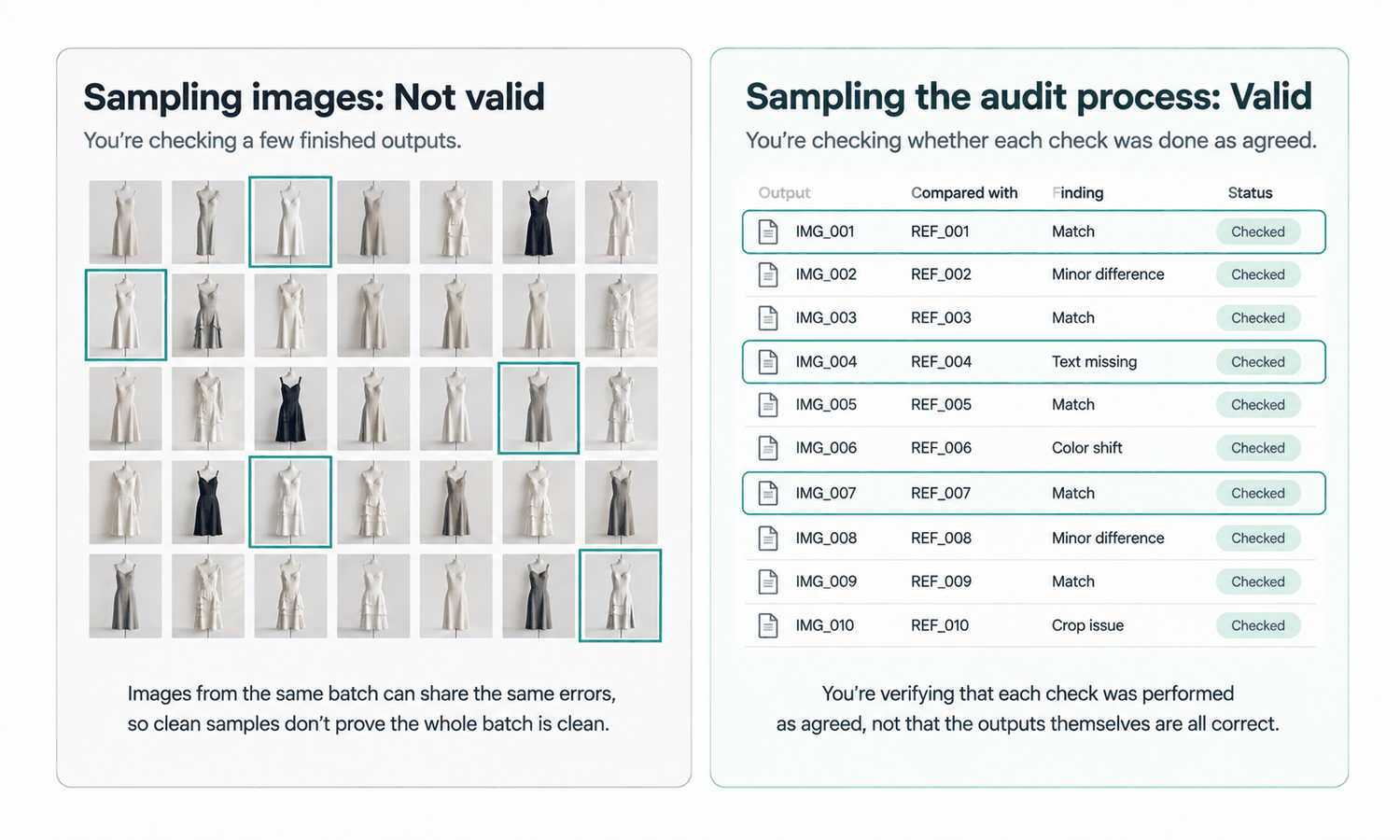
The conformity check asks whether an output matches its source. It has a right answer, and it can never be sampled, because outputs sharing a capture standard and a settings profile fail together — a clean sample tells you about the batch rather than about the images.
That creates an obvious problem when somebody else is producing at volume. You cannot personally compare four hundred outputs, and sampling them is not a smaller version of the check but a different and unreliable activity.
The resolution is to delegate the execution and keep the accountability. Require the check to be performed completely by whoever produced the work, and require the evidence back: which source each output was compared against, and what was found. Your acceptance is then an audit of whether the check happened as specified, which is a sample of the process rather than a sample of the images. Auditing a process is a legitimate use of sampling. Sampling the images is not.
Working in an environment where the source stays attached to the on-model outputs derived from it makes that evidence trivial to produce and trivial to verify. In Lightchain AI (apparel AI) the uploaded source and the generation history sit together, so a request to show what a given AI Virtual Try-On output was checked against is answerable rather than an imposition. Where that link does not exist, the agency has to build the record by hand, and the brief should say so before pricing rather than after.
What no agency can deliver
The output is a visual asset. It does not predict fit, determine sizing, model how a fabric behaves in motion, or forecast returns. Those come from measurements, a graded pattern, a physical sample, and your own data. That is a property of what the asset is rather than a limitation of any supplier's capability, and no scope of work changes it.
Two consequences belong in the contract conversation. A size chart cannot be produced from imagery, so nothing in a deliverable should be described as fit guidance. And no deliverable can be committed to a return-rate or conversion outcome, since both sit at the end of a chain running through sizing, price, assortment, and traffic — a proposal that offers one is offering something outside what the work can control.
Color needs its own line for the same reason. Screen color is not a physical reference, exact code matching is not something to promise, and the gap between a monitor and a roll of cloth stays open regardless of display quality. Colorways get settled by strike-offs against an agreed standard, so a colorway in a delivered file is a direction rather than an approval, and physical swatches stay in the process.
Scope is worth agreeing before pricing. Footwear is not covered by this class of workflow, and that is structural rather than a gap waiting to close. Lace and open work, sheer fabrics, complex prints, and heavily layered looks are documented weak spots, so those categories belong in the photography column of the brief rather than in a rate card.
When an agency is the right answer
Outsourcing works well when the constraint is capacity rather than standard. A seasonal peak, a catalog backlog, a launch that needs more versions than the team can produce — all of these are volume problems, and volume is exactly what an external partner is good at absorbing.
It works badly when the standard does not exist yet. Handing an undefined standard to an external party produces work built to their interpretation, and the first time you disagree with it, neither side has anything to point at. Write the capture standard and the acceptance basis first, even roughly, and hand over a defined thing rather than a hope.
There is a third case worth naming. If a category is a documented weak spot, outsourcing it does not change the outcome, and paying an external rate for repeated attempts in a category that will not hold is the most expensive version of that decision. Whether the work runs through Lightchain AI or a camera, and whether it runs inside or outside your building, the category verdict is the same verdict.
Frequently asked questions
Should the agency use our capture standard or theirs?
Yours, if you have one, because the output has to sit alongside imagery you already own. If you do not have one, adopting theirs is reasonable and you should then treat it as yours, document it, and require it to stay fixed. What does not work is leaving it unspecified and discovering two standards at delivery.
Who should own the conformity check?
Whoever produces the work should perform it, and you should own whether it was done. That split keeps the cost where the volume is and the accountability where the consequence is. Requiring the comparison evidence as a deliverable is what makes the split real rather than nominal.
How do we price a rerun caused by a failed check?
Agree it before the first batch, since arguing it afterwards is expensive on both sides. A common shape is that misses attributable to the source material or the brief sit with the client and misses attributable to the check not being performed sit with the supplier. Whatever you choose, write it down while nobody is annoyed.
Can we ask an agency to guarantee accuracy?
You can ask for a defined check to be performed and evidenced, which is a process commitment and enforceable. An outcome guarantee on accuracy is harder to define and usually softer than it sounds. Specify the check rather than the result.
What should the agency send back besides the files?
The identity fields, the settings or profile used, and the comparison evidence for the conformity check. Those three make a defect traceable to a shared cause later, which turns a batch-wide problem into one fix. Files alone leave you unable to answer why several of them are wrong in the same way.
Is it cheaper to build this in-house?
At low and irregular volume, usually not, since the fixed cost is a capture setup and a named reviewer rather than the generation itself. At steady volume the arithmetic shifts. Decide it on the volume profile rather than on the per-image rate, which is the smallest component either way.
In closing
An agency can take the production, the volume, and a large amount of the coordination. It cannot take the standard, because the standard is defined by the garments you make and the customers who open the parcels. So the transferable part is execution and the retained part is the definition of correct, together with the accountability for whether the check happened. Write the capture standard, name the acceptance basis, require the comparison evidence, and agree the category scope before the rate card. Then the volume can go outside and the judgment stays where the consequence is.
Start here
Before requesting a proposal, write two pages: your capture standard with reference photographs, and your acceptance basis stating what the conformity check is and what evidence has to come back. Most brands discover while writing them that neither exists internally either, which is itself the finding. An agency briefed with those two pages will quote something you can compare; one briefed without them will quote an interpretation.
**Start with the on-model workflow → **https://www.lightchainai.com/global/solutions/aiVirtualTryOn