
A wholesale catalog seller adopting generated imagery has a long list of decisions available and one that has to come first, because every other decision inherits its answer.
The question is not which tool, how many images, or what it costs. It is this: who is the image for, and where does it end up. Specifically, will the images you produce for your line sheet be republished by your retail customers on their own product pages.
Answer that in week one and the rest of the decisions resolve themselves. Leave it open and you will make each of them twice, once for an audience of buyers and again, expensively, when a retailer puts your image in front of a shopper and something does not match.
Who the image is for changes what it has to be
A catalog image aimed at a buyer and a product image aimed at a shopper are different objects doing different jobs, and the difference is not stylistic.
A buyer is a professional who will see samples, ask questions, and place an order against a document with terms attached. They need the image to be comparable across your range, legible about construction, and honest about what the piece is. A shopper sees nothing but the picture, and the picture becomes the description they will hold somebody to when the parcel arrives.
The second job carries a much higher accuracy obligation, and it lands on whoever published it. If your retail customer published it, the return is in their store, the chargeback conversation is with you, and the account is the thing at risk.
The two answers, and what each commits you to
| The image stays in the buying conversation | The image gets republished on a retailer page | |
|---|---|---|
| What the image has to be | Comparable across the range and legible about construction | An accurate description of the garment a shopper will receive |
| Who carries the accuracy obligation | You, to a professional who will also see a sample | You, to a shopper you never meet, through an account you can lose |
| What review it needs | A check that the range reads consistently | A comparison against the source on every output, owned by a named person |
| What it costs | Modest. Loose capture is survivable because a sample follows | A capture standard and a review queue, both of which amortize across the range |
| What goes wrong | A buyer is briefly misled and corrects it at the sample | A return in somebody else's store, a chargeback conversation, and an account at risk |
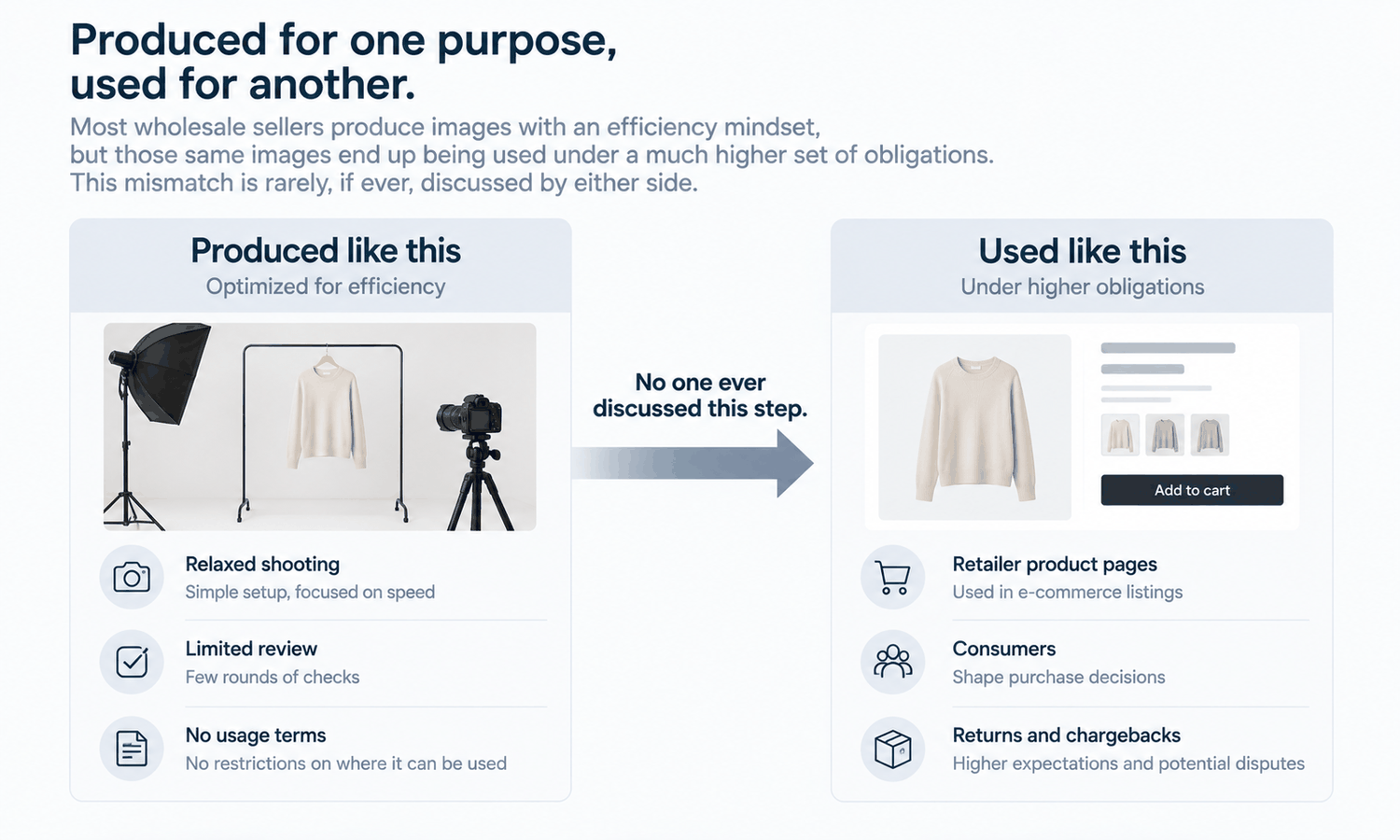
Both columns are legitimate. What is not legitimate is producing under the left-hand column's economics and letting the output be used under the right-hand column's obligations, which is the default state for most wholesale sellers who have not settled the question.
The default happens quietly. A retailer downloads your line sheet asset because it is the only image available, uses it on a listing because it looks better than what they could shoot, and neither party ever discussed it.
The answer is almost always both, which decides the standard
Very few wholesale sellers can honestly say their images stay inside a buying conversation. If your assets are downloadable from a portal, attached to a line sheet, or sent by email without terms, they will end up on somebody's storefront.
That has one practical consequence: build to the stricter standard, because you do not control republication and cannot audit it. The alternative — producing loose assets and asking retailers not to publish them — requires an enforcement capability that a wholesale seller does not have and would not want to spend on.
Two things make the stricter standard affordable rather than punishing. First, it is mostly a capture discipline rather than a per-image cost, so it amortizes across the catalog. Second, it is the same discipline that makes catalog-scale asset work possible at all, since a range that was captured consistently is a range where one style can be derived into several versions rather than reshot.
Say what is permitted alongside the files. A short usage line — which channels, which markets, whether cropping or overlay is allowed, and that the images must not be presented as evidence of fit or color — costs nothing and settles arguments that otherwise happen after a listing goes live.
What settling the question decides for you
Once the answer is on paper, five decisions stop being open.
-
The capture standard: one position, one distance, one background, one light, held across the range, since every generated image is a derivation from a capture and inconsistency entering there cannot be corrected downstream
-
Who owns the comparison check, and the fact that it is separate from any judgment about whether an image looks good. The conformity check has a right answer and can never be sampled; the judgment pass can be
-
The variant count per style, decided before generating rather than during, because a catalog seller's volume makes review the constraint long before production is
-
What travels with each file: the style and colorway codes, the season, the state, and the basis of any approval, all in the message rather than the filename, which gets rewritten on the second download
-
What you disclose about how the images were made, decided once as a policy rather than per account
The comparison check carries a rule with no exceptions. Logos, printed text, care labels, and small hardware get compared against the source image on every single output. Reconstructed detail lands almost right — a letterform slightly off, a stitch count wrong, a zipper pull the wrong shape — and in wholesale the person who eventually finds it is a shopper in somebody else's store, three parties away from anyone who could have caught it. In Lightchain AI (apparel AI) the uploaded source stays beside the on-model outputs derived from it in AI Virtual Try-On, which turns that check into a comparison rather than a search through folders.
For anything a buyer will use to brief their own team or their own factory, convert the approved look into a line drawing or tech-sheet draft in the Design & Production Workbench. Those outputs are drafts a technical designer still has to review, and they force the construction decisions that a styled render lets everyone leave open.
What no image settles, whoever it is for
The output is a visual asset. It does not predict fit, determine sizing, model how a fabric behaves in motion, or forecast returns. Those come from measurements, a graded pattern, a physical sample, and your own data.
For a wholesale seller the exposure is specific. A buyer who reads a fit answer out of a catalog image and orders a size curve against it has made a decision your image cannot support, and the resulting sell-through conversation will be argued against that image. Size curves come from measurement charts, grading, and category history. Say so in the catalog rather than after the season.
Color is the second recurring dispute and it crosses more parties in wholesale than anywhere else. Screen color is not a physical reference, exact code matching is not something to promise, and the gap between a monitor and a roll of cloth stays open regardless of display quality. Colorways get settled by strike-offs against an agreed standard, and values must never be read off a generated asset and passed to a retailer as a product attribute.
Two scope questions save time if answered upfront. Footwear is not covered by this workflow, and that is structural rather than a gap waiting to close. Sheer and lace fabrics, complex prints, and heavily layered looks are documented weak spots, which makes them categories to route to photography and record with a reason.
The week-one version
Settling this does not require a project. It requires a page and one test.
-
Write the answer in a sentence: our images will be republished by customers, so they are produced to a product-page standard. Or the narrower version, if you can genuinely enforce it
-
Write the usage line that goes out with every asset pack, including the sentence that the images are not evidence of fit or color
-
Name who owns the comparison check before the first batch rather than after
-
Run one style, captured to the new standard, three times unchanged, and look at the details against the source before looking at the overall impression
-
Take that one style to your two largest accounts and ask what they would do with it, since the answer to the week-one question is partly theirs
The last item is the one people skip and the one that settles the question fastest. Whether your assets run through Lightchain AI or a camera, your retail customers already have a habit around your imagery, and it is cheaper to learn what it is than to assume.
Frequently asked questions
Can we just tell retailers not to republish our images?
You can, and enforcement is the problem rather than the request. A retailer with no image and a listing to fill will use what they have, and discovering it happens after the listing is live. Assume republication and price the accuracy into the capture standard rather than into an enforcement effort.
Our catalog runs to thousands of SKUs. Is a strict standard realistic?
The strict part is mostly the capture, which is a setup decision rather than a per-SKU cost, so it scales better than it sounds. The per-SKU cost is the comparison check, and that is the thing to staff for and never to sample. Start with the categories that account for most of your volume.
What if a retailer edits our image?
State in the usage line what editing is permitted, since cropping for a grid and compositing onto a lifestyle background carry different risks. An edited image that misrepresents the garment still reaches a shopper as your product. The line does not prevent it, and it does establish what was agreed.
Should the line sheet say which images are generated?
Decide it once as a policy and apply it uniformly, so it reads as a standard rather than as a caveat on particular styles. Buyers who work with multiple suppliers generally expect the disclosure. The more consequential commitment is that the image matches what ships.
Do we need different images for buyers and for retailers' storefronts?
Usually one accurate set serves both, with the storefront requirements deciding the format variants. Producing two sets doubles the review load, which is the constraint you can least afford at catalog scale. Build one master per style and derive versions from it.
Which categories should we not attempt?
Sheer and lace fabrics, heavily layered looks, and anything where a print repeat has to be confirmed rather than proposed. Route those to photography, record the reason next to the category, and set a retest to a product update rather than to a date so the decision stops being reopened.
In closing
Every other decision in a wholesale image program depends on one answer nobody usually writes down. If your assets stay in a buying conversation, you can produce them cheaply and informally. If they end up on a retailer's product page, they are a description of record for a business you do not control, and the accuracy obligation is the same as if you had published them yourself. Almost every wholesale seller is in the second case and operating as though they were in the first. Settling that in week one is what makes the rest of the program coherent.
Start here
Write the sentence today. One line stating whether your images will be republished, and therefore which standard applies. Then send it to whoever owns the asset pack, along with the usage line and the name of the person who will run the comparison check. That page is the whole decision, and every capture, review, and disclosure choice that follows for the rest of the range is downstream of it. Nothing else needs to be settled this week.
**Start with catalog-scale asset work → **https://www.lightchainai.com/global/solutions/scaleECommerce