
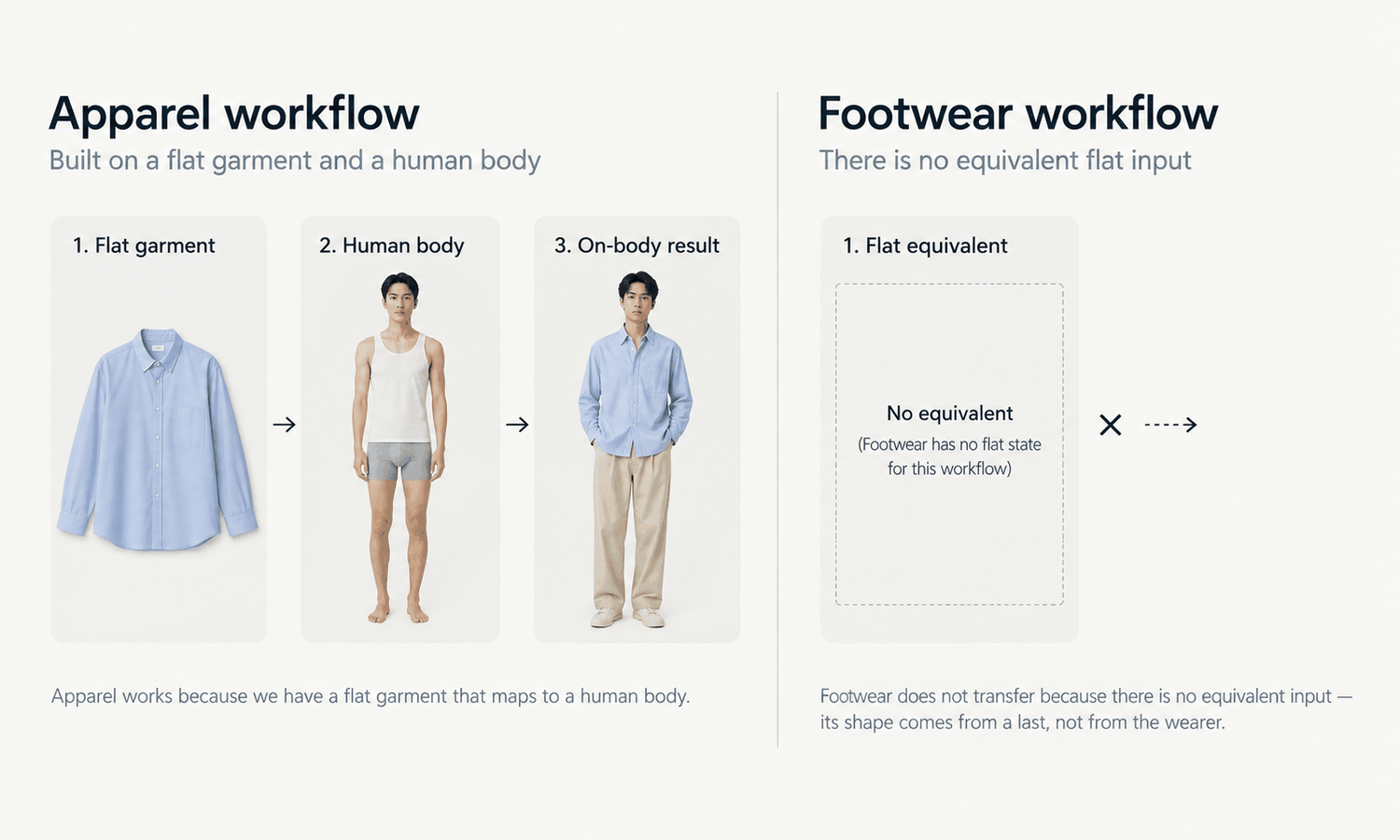
A studio of five sells apparel and a small footwear line, and somebody asks whether the generated imagery working well on the clothing side can be pointed at the shoes. It is a reasonable question and it has a short answer, which is no, and a longer answer about why the two are not the same problem.
The longer answer is worth having, because the same reasoning tells a small studio which of its other categories will scale and which will keep costing what they cost now. Adoption is not a yes or no about a studio. It is a list, category by category, and most of the disappointment in small studios comes from treating it as a single decision.
The scaling question is a category question
| Category | What a single capture supports | What still needs a camera |
|---|---|---|
| Simple woven and knit bodies | Colorways, stylings, and channel versions derived from one flat capture | The capture itself, and the hero frame if there is one |
| Prints and placement graphics | Colorway exploration and layout direction, checked against the spec | Anything where repeat scale has to be confirmed rather than proposed |
| Sheer, lace, and open-work | Very little, since what shows through is the point and is also the documented difficulty | Most of it |
| Heavily layered styling | Looks planned around few overlaps; each additional overlap costs review | Anything where several pieces cross each other |
| Footwear | Nothing. The apparel workflow does not cover it | All of it, planned and budgeted as a shoot |
Read the table as a budget rather than as a verdict. A small studio has a fixed amount of attention for changing how it works, and the return on spending it differs enormously across the rows. Spending it on the rows at the bottom is how a studio ends a season having changed a lot and saved nothing.
What actually scales: capture once, derive many
The apparel categories that scale share one property. The garment can be photographed flat, completely, and consistently, and everything downstream is a derivation from that single capture rather than a new photographic event.
That is what makes the economics work. One disciplined capture of a body supports several colorways, several stylings, and several client or channel versions, and each of those derivations costs a fraction of what a reshoot costs. The colorway and fabric variants in that set run from the one approved base rather than from separate jobs — see Design with Purpose. A studio that gets this right stops thinking about cost per image and starts thinking about cost per body, which is a much smaller number of things to manage.
The condition attached is stricter than it looks. Derivation only works if the capture was neutral and complete — one shoulder line, one distance, one background, one light, held across a collection. Variation entering at capture cannot be derived away, and it is invisible in any single image while being obvious across a set. In Lightchain AI (apparel AI), keeping the capture beside the outputs it produced is what lets a badly captured body be traced to everything derived from it rather than found by accident three weeks later.
Footwear does not transfer, and the reason is structural
The apparel workflow does not cover footwear. That is not a gap waiting to close in the next version, and a small studio planning around it as though it were will plan badly.
A garment is a flexible material that takes its shape from a body. That is exactly the relationship the apparel workflow is built around: a flat piece of cloth, a form, and the way the first meets the second. A shoe is a rigid constructed object with its own fixed geometry, built on a last, whose appearance is governed by that construction rather than by how it falls over anything.
The differences follow directly and none of them is small. There is no flat-lay equivalent for a shoe, so the input that the whole apparel method depends on has no counterpart. The visual language of footwear is form, proportion, and material under a fixed shape rather than drape. And the shoe carries its identity in a set of small hard details on curved surfaces — the sole unit, the stitching, the eyelets, the logo placement — which is a much harder reconstruction problem concentrated on a much smaller object.
Naming this plainly is more useful to a studio than hedging it. A category that will not scale should be planned as a category that will not scale, budgeted for photography, and left off the list of things anybody is trying to fix.
The detail problem is worse on a small rigid object
Detail failure is the same failure mode across every category and it does not scale linearly with the size of the object. On a jacket, a wrong stitch count on a pocket occupies a small part of a large frame and reads as texture. On a shoe, the details are most of what the customer is looking at, and there is nowhere for an error to hide.
The rule does not change with the category. Logos, printed text, care labels, and small hardware get compared against the source image on every single output, without exception. Reconstructed detail lands almost right — a letterform slightly off, a stitch count wrong, a piece of hardware the wrong shape — and almost right survives an appreciative look and fails in front of whoever knows the product.
This is a good argument for keeping the check strict on the apparel side too, and a small studio is where it gets negotiated away first, on the grounds that everybody is looking at the images anyway. Looking is not comparing. Converting an approved look into a line drawing or a tech-sheet draft through the Design & Production Workbench forces the same detail decisions to become explicit, and those outputs are drafts that a technical designer still has to review.
What no image settles, in either category
The output is a visual asset. It does not predict fit, determine sizing, model how a fabric behaves in motion, or forecast returns. Those come from measurements, a graded pattern, a physical sample, and your own data.
Footwear puts more distance between an image and a fit answer, not less. Shoe fit is length, width, volume, and the shape of the last, and three of those four are properties of an interior that no photograph of an exterior contains. A studio that would not claim a fit answer from a garment image should be more careful still with footwear rather than less, since the visual convincingness of a rendered shoe is unrelated to whether it fits anybody.
Color has the limit it always has, and a small studio meets it in front of a client. Screen color is not a physical reference, exact code matching is not something to promise, and the gap between a monitor and a roll of cloth stays open regardless of display quality. Colorways get settled by strike-offs against an agreed standard, and values must never be read off a generated asset and sent onward.
Where a small studio should put the saved effort
The point of naming what will not scale is that it frees a decision about the rest.
-
Put the process effort into apparel bodies that appear more than once a season, since those are where derivation pays repeatedly rather than once
-
Budget footwear as photography, plan it as a shoot, and stop treating it as a thing somebody will solve
-
Spend part of what apparel saves on shooting the shoes properly, which is usually the first time the footwear line has had a proper budget
-
Keep one written capture standard for the apparel side and one shot list for the footwear side, rather than one confused process covering both
-
Revisit the category list once a season, not once a month, so the split stops being reopened by whoever is under pressure that week
Making the split explicit also changes what the studio says to clients, which matters more than it sounds. A studio that can state which categories it produces conventionally and which it derives is describing a method rather than defending a shortcut. Going from an idea to a finished asset quickly is a real advantage on the rows where it applies, and claiming it on rows where it does not is how a studio loses the credibility it earned on the others.
Whether a studio runs colorway and fabric work through Lightchain AI or through a camera, the category list is the same list. The tool changes what each row costs. It does not move a row from one column to the other.
Frequently asked questions
Could we photograph shoes and use them as source images anyway?
The apparel workflow is built for garments and does not cover footwear, so a shoe photograph has nothing to be a source for. Time spent testing this is time not spent on the apparel bodies where the same effort compounds. Shoot the footwear line as a shoot and put the process work where it returns something.
We only have six apparel styles a season. Is derivation worth it?
The number that matters is repetition rather than count, so ask how many of the six appear in more than one colorway, channel, or client version. Six bodies each appearing in four versions is twenty-four derivations from six captures, which is worth the discipline. Six bodies each appearing once is not, and a studio in that position should keep shooting.
What about bags, belts, and other accessories?
They sit closer to footwear than to apparel: rigid or semi-rigid constructed objects whose identity is in hardware and finish rather than in drape. Treat them as a photography category by default and test individually rather than assuming the apparel result transfers. The test is cheap and the assumption is expensive.
Should we tell clients which images were generated?
Yes, as a standing line in the proposal rather than a case-by-case decision, and it is easier to state alongside the category split. Saying that apparel is derived from a controlled capture and footwear is photographed reads as method. Discovering it later reads as something that was being kept quiet.
Our footwear line is small. Can we skip photographing it well?
A small line is where each image carries more weight, since there are fewer of them and every one is doing more work. The saved effort on the apparel side is precisely what makes a proper footwear shoot affordable for the first time. Skipping it spends the saving on nothing.
Does the category list change as products improve?
Some rows will move and the structural ones will not, so revisit the list on a product update rather than on a schedule. Keep the previous version so a change can be seen rather than assumed. A row that moved is worth a small test; a row that did not is worth leaving alone.
In closing
Adoption in a small studio is not one decision and should never be presented internally as one. Some categories scale because a flat, complete, consistent capture can be derived from many times over. Footwear does not, for reasons that sit in what a shoe is rather than in how good any output looks, and the apparel workflow does not cover it. Write the category list, budget the rows that will not scale as photography, and spend the saving there. A studio that knows which of its categories are which is more useful to a client than one that believes everything changed.
Start here
Write your categories in one column and, next to each, how many times a single capture would be reused in a season. The rows with a number above one are where process effort returns something; the rows with a one, and the footwear row regardless, are photography. That list takes twenty minutes and it will settle arguments that would otherwise run all season. Then put the whole saving from the top rows into shooting the bottom ones properly.
**Start with fabric and colorway work → **https://www.lightchainai.com/global/solutions/designWithPurpose