
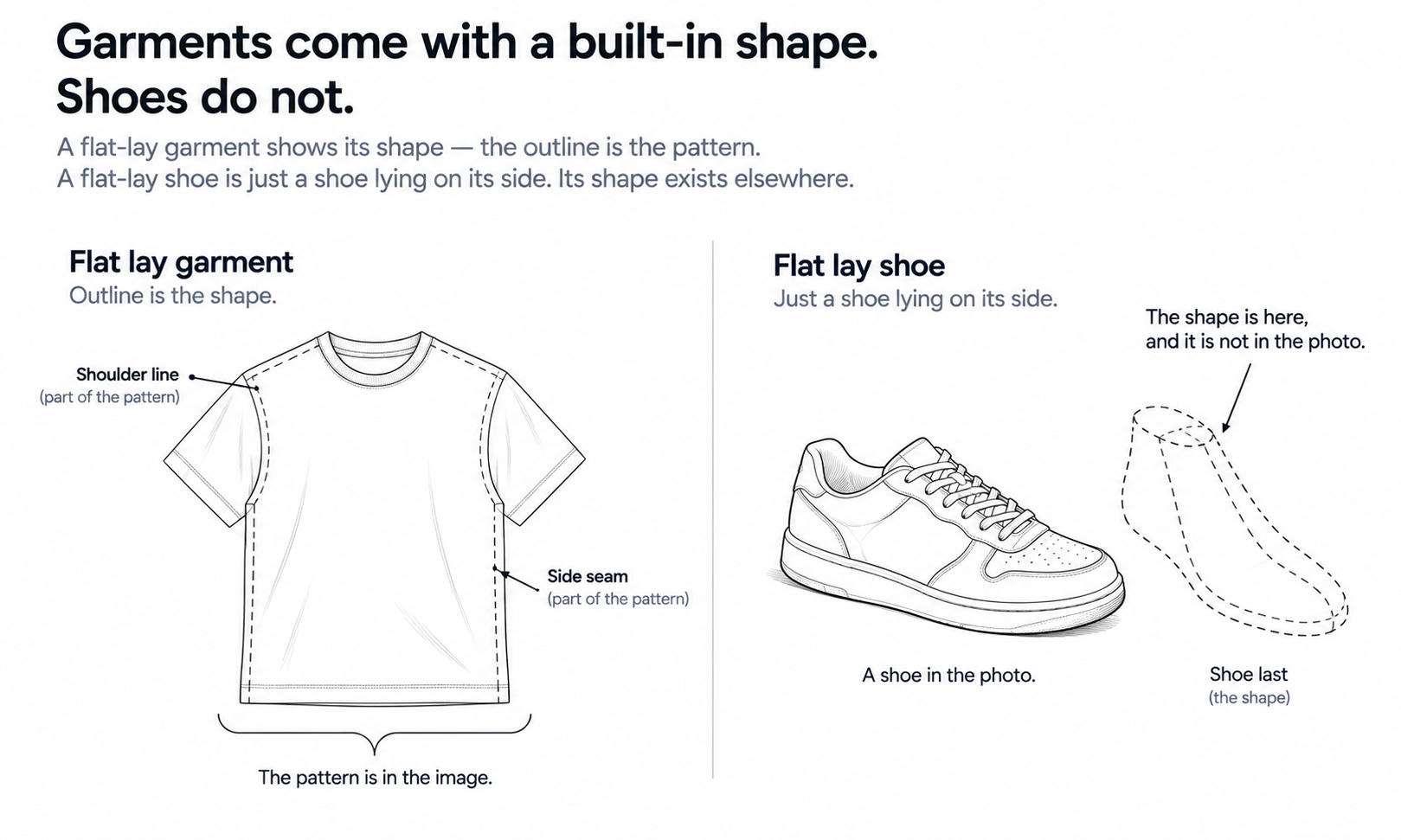
A direct-to-consumer footwear brand looking at this class of workflow will find a clean answer quickly, and it is worth giving it plainly: footwear is not covered.
That is not a gap waiting for a version to close, and it is not a matter of results being poor in this category. It is that the input the method depends on does not exist for a shoe.
The rest of this is the mechanical reason, what a footwear brand can genuinely use, and what the alternatives actually require.
What the method needs, and what a shoe provides
| What the method needs | What a garment provides | What a shoe provides |
|---|---|---|
| A flat state that carries the shape | A laid-out garment. The outline is the pattern and the seams sit where they sit | Nothing equivalent. A shoe photographed flat is a shoe lying down |
| Surface readable from one view | Most of it, since a garment is largely a surface | Partly. Much of a shoe is structure rather than surface |
| Markings in a checkable position | Prints, labels, trims, visible on the laid-out piece | Present, but on a form rather than on a flat plane |
| A fit answer | Not provided. It comes from measurements and a fitting | Not provided, and further away: length, girth, volume and last shape are internal |
The first row is the whole answer. Everything the apparel method does begins with a garment laid flat and photographed complete, because a laid-out garment carries its own shape: the outline is the pattern, and the seams sit where they sit.
A shoe has no equivalent state. It is a rigid object built on a last, and photographing it flat is photographing a shoe lying down, which shows one view of a three-dimensional object rather than the object's own shape laid out.
Why this is structural rather than a version gap
The distinction matters because the two get planned for very differently. A weak spot is something to route around this season and retest after a product update. A structural absence is something to plan permanently.
Try on shoe capability sits in the second category. The method takes a flat garment image and produces the garment on a figure; a footwear equivalent would need a different input, which means a different method, not a better one. Waiting for it is waiting for a different product rather than for an improvement to this one.
Two consequences follow for planning. There is no retest to schedule, because nothing about the input changes. And there is no partial adoption to attempt: this is not a category where results improve with a better capture, since the capture that would help does not exist.
What a footwear brand can actually use
Most footwear brands are not only footwear brands, and the useful answer is about the rest of the range.
Apparel in the range works normally. So do flat, laid-out accessories where a laid-out state carries the shape — scarves, some bags, belts as flat items. Those pieces sit inside the method without qualification, and a footwear-led brand often has more of them than it thinks.
There is a second thing that transfers, and it is worth naming because it is easy to miss while the answer about footwear is being absorbed. Whatever a footwear brand learns about capture standards, identity fields and checking outputs against sources applies to the apparel side without translation. A brand that builds those habits for its garments has built them for its whole imagery operation, including the parts that will always be photography. In Lightchain AI (apparel AI) or in any similar arrangement, the discipline is the transferable asset rather than any particular output.
The capture discipline transfers even where the method does not. A repeatable position, distance, background and light is worth building for footwear photography for the same reason it is worth building for garments: it makes a range read as one set rather than as several sessions, and it makes any downstream work comparable. That is a photography investment rather than a workflow one, and it pays regardless.
For anything heading toward production, a line drawing or tech-sheet draft in the Design & Production Workbench is a construction document rather than a presentation one, and those outputs remain drafts a technical designer reviews.
What the alternatives actually require
Two other routes exist for footwear visualization, and both need something a photograph does not provide.
A three-dimensional asset route builds the shoe as geometry. That is real work per style, done by people with that skill, and it repays through reuse across colorways and seasons if the library is maintained. It is a different capability with a different team, and a footwear brand evaluating it should evaluate it on its own terms rather than as a substitute for something unavailable.
An augmented reality experience sits downstream of that, because it needs an asset to place. Choosing it means choosing the asset route underneath as well, which is the dependency most often discovered mid-schedule rather than at the start.
There is a sequencing point worth making about both. A brand evaluating either route usually starts from a picture of the outcome — a shopper rotating a shoe, or seeing it in a room — and works backwards. Working forwards from what has to be built first produces a different and more useful conversation, because the asset is the long pole and the surface is the short one. Deciding the surface before the asset is the most common way a footwear visualization project acquires a dependency nobody scheduled.
Neither is being recommended or discouraged here. The point is that both are asset-creation projects rather than image-derivation ones, and their cost shape is front-loaded in a way this workflow's is not.
What no route supplies
Worth stating because the original question about footwear is often really a question about outcomes.
Any output from any of these routes is a visual asset. It does not predict fit, determine sizing, model how a fabric behaves in motion, or forecast returns. Those come from measurements, a graded pattern, a physical sample, and your own data. Footwear fit is length, girth, volume and last shape, and three of those four are internal properties an external image of any kind does not contain.
Nor can any of it be scoped against a conversion or return-rate outcome. Those figures sit at the end of a chain running through sizing, price, assortment and traffic, and published reviews of this field report conflicting findings rather than a settled effect. A return-on-investment case built on a conversion number is a case built on something nobody can currently establish, which is why it collapses the first time somebody asks for the source.
Color has its own limit across every route. Screen color is not a physical reference, exact code matching is not something to promise, and the gap between a monitor and a roll of material stays open regardless of display quality. Shades get settled physically against an agreed standard.
Where the budget actually goes for D2C footwear
If the question was how to improve what a shopper sees, the answers for footwear are unglamorous and available now.
-
Photograph to a repeatable standard, since consistency across a range is the single most visible improvement and it is a photography decision
-
Publish internal measurements rather than only a size conversion, because footwear fit is length, girth and volume and shoppers can compare against a shoe they own
-
Show the pieces of the range that do sit inside the derivation method, since that is where an imagery budget currently buys the most
-
Treat a 3D route as an asset-creation project with its own team and timeline, priced on reuse across colorways and seasons
-
Keep the shade decision physical, whichever route produces the images
Deciding colorway direction still benefits from being made early, and for the apparel and flat accessories in a footwear brand's range that decision can be explored the same way it would be anywhere else. In Lightchain AI (apparel AI) the uploaded source stays beside every output derived from it, which applies to those pieces and not to the shoes. Across a catalog the honest position is that part of the range is served and part is not, and knowing which is which is worth more than a partial attempt at both.
Frequently asked questions
Will footwear be supported later?
A supporting method would need a different input than a flat photograph, which makes it a different capability rather than an improvement to this one. Planning around it as though it were imminent is planning around a product that does not exist yet.
What about photographing a shoe from many angles?
More views of the outside give more of the outside. Footwear fit is largely internal — length, girth, volume and last shape — and additional external views do not reach any of those. It reduces what has to be produced without adding a new kind of information.
Are bags and accessories covered?
Flat, laid-out items where the laid-out state carries the shape generally behave like garments. Structured bags built on a form behave more like footwear. Sort by whether a flat state exists rather than by whether it is called an accessory.
Can we at least use it for our apparel line?
Yes, and that is usually the largest available gain for a footwear-led brand, since the apparel and flat accessories sit inside the method without qualification. Start there rather than attempting a partial footwear adoption.
How should we present shoe fit to shoppers?
Publish internal measurements — length, and girth or width where you have it — rather than only a size conversion table. Shoppers can compare those against a shoe they already own, which is the same mechanism that works for garment measurements.
What would an honest business case look like?
One built on production cost rather than on conversion: what a set of images currently costs per style, and what it would cost by another route. Conversion effects are not currently establishable from the published evidence, so a case resting on them rests on an open question.
In closing
Footwear sits outside this workflow because a shoe has no flat state that carries its shape, and that is a property of shoes rather than a stage of development. The practical response is to plan permanently rather than to wait: use the method for the apparel and flat accessories in the range, build a repeatable photography standard for the footwear because consistency is visible and available now, and treat a three-dimensional route as a separate asset-creation project if it is worth it on its own arithmetic. What no route supplies is a fit answer or an establishable conversion effect, and a business case is stronger without either.
Start here
Sort your range by whether each item has a flat state that carries its shape. The apparel and flat accessories go in one column and the footwear in another, and the first column is where an imagery decision is available today. Most footwear-led brands find that column larger than expected, and it is the part of the question that has an answer this quarter. The footwear column is a photography decision, and that one is available too.
**Start with catalog-scale asset work → **https://www.lightchainai.com/global/solutions/scaleECommerce