
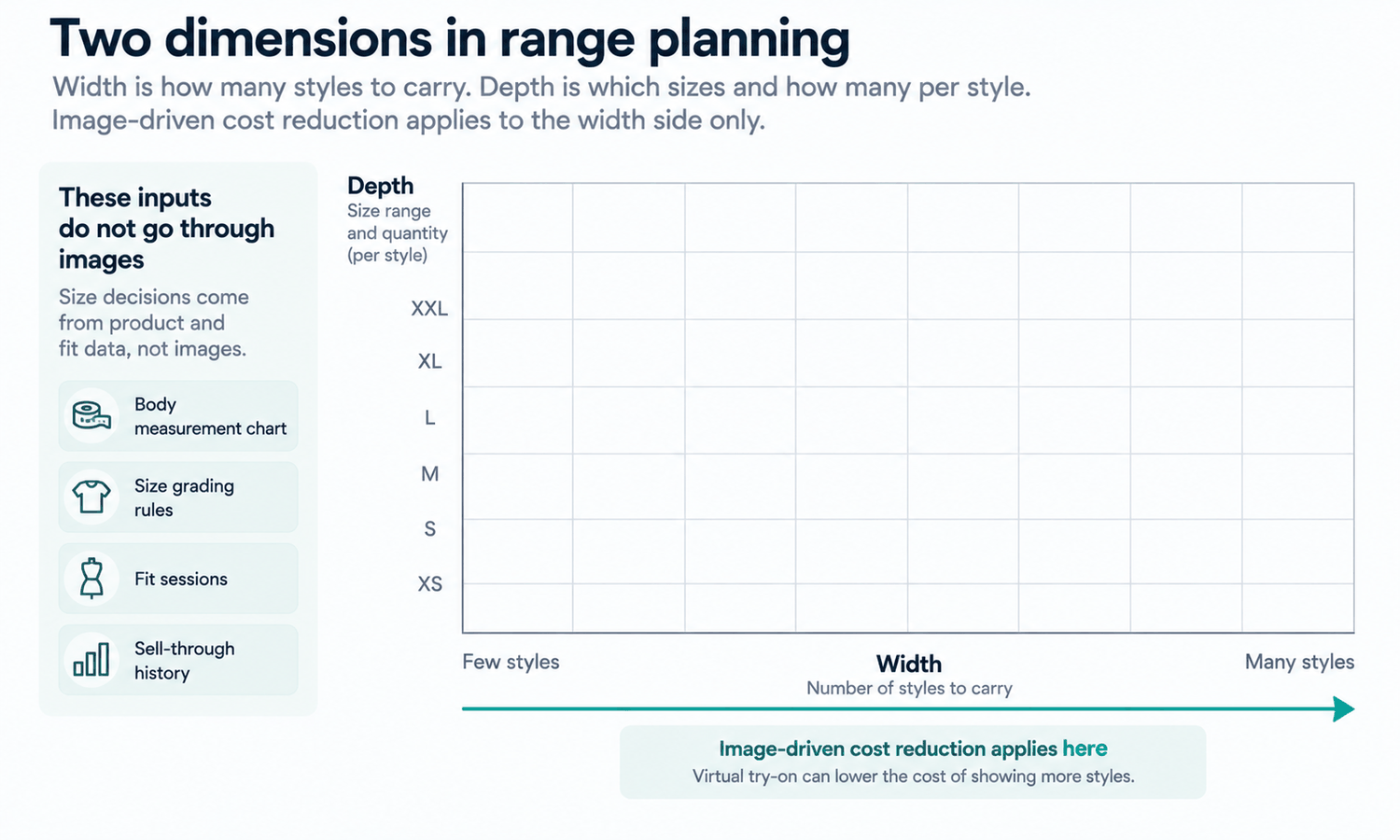
A range planner hearing that imagery got cheap has two different hopes, and only one of them is available.
The first is that a style which just missed the range might now be carriable, because the cost of showing it fell. That is a real possibility and it is testable on one style. The second is that something about try on for size gets easier — that the size curve, the depth, or the range of sizes carried might be informed by what these images show. That one is not available at any price, and the reason is worth understanding before a season is planned around it.
Separating those two before running any test is what makes the test worth running.
Two hopes, one of them available
| The hope | Is it available | Where the answer comes from |
|---|---|---|
| A marginal style becomes carriable because showing it costs less | Yes, if the cost of showing was the binding constraint | A test on one style, measuring cost per usable set and category stability |
| We can carry more styles overall | Partly, and the next constraint is review capacity rather than imagery | Your own review hours, counted per week rather than assumed |
| The size curve can be informed by what the images show | No | The measurement chart, the grading, the fit sessions, and sell-through history |
| We can extend the sizes we carry more easily | No. Extension is a grading and fit commitment first | Grading work and fit sessions, neither of which imagery shortens |
| A colorway can be committed to from what we see | No. It narrows what to sample | A strike-off against an agreed standard |
The distinction is between a decision about breadth and a decision about depth. Breadth — how many styles, in which categories — has a cost of showing attached to it, and that cost moved. Depth — which sizes, how many of each — is decided from measurements, grading, and what sold through last time, and none of those three passed through an image.
That is why a range planner's test should be built around the first row and should say nothing about the second.
Which cost was actually binding on the style you cut
Before testing anything, work out why the style did not make the range. There are usually three candidates and they behave completely differently.
If it was cut because sampling cost or a fabric minimum could not be justified at forecast volume, imagery changes nothing. The commitment happens before any image exists, and the constraint sits with the mill and the sample room.
If it was cut because the cost of photographing it could not be justified — a style that needed its own shoot for a small forecast — then the cost that moved is the one that was binding, and the style is a genuine candidate for reconsideration.
If it was cut because nobody had capacity to manage another line, the answer is more complicated, since cheaper imagery adds to that load rather than reducing it. Every additional style adds review work, and review is the constraint that grows with breadth.
Most planners find their cut list contains all three, and sorting it takes an hour. That sort is worth more than the test that follows, because it tells you which styles the test can even speak to.
The one style to test, and what the test measures
Pick the marginal style: the one that just missed, in a category where the photography cost was the binding constraint. Not the most interesting style, not the one somebody wants to revive, and not an easy style from a category that already works.
Then measure the thing that matters to a range decision rather than the thing that is easy to look at.
-
What it costs to produce a usable set of images for that style, counting attempts and review minutes rather than a list price
-
Whether the category holds: run the same prepared source three times unchanged and look at whether the result is stable, since an unstable category cannot carry a style at low forecast volume
-
Whether the on-model output can stand alongside the rest of the range on a collection page, because a style that reads as belonging to a different brand costs more than it earns
-
What the style adds to review load per week, which is the constraint that will bind next if breadth increases
-
Whether the colorway and fabric direction for the style is settled enough to show, since exploring it is cheap and committing to cloth is not
-
Whether the fabric is in a documented weak spot — lace and open work, sheer fabrics, complex prints, and heavily layered looks belong with photography, and a style in that group is not a candidate regardless of forecast
Logos, printed text, care labels, and small hardware get compared against the source image on every single output, without exception, and the minutes that takes belong in the cost figure rather than outside it. Reconstructed detail lands almost right — a letterform slightly off, a stitch count wrong, a zipper pull the wrong shape — and a marginal style with a low forecast is exactly the one where a team is tempted to skip the check.
What the test cannot tell you about the size curve
The output is a visual asset. It does not predict fit, determine sizing, model how a fabric behaves in motion, or forecast returns. Those come from measurements, a graded pattern, a physical sample, and your own data. That is a property of what the asset is rather than a limitation of any result, and no volume of imagery moves it.
For a range planner the consequence is specific and worth stating in the plan rather than assumed. A size curve is built from the measurement chart, the grading, the fit sessions, and sell-through history in that category. Nothing in a generated image contributes to any of those four. A style shown convincingly across a size range on screen has demonstrated appearance and nothing about how those sizes will perform.
The same applies to the decision about how many sizes to carry. Extending a range up or down is a grading and fit commitment before it is a merchandising one, and imagery cannot shorten the fit work that extension requires.
Color belongs here because it reaches the buy. Screen color is not a physical reference, exact code matching is not something to promise, and the gap between a monitor and a roll of cloth stays open regardless of display quality. Colorways get settled by strike-offs against an agreed standard, so a colorway explored on screen narrows what to sample rather than confirming what to buy.
What a positive result actually licenses
Suppose the test comes back well. The style can be shown at a cost the forecast supports, the category is stable, and the images sit alongside the range.
What that licenses is carrying that style. What it does not license is a general expansion of breadth, and the difference matters because the second-order costs of breadth are not visual. More styles means more review, more identity fields to maintain, more product pages, more stock decisions, and more of the long tail that consumes attention while contributing little. A cheaper cost of showing removes one constraint and leaves the others in place.
There is a specific version of this to watch. If the reason a style was marginal is that demand for it was uncertain, cheaper imagery has not reduced that uncertainty. It has only made it cheaper to find out, which is genuinely useful and is a different claim. Deciding what a season carries still rests on the forecast rather than on the asset cost.
Whether the work runs through Lightchain AI or a camera, the range decision has the same inputs it always had, with one of them cheaper.
Recording the verdict so it survives the season
A test result that lives in somebody's memory gets relitigated in three months, usually in the week when nobody has time for it.
Write the finding as a sentence about a category rather than a verdict about a style or a tool. Something like: styles in this category can be shown at a cost supporting a forecast of this size, provided the source is captured to the standard, and the fabric group holds. That statement survives being repeated to somebody who was not in the room.
Keep the source photographs and the outputs together so a rerun after a product update is a comparison rather than a fresh opinion. In Lightchain AI (apparel AI) the uploaded source stays beside what AI Virtual Try-On produced from it, which is what makes a later rerun comparable. And record the categories that were ruled out with the reason next to each, so the same style does not return to the cut list debate every season with nobody able to say why it left.
Frequently asked questions
Can we use this to decide whether to extend our size range?
No. Extending a size range is a grading and fit commitment, and the work it requires is measurement and fitting rather than imagery. Showing a garment convincingly at a larger or smaller size demonstrates appearance and contributes nothing to whether the grade holds.
Which style should we test if several are marginal?
The one in the category you expect to use most next season, since the finding is a category verdict rather than a style verdict. Testing a style from a category you will not repeat produces information with nowhere to go. Choose for reuse rather than for interest.
What if the test result is good but the forecast is still weak?
Then the binding constraint was never the imagery, and carrying the style is a demand decision that has not changed. Cheaper showing makes it cheaper to find out whether demand exists, which is a reason to test the market rather than a reason to commit depth.
Should the test include a size range?
Include whatever sizes you would actually show, for appearance and styling purposes only. Keep the size curve decision entirely separate and sourced from the measurement chart and sell-through. Mixing the two on one page is how an appearance result gets read as a sizing result.
How does this affect the long tail?
It lowers the cost of showing tail styles and raises the total review load, which are opposing effects. Work out the second before acting on the first, since review capacity is what usually binds after breadth increases. A tail that grows faster than review capacity produces unchecked pages.
Do we rerun this every season?
Rerun after a product update or a change to your capture standard rather than on a schedule, and keep the original test set so the second run is a comparison. An unchanged setup retested each season returns the same answer at a cost. Record the trigger alongside the verdict.
In closing
Two questions arrive together and only one has an answer. Whether a marginal style can be carried now that showing it costs less is testable on one style, and the test is about cost per usable set, category stability, and whether the images sit alongside the range. Whether the size curve or the sizes carried should change is not touched by any of this, because those come from the measurement chart, the grading, the fit sessions, and sell-through. Test the first, source the second where it has always come from, and keep them separate in the plan.
Start here
Sort last season's cut list into three columns before testing anything: cut on sampling or fabric minimums, cut on the cost of showing it, and cut on capacity to manage it. Only the middle column can be reopened by cheaper imagery, and it is usually shorter than expected. That sort takes an hour and it tells you whether there is a test worth running at all.
**Start with catalog-scale asset work → **https://www.lightchainai.com/global/solutions/scaleECommerce