
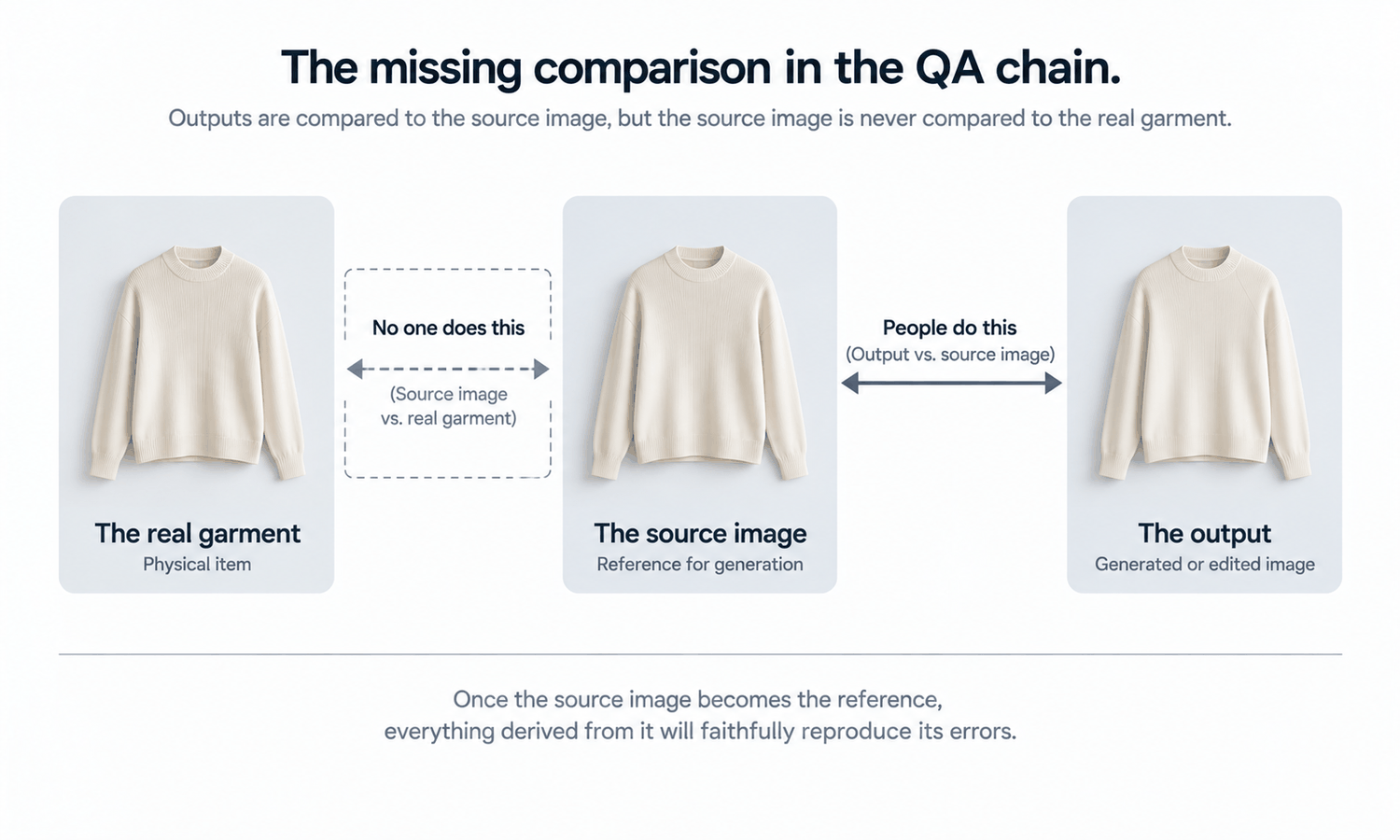
Accuracy in this area gets measured on whatever is easy to measure, which is a single output compared against the file it came from. That check is real and worth doing. It is also narrower than the word accuracy suggests, and what falls outside it is missed systematically rather than at random.*
Somebody looking for free try on clothes tooling usually reaches this question at the point where the volume of imagery has grown past what anybody is casually eyeballing. The useful move at that moment is not a stricter check. It is knowing which three things the check has never covered.
What the check covers, and against what
| What is measured | What it is measured against | What that leaves out |
|---|---|---|
| Details in a single output: logos, printed text, care labels, small hardware | The source photograph the output was derived from | Whether the source photograph itself represents the garment |
| Print position and repeat | The source and the specification | Nothing much. This one is genuinely covered |
| Whether an image is good | The campaign direction and the reviewer's judgment | Everything that is a property of the set rather than of one image |
| Nothing, routinely | — | Whether the published file still matches the file that was approved |
The second column is the one worth staring at. Every routine accuracy check compares an output against a source photograph, and everything the source photograph itself gets wrong passes through as correct.
The three gaps below follow from that structure. None of them is a failure of attention, and adding a stricter version of the existing check reaches none of them.
The gap nobody owns: the source against the garment
The conformity check answers whether the output matches the source. Nobody answers whether the source matches the garment.
That question has an owner in a traditional photography workflow, because the person shooting has the garment in front of them and sees the result on a screen in the same session. In a derived workflow the source is captured once, often weeks earlier, and everything after that compares against the file rather than against the cloth. A shoulder line that photographed short, a color cast from the light, a trim that sat wrong on the day — each of those becomes the reference, and everything derived from it is faithfully wrong.
The correction is small and almost never scheduled: compare the source photograph against the physical garment once, at capture, before it becomes the reference for everything else. That takes seconds while the garment is still on the table and is impossible afterwards. Where a body recurs across colorways and seasons, that one check is inherited by every image derived from it, which makes it the minute that returns the most in the whole process.
The gap between images: consistency across a set
The second gap is invisible by construction. Every image in a set can pass its own check and the set can still be wrong, because consistency is a property of the collection rather than of any member of it.
A collection page is a comparison whether or not anybody designed it as one. Drift enters when a model direction changes midway, when a batch runs with different settings, or when one style is rerun after a fix and comes back subtly different. No single image is defective. Reviewed one at a time, all of them pass.
So the check that catches this is a different action rather than a stricter one: open the set together, at the size a customer sees it, and look at the set rather than the images. Across a catalog at scale this is the only defect that a final look can still catch cheaply, and it is the one most likely to be skipped because every individual image has already been approved.
The gap after the file leaves
The third gap opens once the asset is out of your hands. Files get cropped for channels, compressed to hit page weight, processed on ingest, and retouched for a version somebody needed.
Each of those can undo what the check verified. Compression aggressive enough to hit a target can degrade the small features that were compared — a care label becomes illegible, a printed mark loses its edge — and the image still looks correct at page size. A crop that removes a hem changes what the image asserts. A platform's own color handling adds a second gap on top of the one between screen and cloth.
The measurement gap here is that accuracy was established on the master and nobody re-establishes it on what is live. Taking one approved on-model output through to a live listing on each channel and comparing it against what was approved is a small exercise that reports on a large surface. Where one region has degraded and the rest is sound, a targeted correction is smaller than a rerun, though a compression problem is a settings question rather than an image one.
What cannot be measured at all
Three gaps can be closed. A fourth cannot, and it is worth separating from the others so that effort does not get spent there.
The output is a visual asset. It does not predict fit, determine sizing, model how a fabric behaves in motion, or forecast returns. Those come from measurements, a graded pattern, a physical sample, and your own data. No accuracy check reaches any of them, because they are not properties of the image and a more accurate image is not closer to containing them.
So an accuracy program cannot validate a size chart, and fit language has to trace back to the measurement chart and the fit session rather than to how carefully the imagery was checked. And no accuracy result can be presented as the reason a return rate moved, since that rate sits at the end of a chain running through sizing, price, assortment, and traffic. A well-run check prevents a specific kind of mismatch; it does not license a causal claim.
Color cannot be measured on screen either. Screen color is not a physical reference, exact code matching is not something to promise, and the gap between a monitor and a roll of cloth stays open regardless of display quality. Colorways get settled by strike-offs against an agreed standard, so a check can confirm that a colorway pass produced usable candidates and cannot confirm a shade.
Footwear is not covered by this class of workflow, and lace and open work, sheer fabrics, complex prints, and heavily layered looks are documented weak spots. Those are category verdicts rather than accuracy findings.
Closing three gaps without adding a review layer
None of the three closable gaps needs a new review stage, which matters because a new stage is the thing that gets dropped first.
-
Check the source against the garment at capture, while the garment is still there. One minute per body, inherited by everything derived from it
-
Look at the set together once before publishing, at full size, as a separate action from reviewing images
-
Take one asset per channel through to a live listing and compare it against the approved master, once per channel rather than once per asset
-
Keep the per-output comparison exactly as it is, since it does the job it was built for and none of these gaps is its fault
-
Record which of the three you are not doing, so a defect found later has a candidate cause rather than an argument
The per-output check stays fast only if the source is adjacent. In Lightchain AI (apparel AI) the uploaded source sits beside every AI Virtual Try-On output derived from it, which is what keeps the routine comparison at seconds rather than minutes — and a check at seconds survives a busy week while the same check at minutes does not. Whether the work runs through Lightchain AI or a camera, the three gaps are the same three.
Frequently asked questions
Is there a free version of this kind of tool?
Terms change, so read the current listing rather than relying on any article including this one. What does not change is that the checks described here cost the same regardless of what generation costs, and two of the three require no tooling at all.
Which gap should we close first?
The source against the garment, because it is the cheapest and everything derived inherits it. It also has no owner in most workflows, which means closing it does not compete with anybody's existing responsibility. One minute at capture, on the bodies that recur.
How do we check a set without reviewing every image again?
Open the collection page as a shopper would and look at the set rather than the images. You are looking for drift between styles, not for defects within them, which is a different act of attention and much faster. It catches what per-image review structurally cannot.
Our images pass every check and customers still report mismatches. Why?
Check the source against the garment first, since a faithful derivation from an inaccurate source passes every downstream check. Then check what is live against what was approved. Those two account for most cases where the checking is sound and the outcome is not.
Does a stricter per-output check help?
Not with these three, since none of them is caused by the per-output check being too loose. Tightening it costs review time and reaches nothing new. Spend the same attention on the gaps instead.
Should we measure accuracy as a score?
Record it as pass or fail per output and as a separate note for each of the three gaps, rather than as a single figure. A composite score averages things with different causes and different fixes, and it invites a target that people will manage toward rather than a defect they will find.
In closing
The routine accuracy check compares an output against a source photograph, which leaves three things structurally uncovered: whether the source represents the garment, whether the set holds together, and whether what is live still matches what was approved. None of the three is caught by checking harder, and all three are cheap to close because two of them are separate actions rather than additional review. Around them sits a fourth gap that no check reaches at all, and knowing which one that is stops effort being spent where it cannot pay.
Start here
Take one body that appears in several colorways and answer one question: has anybody ever compared its source photograph against the physical garment. In most workflows the answer is no, and that source is the reference for every image derived from it. Checking it now costs a minute and is the only one of these gaps that gets harder every week it stays open, since each derived image makes the reference more expensive to correct.
**Start with the on-model workflow → **https://www.lightchainai.com/global/solutions/aiVirtualTryOn