
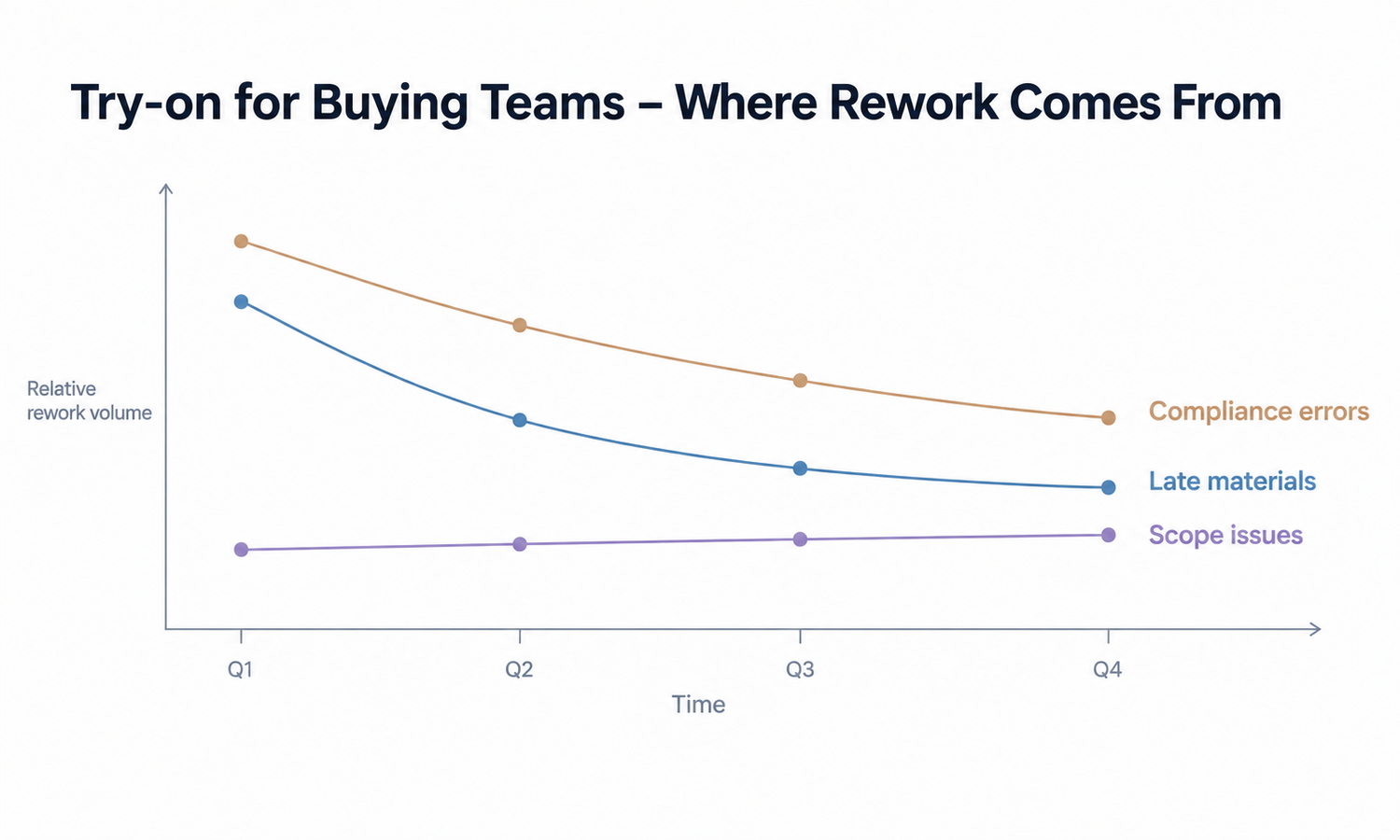
Rework in a buying team looks different from rework anywhere else. Nobody redoes an image. What gets redone is a decision — a colorway reselected, an order quantity revised, a range plan reopened three weeks after it closed.
That kind of rework is expensive because it propagates. A single reversed selection pulls in merchandising, planning, and often the supplier, and it arrives after everyone has moved on to the next thing. Understanding where it originates is more useful to a buyer than any assessment of image quality.
It is also worth being precise about who absorbs it. The buyer carries the conversation, merchandising carries the replanning, and the supplier carries a changed order they had already begun to schedule. Three teams pay for one reversal, which is why the sources are worth separating rather than treating rework as a single unfortunate category.
Three sources, in order of cost
The first is a selection made from a visual that the physical product later contradicts. This is the expensive one, and it concentrates in a predictable place: fit, hand, and true color, none of which an image can settle.
The second is a selection made from a visual that turned out to depict something other than the specified product — a different closure, a wrong pocket, a print at the wrong scale. Rarer, and it reaches further, because the buy was placed against something that does not exist. Where it survives to delivery it becomes a customer-facing discrepancy rather than an internal correction, which puts it in a different cost category entirely.
The third is a selection nobody made, because the imagery for a style arrived after the range review and the style dropped out by default. That one leaves no trace and nobody counts it, which is why it persists.
Why the first source is a scope problem
A buyer looking at a convincing on-model image is receiving a genuine answer to one question and an implied answer to several others.
The genuine answer is what the garment looks like on a body. The implied answers concern how it will sit, how the fabric will move, and what the color really is — and the image supplies none of those while looking as though it does. The output is a visual asset. It does not predict fit, determine sizing, model how a fabric behaves in motion, or forecast returns. Those come from measurements, a graded pattern, a physical sample and your own data. Screen color is not a physical reference either: a colorway direction shown on a monitor is a shortlist rather than an approval, and it is settled by a strike-off against an agreed standard. An image narrows the candidates and stops there.
Rework from this source is not caused by poor imagery. It is caused by a good image being asked a question outside its scope, which means better imagery will not reduce it. Only a narrower decision will.
The counterintuitive consequence is that improving image quality can make this source worse. A more convincing image invites more confidence, and confidence is exactly what leads a buyer to settle a question the image was never able to answer. Teams that adopt better imagery and keep the same decision scope frequently see this category rise.
The scope line, written once
Buying teams that avoid this category of rework tend to have stated the line explicitly rather than assumed it.
Visuals may settle whether a style is in or out on appearance, whether it fills a gap in the range, and whether it sits alongside the rest of the buy. Visuals may not settle size, fit, layering tolerance, fabric hand, or final color. Those wait for the sample and the strike-off.
Put that on the range review deck rather than in a policy document, since the deck is what people are looking at when the decision happens. One line, repeated every season, and it removes most of the first source.
Repetition is the part that gets abandoned. A line that appears in the first deck of a season and disappears from the rest teaches everyone that it was a formality, and the reviews where it matters most are the late ones, under deadline, when the temptation to settle a fit question from a picture is strongest.
The second source needs a different person
Conformity errors — imagery depicting a garment that differs from the specification — are invisible to a buyer, because a buyer does not hold the tech pack and would not be expected to.
The check belongs upstream, before assets reach a review, and it belongs to someone holding the document. A buying team's contribution is to insist that the check happened rather than to perform it, which is a reasonable thing to require and takes no time.
Ask for confirmation on the deck itself. A line stating that imagery has been checked against specification for the styles shown gives a buyer something to rely on and gives whoever produced the deck a reason to have done it.
That second effect is the larger one. A check nobody is asked to confirm gets skipped under pressure without any decision being taken, while a check that has to be declared on a deck gets performed because someone will have to write the line either way.
The third source is the one nobody counts
Styles that dropped out because their imagery was late leave no record. The range review happened, the style was not discussed, and the absence looks like a decision.
Count it deliberately for one season. After each review, list the styles that were not shown and mark why. The pattern usually concentrates — late samples from one supplier, or a category whose imagery consistently arrives last — and both are fixable once visible, generally by moving a date rather than by changing anything about how assets are produced.
This is the cheapest rework to eliminate because it does not require anything to be redone. It requires something to have been present, and the fix is scheduling rather than quality.
It is also the source most likely to be misattributed. A style that quietly dropped out gets recorded as a commercial judgment, and the following season's range is planned against a decision nobody actually made. Over two or three seasons that produces a range shaped partly by which imagery happened to arrive on time.
What a buying team can ask for
| Ask | Why it reduces rework | Cost to the requester |
|---|---|---|
| Scope line on the deck | Removes the implied answers | One line |
| Confirmation of specification check | Closes the conformity source | One line |
| Sample date beside each style | Shows what is still provisional | One field |
| List of styles not shown, with reasons | Surfaces the invisible source | Five minutes after review |
Four requests, none of which require a buyer to do anything additional during a review. They shift work upstream to the people who can actually perform it, which is where it belongs.
Make them once, as a standing expectation for every review, rather than raising them per season. Requests repeated each season read as dissatisfaction with the last one; a standing format reads as how this team works, and it survives a change of personnel on either side.
Where a pending question is a colorway or material rather than a construction, a revised visual is usually a regeneration from the approved base rather than a new round — swapping the fabric, color or style on the existing design — see Design with Purpose.
What improves and what does not
Imagery quality will improve, and one of the three sources will shrink with it. Conformity errors become less likely as sources and processes tighten, and late imagery becomes less common as production speeds up.
The first source will not shrink, because it is not a quality problem. Fit, hand and true color sit outside what any image can supply, and the only thing that changes their contribution to rework is where a buying team draws its scope line. The on-model output a buy is judged from comes from an approved product photograph — see AI Virtual Try-On — and no version of it will answer a fit question.
Knowing which of the three you are looking at determines whether to wait for improvement or to change how you decide. Two of the three reward patience and one punishes it, and a team that treats them identically will be waiting for a fix that is not coming.
Questions buying teams ask
Where does most of our rework actually come from? Selections made from visuals on questions the visual could not answer, most often fit, hand and true color. That source is a scope problem and will not improve as imagery improves.
Should we stop using imagery in range reviews? No. It settles appearance, range fit and coherence, which are real decisions. The correction is stating what it does not settle, on the deck, at the moment of the decision.
Whose job is the specification check? Someone holding the tech pack, upstream of the review. A buying team should require confirmation that it happened rather than perform it.
How do we find the rework nobody counted? List the styles not shown at each review and why, for one season. The reasons concentrate, and the pattern is usually a scheduling issue rather than a capability one.
Does a sample date on the deck help? Considerably, because it distinguishes settled styles from provisional ones without anyone having to remember. It also makes a reissue an expected event rather than a surprise.
Will better imagery reduce our reversals? Partly. It reduces conformity errors and late arrivals, and it does nothing for reversals on fit or color, which are the expensive category.
Where the rework is decided
Before the review, in what the deck states and what has been checked. A buying team cannot inspect its way out of any of the three sources during a meeting: the first needs a scope line, the second needs an upstream check, and the third needs a schedule. All three are requests rather than tasks, which makes them unusually cheap to make. And the first will still be there next year, because a better picture does not become a fit assessment.
Add two lines to the next range review deck.
**One stating what the imagery settles and what waits for the sample, and one confirming that the styles shown have been checked against specification. Then list the styles that were not shown, with reasons, in the five minutes after the review. Three additions, no extra work during the meeting, and they address all three sources of rework a buying team actually experiences. → **AI Virtual Try-On
About the author
[REPLACE — real person's name, role, relevant experience, LinkedIn URL. No team byline.]