
A clothes try on app can only show a style that has assets. Assets can only exist once somebody photographed the garment. The garment only exists once fabric arrived and a sample was made.
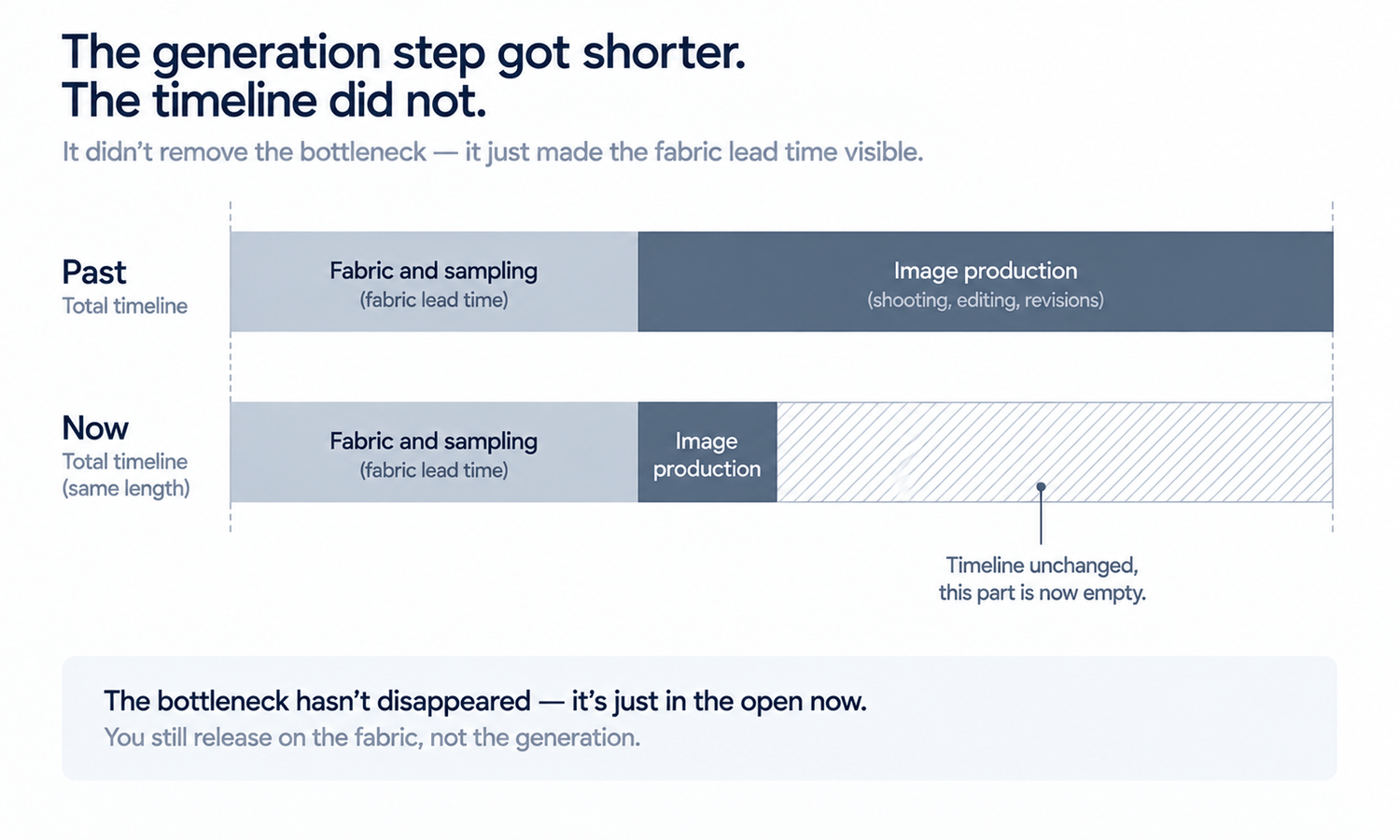
So the coverage a shopper experiences is set by a fabric clock rather than by an imagery clock, and the styles missing from the app on launch day are usually the styles whose cloth ran late. That is not an imagery problem appearing in the wrong place. It is a lead-time problem appearing in a new one.
The connection is worth making explicit because the two are managed by different people who rarely discuss the same calendar.
What actually determines coverage
| For a shopper to see a style | What has to have happened | Who controls it |
|---|---|---|
| A garment has to exist | Fabric arrived, a sample was made, and any revision round closed | Sourcing and product development. This is the long pole |
| Somebody has to have photographed it | A shoot slot after that date, to a consistent standard | Whoever holds the shoot calendar, working backwards from a date they do not set |
| Assets have to have been produced and checked | A short step, and the comparison against source on every output | Your side, and it is the shortest link in the chain |
| The app has to have them | Delivery, which is a lookup over what already exists | The app team, and this is the only row they decide |
Reading the fourth column, only one row is a decision anybody makes about the app. The rest are consequences of when material arrived, which is why coverage is planned in a sourcing meeting rather than in a product one.
That also means the fix for a coverage gap is rarely faster imagery. Imagery is already the shortest step.
Why this only became visible recently
When photography and retouching took weeks per range, the imagery step had a buffer inside it, and a fabric delay of two weeks disappeared into that buffer without anybody noticing.
Cheap generation removed the buffer by shortening the step. The work still happens, and it happens quickly enough that the timeline is now almost entirely lead time. When one bottleneck is removed, the next one becomes visible, and this is that pattern in its ordinary form: nothing about sourcing changed, and sourcing is now what the launch waits on.
Teams often read that as a new problem. It is an old problem with the cover taken off, and it responds to sourcing tools rather than to imaging ones.
The one genuine imagery-side gain is that a shorter step means a late sample has more room to still make the date. That is worth having, and it is not the same as being able to launch without one.
What the hole looks like to a shopper
Partial coverage is not experienced as partial. A shopper who taps a try-on view and finds nothing does not conclude that this particular style arrived late; they conclude the feature is unreliable.
That is why the empty state is a design decision rather than an oversight. Falling back to standard product photography, without an interface that appears broken, keeps the feature's reputation attached to the styles it does cover. Leaving a blank does the opposite, and does it on the styles that were already having a difficult season.
The other thing partial coverage does is make the covered styles carry the judgment. A shopper who meets the feature on three styles and finds it useful on all three has formed a view; a shopper who meets it on three and finds it empty on two has formed a different one, and neither shopper has seen the catalog. Which styles happen to be covered early therefore does more work than the coverage percentage suggests.
There is a second-order effect worth watching. When coverage is patchy and a launch is close, somebody proposes producing assets from a proto so the hole is filled. That is a legitimate route with a labeling rule attached: an asset derived from a proto carries that state with it, because a proto differs from production in exactly the places a customer checks. Filling a coverage hole with unlabeled proto assets converts a scheduling problem into an accuracy one, which is a worse trade at any date.
Planning the shoot calendar against the fabric calendar
Most teams keep two calendars and align them once, at the start of a season, after which they drift independently.
The alignment worth maintaining is narrow. For each style, the date that matters is when a photographable garment exists, and that date is downstream of fabric arrival, sampling and any revision round. Working backwards from the launch, the shoot slot has to sit after it, and the asset production has to sit after that.
There is a sequencing point underneath that. The shoot slot cannot be booked against a date somebody hopes for; it has to be booked against the date a garment will be in a room. Those two dates diverge most for exactly the styles that will slip, because a hoped-for date is an average and a slipping style is not an average. Booking against the hoped-for date produces a slot that arrives before the garment does, which wastes the slot and moves the style to the end of the queue.
Two practical points follow. Group the shoot by fabric arrival rather than by category, since garments waiting on the same mill will land together and can share a session. And hold one slot late in the calendar for whatever slips, because something does, and an unplanned slot becomes an unreviewed style.
Where a style recurs across seasons in the same body, its capture is not on the fabric clock at all — it was shot once and the colorway work derives from it. Deciding colorway direction that way is what makes a recurring body immune to the arrival date of this season's cloth, and it is the strongest argument for capturing recurring bodies to a standard.
What imagery cannot pull forward
The temptation with a late fabric is to use the short imagery step to buy back the whole delay, so it is worth being exact about which parts of a delay are recoverable.
The output is a visual asset. It does not predict fit, determine sizing, model how a fabric behaves in motion, or forecast returns. Those come from measurements, a graded pattern, a physical sample, and your own data. A fit session cannot be brought forward by generating images, and a size set cannot be signed off from imagery however good the available garment was.
Color is the same. Screen color is not a physical reference, exact code matching is not something to promise, and the gap between a monitor and a roll of cloth stays open regardless of display quality. Colorways get settled by strike-offs against an agreed standard, so a late lab dip is not recoverable by showing the colorway on screen. A shade shown before its strike-off is a direction, whatever the calendar says.
Footwear is not covered by this class of workflow, and lace and open work, sheer fabrics, complex prints, and heavily layered looks are documented weak spots. A late arrival in one of those categories does not become a candidate for this route because the date is close.
What a short imagery step genuinely buys is time on the imagery, which is the smallest component of the delay. Everything else waits on the cloth.
Three decisions before launch
All three are cheap in advance and expensive in the week before.
-
Decide the empty state: what a shopper sees on a style with no assets, since partial coverage is normal and shoppers meet it
-
Decide the proto rule: whether proto-derived assets may fill a coverage hole, and that they carry their state if they do
-
Decide the late slot: one shoot slot held in reserve, because the styles that slip are the ones that changed most and need it most
Beyond those, the recurring-body decision is the one that compounds. A body captured once to a standard is available for every season it reappears in, which takes it off the fabric clock permanently. In Lightchain AI (apparel AI) the uploaded source stays beside every AI Virtual Try-On output derived from it, which is what makes a body captured two seasons ago still usable rather than merely archived. Whether the work runs through Lightchain AI or a camera, coverage is a sourcing outcome and the shoot calendar is where the two meet.
Frequently asked questions
Can we not just generate assets for styles we do not have yet?
Generation needs a photograph of the garment, so a style with no garment has nothing to derive from. Where a proto exists, that is a route with a labeling rule attached. Where nothing exists, there is no input and nothing to produce from.
Our coverage is always incomplete. Is that a failure?
It is the normal state at any realistic lead time, which is why the empty state is worth designing rather than treating as an exception. The failure is an interface that looks broken, not a catalog that is partially covered.
Should the app team be in the sourcing meeting?
Somebody who knows the shoot calendar should be, since coverage is decided there and nowhere else. It does not need to be a standing attendance; it needs to be whoever can say when a photographable garment will exist.
Which styles should we prioritise for shooting?
Recurring bodies first, since capturing them once removes them from this problem permanently. Then whatever arrives earliest, since a garment in hand is a shootable garment and waiting for a full range wastes the slot.
Does a shorter imagery step help with late fabric at all?
It gives a late sample more room to still make the date, which is a real gain. It does not shorten the fabric lead time, the sampling round, or the fit session, and those are where the delay actually is.
What about styles that were dropped after the shoot?
Keep the assets and the source together rather than deleting them, since a dropped style often returns and a body captured to a standard stays usable. Deleting saves storage and costs a future shoot slot.
In closing
An app shows what exists, and what exists is downstream of when fabric arrived. That was always true and was invisible while imagery took weeks; a shorter imagery step removed the cover rather than the problem. So coverage is planned against a sourcing calendar, the empty state is a design decision because partial coverage is normal, and the one durable escape is capturing recurring bodies once to a standard so they stop depending on this season's cloth.
Start here
Put the shoot calendar and the fabric arrival calendar on the same page and mark, for each style, the date a photographable garment will exist. The styles where that date falls after the launch are your coverage gaps, and you now know them months early rather than in the week before. Most teams have never had the two calendars in one view, and the exercise usually surfaces two or three styles that were never going to make it.
**Start with the on-model workflow → **https://www.lightchainai.com/global/solutions/aiVirtualTryOn