
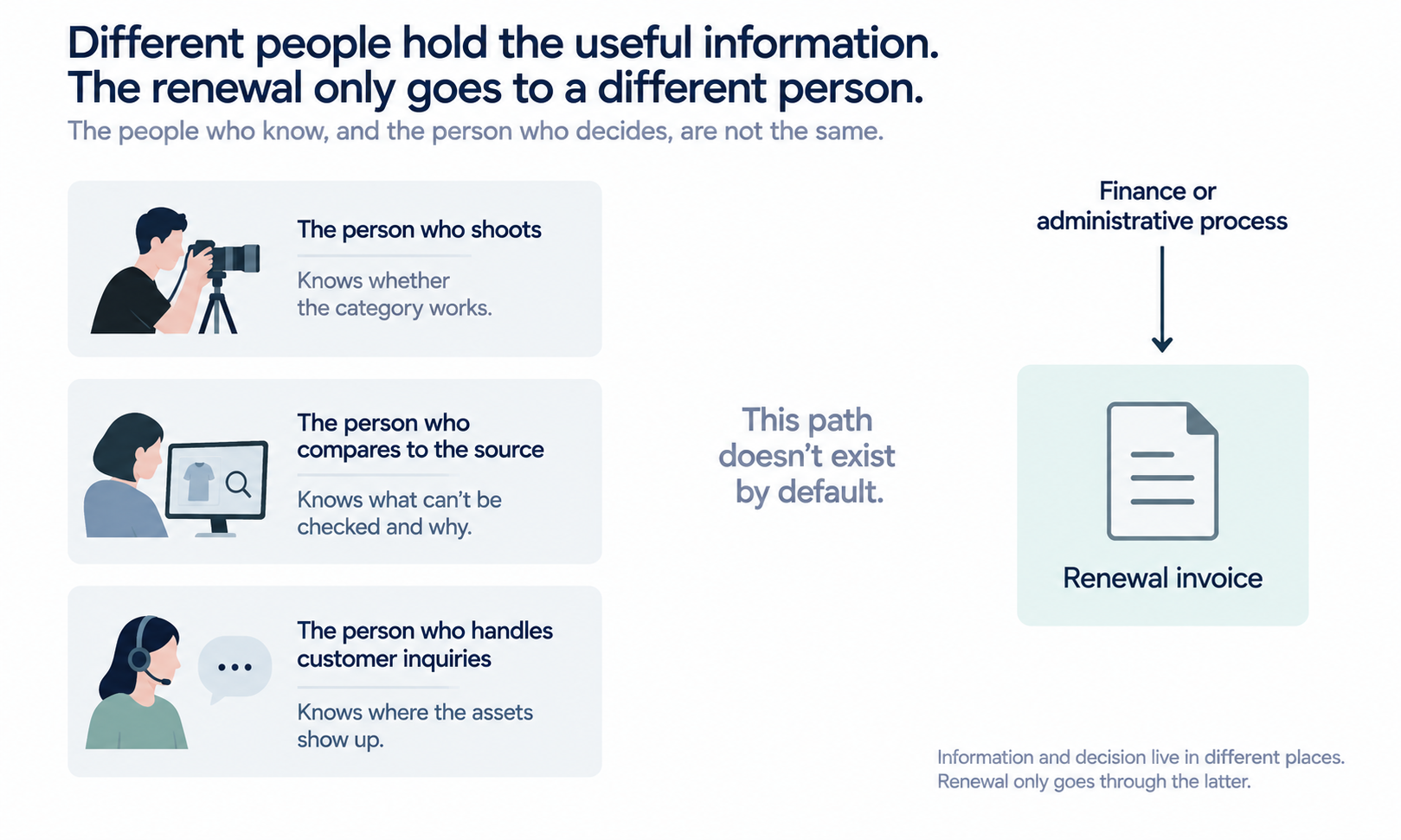
Renewal is the only moment when the terms are genuinely open, and it usually arrives as an invoice rather than as a decision. Somebody approves it because the work is running and stopping it would be disruptive, and a year's worth of learning goes unused.
That learning is the point. At signing you were guessing about which categories would hold, what the work would cost per usable image, and where your assets would end up once they left the building. A year later you know all three, and knowing them is what makes a renegotiation possible rather than a request.
For a wholesale catalog seller the most valuable of the three is the last one, and it is usually the term nobody wrote.
Renewal arrives as an invoice, not a decision
The mechanics are ordinary. A renewal date passes into somebody's queue, the amount is not dramatic, and the alternative is a project nobody has capacity to run. So it gets approved on the same terms, and the same terms were written when you knew least.
There is a second reason it goes unexamined. The people who now hold the useful information — whoever runs the capture, whoever does the comparison against source, whoever fields the calls from accounts about assets — are not usually the people who see the renewal. The knowledge and the decision sit in different places.
Fixing that costs a calendar entry six weeks before the date and one page from each of those people. It is the cheapest preparation available and almost nobody does it.
What a year told you that you did not know at signing
| At signing you assumed | A year later you know | What that changes |
|---|---|---|
| A rough volume and a rough mix | Cost per accepted output, by category, from your own records | Whether the tier and the volume assumption were ever right, in either direction |
| Most categories would work | Which ones held and which went to photography, with reasons | Scope, reopened deliberately rather than extended by omission |
| Accounts might republish your imagery | Whether they did, where, and in what form | Usage terms written from evidence rather than from a hypothetical |
| The comparison against source would happen | What could not be checked, and why | A specification request rather than a request for more effort |
| Files would arrive with what they need | Which identity fields survived the handoff and which were re-entered | What has to come back with the work, which costs a supplier little |
Read the third column as an agenda rather than a summary. Each row is something you can now state with evidence, and a term negotiated from evidence behaves differently from a term negotiated from a preference.
The rows are also independent. A renewal conversation that only reaches the first two is still worth having, and the third can wait for the following cycle if the account relationships are delicate.
The term worth renegotiating first: where your assets ended up
At signing you assumed retail accounts might republish your imagery on their own product pages. A year later you can see whether they did, and the answer is almost always yes.
That changes the conversation from a hypothetical to a fact, and facts are easier to write terms around. What is worth having in writing is narrow: which channels the assets may appear in, whether cropping or compositing is permitted, and a line stating that the images are not evidence of fit or color and must not be presented as such. That last clause matters most for anything derived from colorway work, since a shade shown on an account's page is the version a shopper will hold you to. None of that is onerous to agree and all of it is difficult to agree retrospectively after a dispute.
There is a corresponding obligation on your side, and renewal is when it becomes concrete. If the assets are being republished into channels you do not control, they are operating as product-page imagery for businesses whose customers you never meet, and the accuracy standard that applies is the stricter one. That is not a contractual point so much as a production one: build catalog assets to the standard of the furthest place they will travel, because a year of evidence now tells you how far that is.
Renegotiating the plan on the right unit
The second conversation is with whoever supplies the workflow, and the mistake is to open it on the list rate.
The number that matters is cost per accepted output — your spend divided by the images that passed the comparison and went somewhere — and after a year you have it by category rather than as an estimate. That figure is what tells you whether a different tier is warranted, whether the volume assumption in the original arrangement was wrong, and which categories were quietly subsidizing others.
For the platform's own published figures, point packages start at $9.90 for 600 points, described by the company as roughly 20 images, with further tiers published alongside; read the current pricing page rather than an article, since terms change. Treat published rates as a floor in any case, since they describe a scenario where every attempt succeeded and nobody spent time reviewing.
The more useful renegotiation is often not about money. It is about what comes back with the work: whether identity fields survive, whether comparison evidence is returned, and whether an output on a live page can still be traced to its source. Those are specification changes rather than commercial ones, and they cost the supplier little while being worth a great deal to you.
What cannot be renegotiated into existence
Some terms are not available at any price or on any renewal, and asking for them wastes a conversation that has other work to do.
The output is a visual asset. It does not predict fit, determine sizing, model how a fabric behaves in motion, or forecast returns. Those come from measurements, a graded pattern, a physical sample, and your own data. No contractual language changes that, because the limit is in what the asset is rather than in what was agreed about it.
So no arrangement should be scoped against a return-rate or sell-through outcome, since both sit at the end of a chain running through sizing, price, assortment, and traffic. And no clause makes a size chart derivable from imagery; a buyer reading a fit conclusion out of a catalog image has made a decision your assets cannot support, and the catalog should say where size guidance actually comes from.
Color is worth writing down precisely because it recurs across accounts. Screen color is not a physical reference, exact code matching is not something to promise, and the gap between a monitor and a roll of cloth stays open regardless of display quality. Colorways get settled by strike-offs against an agreed standard, so a colorway in a delivered file travels as a direction rather than an approval.
Footwear is not covered by this class of workflow, and lace and open work, sheer fabrics, complex prints, and heavily layered looks are documented weak spots. A renewal that quietly extends scope into those categories has extended it into a category verdict rather than a capability gap.
How to arrive at renewal with a position
Six weeks is enough, and the preparation is mostly collection rather than analysis.
-
Pull cost per accepted output by category for the year, not as an average, since the average hides which categories were carrying the arrangement
-
Ask whoever runs the comparison what they could not check and why, because that answer is usually a specification gap rather than a capability one
-
Search for three of your own product images on your accounts' sites and record where they appear, which is the evidence the usage conversation needs
-
List the categories that failed and the reason next to each, so scope is renegotiated deliberately rather than by omission
-
Write the three or four specification changes you want, separately from anything about price, and take them in that order
Where the uploaded source stays beside every on-model output derived from it, the first two of those take an afternoon rather than a week. In Lightchain AI (apparel AI) that link exists by default, so tracing an AI Virtual Try-On result back to the garment it came from is a lookup rather than a project; where it does not exist, the reconstruction is itself a finding worth raising at renewal.
Whether the work runs through Lightchain AI or a camera, the position is what you bring rather than what you are offered, and a year of operating is what produces it.
Frequently asked questions
We are happy with the arrangement. Is there anything to renegotiate?
Probably the specification rather than the price, since satisfaction with output says little about whether provenance, identity fields, and comparison evidence are coming back. Those gaps are invisible while things go well and expensive the first time something goes wrong. A satisfied renewal is the easiest moment to ask for them.
Our accounts republish our images and nobody agreed to it. What now?
Treat it as the current state rather than a breach, since it usually happened because no terms existed and a listing needed filling. Write the usage line into the next cycle and build the assets to the standard that situation implies. Attempting to unwind a year of republication is not a realistic project.
Should we ask for a lower rate or better terms?
Terms, in most cases, since the rate is the smallest component of what the work costs and the specification changes are cheap for a supplier to grant. Take specification first and price second, and be prepared to accept the rate in exchange for what comes back with the files.
What if our category mix changed during the year?
That is one of the strongest reasons to reopen the arrangement, since a volume or tier assumption built on last year's mix may now be wrong in either direction. Bring the per-category figures rather than a general impression. A mix shift is evidence, not a complaint.
Who should be in the renewal conversation?
Whoever holds the operating knowledge, which is usually not whoever holds the renewal. One page each from the person running capture, the person doing the comparison, and whoever fields account queries about assets. Without those three the conversation runs on assumptions from the original signing.
How far ahead should we start?
Six weeks, which is enough to collect the figures without becoming a project. Starting earlier tends to produce analysis nobody uses; starting later produces an invoice approval. The date should sit in a calendar rather than in somebody's memory.
In closing
A renewal is the one moment when a year of operating knowledge can be converted into terms, and it is routinely spent approving an amount. Three things are now known that were guesses at signing: what the work costs per accepted output by category, which categories hold, and where your assets actually travelled. The third is the one a wholesale seller should act on first, because republication turns your line sheet imagery into product-page imagery for businesses you do not control. Bring the figures, ask for specification before price, and put the date in a calendar.
Start here
Search for three of your own product images on two of your largest accounts' websites and note where they appear and in what form. That takes twenty minutes and produces the single most useful input to a renewal conversation, because it converts an assumption about republication into a documented fact. Whatever it shows, it is the thing you did not know a year ago, and it is the input a renewal conversation is otherwise conducted without.
**Start with catalog-scale asset work → **https://www.lightchainai.com/global/solutions/scaleECommerce