
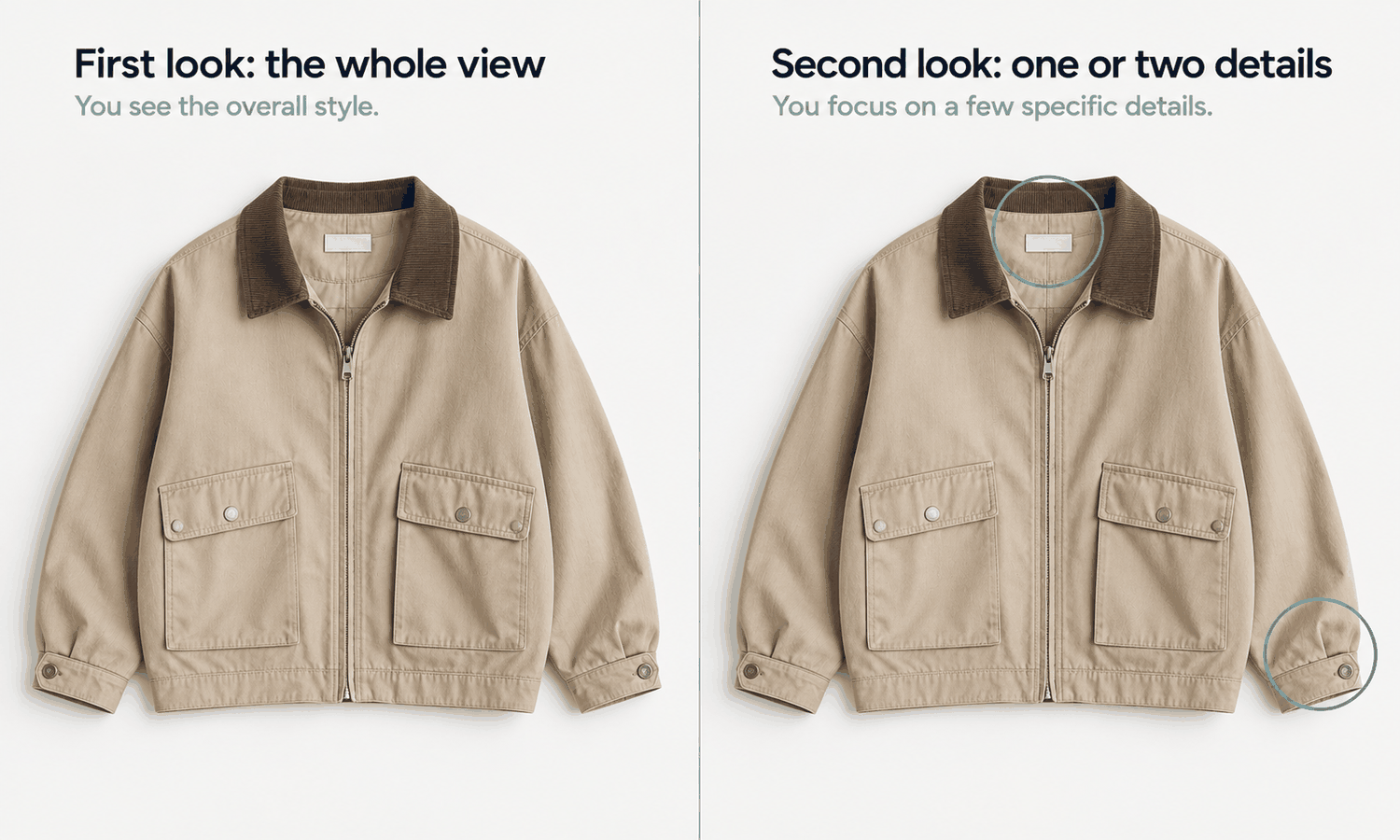
A first order and a second order are decided by different people, at different moments, on different evidence. Founders tend to optimize hard for the first and assume the second follows from it.
The first order is bought from an image. Somebody sees a piece, likes it, and commits on the strength of what they were shown. The second is bought from the parcel: from what arrived, what it felt like, and whether it was the thing they thought they were getting.
That gap is where the useful question sits. Everything spent making a piece more appealing to try on works on the first decision. Only accuracy works on the second, and in a world where imagery got cheap, accuracy is the part that quietly gets negotiated away.
Two orders, two different decisions
| The first order | The reorder | |
|---|---|---|
| What it is decided from | An image, a price, and whatever else is on the page | The garment itself, held, compared against what was shown |
| Who decides | Somebody who has not seen the product | Somebody who now has, and who remembers the difference |
| When | In seconds, at the moment of the visit | Weeks later, at unboxing, and again the next time you show them something |
| What imagery contributes | Nearly everything. This is what appeal is for | Only whether it was accurate. Appeal has already been spent |
| What a failure looks like | No sale, which is visible immediately | A quieter second visit, which looks like softening demand |
The column that matters to a founder is the second one, because a business built on first orders is a business that has to buy every customer twice. Reorders are also the number that tells you whether the product is right, and imagery cannot flatter its way into that answer.
None of this is an argument for dull photography. It is an argument for treating appeal and accuracy as two separate obligations that happen to travel in the same file, and for noticing that only one of them is under pressure when a team gets busy.
The detail is where the second decision gets made
Watch somebody open a parcel and the sequence is consistent. They look at the whole thing, then they look closely at one or two specific things: the label, the hardware, the print at the shoulder, the stitching at the cuff. That close look is where the comparison against the image happens, and it happens at a level of detail no product photograph was consciously designed around.
This is why a near miss does more damage than an obvious difference. An obviously different garment is a mistake and gets treated as one, usually with a message and a replacement. A garment that is almost right produces something worse: a quiet downgrade in how much the person trusts the next thing you show them.
So the rule that applies here has no exceptions attached to it. Logos, printed text, care labels, and small hardware get compared against the source image on every single on-model output before it goes anywhere. Reconstructed detail lands almost right — a letterform slightly off, a stitch count wrong, a zipper pull the wrong shape — and almost right is precisely the failure that survives your review and arrives at the one review that decides a reorder. When one region fails and the rest of the frame is sound, a targeted correction to that region is smaller than a rerun and keeps the rest of a set comparable.
What a stockist's reorder turns on
For a wholesale account the mechanics differ and the principle holds. A buyer's second order depends on sell-through, and it also depends on whether what arrived matched what they bought from.
A stockist who got a surprise once orders defensively afterwards. Not always by dropping you, which would at least be visible, but by taking fewer sizes, fewer colorways, or a smaller depth. That is a reorder decided by an accuracy failure and recorded as a merchandising decision, and from your side it looks like softening demand rather than a repaired trust problem.
The same imagery reaches further in wholesale, too. Line sheet assets frequently end up on a stockist's own product pages, which means an inaccuracy is republished into a channel you do not control and reaches a shopper you never meet. Building catalog assets to the standard of the furthest place they will travel is cheaper than auditing where they went.
The gap you can measure before anybody else finds it
There is a check available to a founder that almost nobody runs, and it takes one afternoon.
Take goods from the last shipment that actually arrived — not the sample, the shipment — and put them next to the images that sold them. Look at the four things a customer looks at: label, hardware, print position, and the finish at one visible seam. Then ask whether a person holding one and looking at the other would notice a difference.
-
Compare shipped goods rather than the photographed sample, since variance between the two is where a technically accurate image becomes a misleading one
-
Do it per style rather than as a general impression, because the failure is almost always specific and almost never uniform
-
Include your strongest sellers rather than the ones you are least sure about, since those are the ones with the most parcels already out
-
Write down what you find next to the style code, so a repeat of the same issue is visible as a pattern rather than as a fresh surprise
-
Repeat it once per production run rather than once, because the gap opens between runs rather than within one
Whatever this turns up is the most actionable information available to a small brand, and it costs nothing but attention. In Lightchain AI (apparel AI) the uploaded source stays beside the outputs AI Virtual Try-On derived from it, which makes the second half of the comparison easy; the first half still requires somebody to go and hold the garment.
What imagery cannot do for a reorder
The output is a visual asset. It does not predict fit, determine sizing, model how a fabric behaves in motion, or forecast returns. Those come from measurements, a graded pattern, a physical sample, and your own data. That is a property of what the asset is rather than a limitation of any particular result.
Two things follow for a founder specifically. A size chart cannot be assembled from imagery, and a size chart is the document a customer holds you to when a garment does not fit. And no asset can be presented, internally or to an investor, as the reason a repeat purchase rate or a return rate moved, since both sit at the end of a chain running through sizing, price, assortment, and product itself.
Color needs saying because it reaches the parcel directly. Screen color is not a physical reference, exact code matching is not something to promise, and the gap between a monitor and a roll of cloth stays open regardless of display quality. Colorways get settled by strike-offs against an agreed standard, and a shade difference discovered at unboxing is the version of this that costs a reorder.
Two scope answers save time. Footwear is not covered by this class of workflow, and that is structural rather than a gap waiting to close. Lace and open work, sheer fabrics, complex prints, and heavily layered looks are documented weak spots, so those categories belong with a camera rather than in a retry loop.
Where a founder should put the next hour
The instinct when reorders soften is to look at acquisition, the product, or the price. Those are all real and all slower to test than the thing described above.
Run the shipped-goods comparison first, because it is the only one that can be completed this week and the only one that touches trust directly. If the comparison comes back clean, you have eliminated a cause and can move to the slower questions with more confidence. If it does not, you have found something that is cheap to fix and expensive to leave.
Then decide who owns the detail check going forward, and make it somebody other than whoever made the image. The comparison does not require the taste that produced the picture, which is exactly why a second person can do it. Whether the work runs through Lightchain AI or a camera, the check is the same check, and it is the part of the process most likely to be dropped in the week before a launch.
Frequently asked questions
Is this really more important than better product photography?
They are different jobs rather than competing ones, and better photography works on the first order while accuracy works on the second. A brand that needs more first orders should invest in appeal. A brand with first orders and weak reorders has a problem appeal cannot reach.
Our reorders are soft. Does that prove an accuracy problem?
No, and the comparison is worth running because it is the fastest cause to rule in or out rather than because it is the likeliest. Price, product, and audience fit are all candidates and all take longer to test. Eliminating a cheap cause first is a sequencing decision rather than a diagnosis.
Should imagery ever be more flattering than the garment?
The gap it creates is discovered by the person who paid, which is the most expensive place to be corrected. Aim for accurate, which for a good garment is flattering anyway. Where a piece photographs poorly and looks better in person, that is a photography problem rather than a reason to compensate in the other direction.
How do I check this when I sell through stockists?
Ask a stockist to send you a piece from a delivery, or buy one from their shop floor. What you need is a garment that went through the full chain rather than one from your own stock. The difference between those two is exactly what you are looking for.
What if the mismatch came from the factory rather than the imagery?
Then the imagery was accurate and the production varied, which is a different problem with the same symptom for the customer. Record which one it was, because the fixes are unrelated and confusing them wastes a season. The comparison tells you which without needing to guess.
We are pre-launch. Is this relevant yet?
It is easier to build now than to retrofit, and the habit costs about ten minutes per style once it exists. Decide who owns the detail check before the first order rather than after the first complaint. Pre-launch is the only time this is free.
In closing
Founders spend on the first order because it is the one they can see. The second is decided later, by somebody holding the garment, comparing it against what they were shown, and looking specifically at the label, the trim, and the print. Appeal cannot reach that moment and accuracy is the whole of what does. So the detail check before an image leaves is not quality assurance overhead. It is the part of the process that operates on the number a founder actually needs.
Start here
Order one of your own products the way a customer would, through the normal channel, and open it next to the images that sold it. Look at the label, the hardware, the print position, and one visible seam. Whatever you notice in those first thirty seconds is what a customer noticed too, and it is a shorter list than you expect. Fix that list before anything else on the marketing plan.
**Start with the on-model workflow → **https://www.lightchainai.com/global/solutions/aiVirtualTryOn