
**Ask what swap clothes ai can and cannot do and you get a list. **
The list is usually accurate and rarely useful, because it mixes two kinds of limit that look identical from outside and behave in opposite ways.
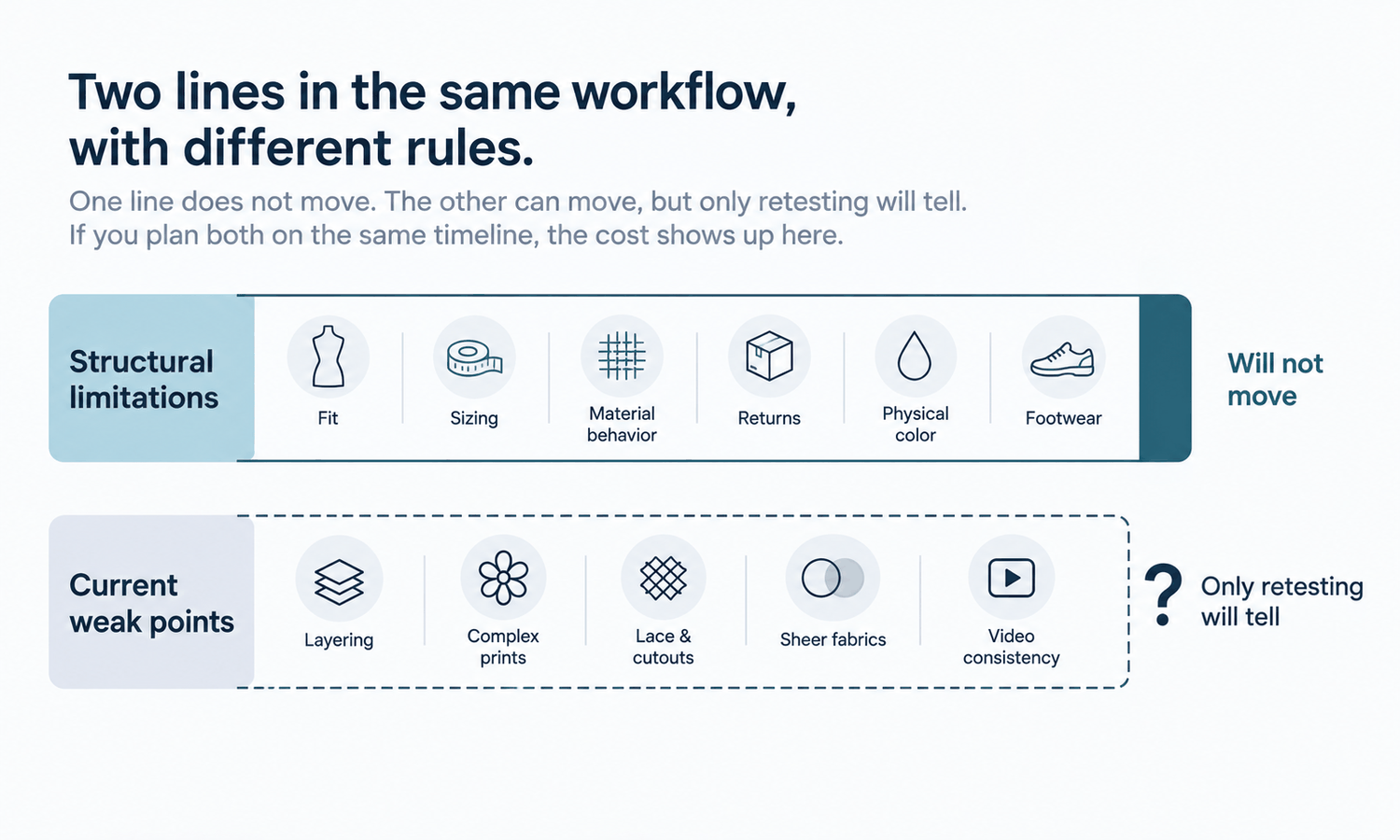
**One kind is a property of what the output is. A visual asset cannot tell you how a garment fits, and no version of anything changes that, because the limit is in the category of thing rather than in the quality of the result. **
The other kind is a current weak spot: a category where results are unreliable now, which may or may not read differently after a product update.
Confusing them is expensive in both directions. Teams keep retrying against structural limits, waiting for an announcement that cannot come. And they build permanent workarounds for weak spots that a twenty-minute retest might have cleared. Sorting the list is worth more than lengthening it.
What it does, and under what conditions
| What it does | What that actually is | The condition attached |
|---|---|---|
| Puts a garment onto a model figure | A visual asset showing how a piece reads on a body, produced from a photograph of that piece | A consistent, complete, unobstructed source capture. Without one, the result describes your photography |
| Produces colorway and fabric variations | Candidates for a decision somebody still has to make physically | Treated as a shortlist. Nothing here is a color approval |
| Reproduces prints, marks, and hardware | A reconstruction that is usually close and occasionally close enough to pass unnoticed | A comparison against the source on every output, with no exceptions |
| Converts a look into a line drawing or tech-sheet draft | A draft that makes construction decisions explicit instead of leaving them shaded | Review by a technical designer. It arrives as work rather than instead of it |
| Turns existing 3D assets into flat garment images | An input path into the workflow for teams that already hold 3D files | The flat image still has to meet the same capture standard as a photograph |
Every row in that table has a condition in the third column, and the conditions are not decoration. A capability that works given a consistent source photograph does not work without one, and the difference between those two states is not visible in a demonstration. Most disappointment with this class of workflow is a condition that was never met rather than a capability that was overstated.
The strongest of those conditions is the source. Everything produced is a derivation from a capture, so a workflow described as fast is fast on the far side of a photographic discipline that most teams have not yet put in place.
The conditions are the real specification
A capability list without conditions attached is a sales document. The working version reads differently.
On-model output** through AI Virtual Try-On is reliable given one position, one distance, one background, one light, held across a collection, and unreliable given a folder of photographs taken over two years by four people. Colorway and fabric exploration is fast and useful, and it produces candidates rather than approvals. Detail reproduction works when somebody compares against the source, and fails silently when nobody does.**
That last one has a rule with no exceptions attached. Logos, printed text, care labels, and small hardware get compared against the source image on every single output. Reconstructed detail lands almost right — a letterform slightly off, a stitch count wrong, a zipper pull the wrong shape — and almost right survives an appreciative look, which is why the check has to be a comparison rather than an impression. In Lightchain AI (apparel AI) the source stays beside the outputs derived from it, which makes that comparison a two-second job rather than a search, and the administrative side of this is where teams lose more time than they expect.
What it cannot do, and why that is not a version problem
The output is a visual asset. It does not predict fit, determine sizing, model how a fabric behaves in motion, or forecast returns. Those come from measurements, a graded pattern, a physical sample, and your own data. That is a property of what the asset is rather than a limitation of any particular result, and no improvement in how convincing an image looks moves it.
Three things follow that are worth stating plainly rather than leaving to inference. A size guide cannot be assembled from imagery, because a size guide is a measurement document and one built from pictures is a sizing claim with nothing behind it. No asset can be presented as the reason a return rate or a conversion figure moved, since both sit at the end of a chain running through sizing, price, assortment, and traffic. And there is no physical simulation here — no geometry is built and no material behavior is predicted, so the drape in an output is rendered rather than computed and says nothing about the cloth. Existing 3D assets can be converted into flat garment images that then enter the workflow as inputs, which is a different thing from the workflow producing or simulating 3D.
Footwear belongs in this section rather than the next one. It is not covered, and the reason is structural: a shoe is a rigid object built on a last, with no flat-lay equivalent to serve as the input the whole method depends on. Planning for it to arrive is planning for something that would require a different method.
Color has a limit of the same kind. Screen color is not a physical reference, exact code matching is not something to promise, and the gap between a monitor and a roll of cloth stays open regardless of display quality. Colorways get settled by strike-offs against an agreed standard, and no display improvement closes that gap because the gap is not a display problem.
The current weak spots, and how to hold them
A different list behaves differently. Layered styling with occlusion, complex prints, lace and open work, sheer and transparent fabrics, and frame-to-frame consistency in video are documented weak spots. Results in these categories are unreliable, and that statement is about now rather than about the nature of the thing.
The right posture is neither to wait nor to declare them permanently out of scope.
-
Route the category to conventional photography and record the decision with the reason next to it, so it stops being reopened every season by whoever is under pressure that week
-
Keep the test set: the source photographs and outputs from whatever evaluation produced the verdict, since a retest is only informative if it is comparable to the original
-
Set the retest trigger to a product update or a change in your own inputs rather than to a calendar date, because retesting an unchanged setup on a schedule produces the same answer at a cost
-
Retest on your own garments rather than on a demonstration, since the verdict that matters is about your categories and nobody else's
-
Reduce overlaps rather than retrying them: a look styled with one garment crossing another is a smaller problem than three, and the version with fewer boundaries is often the version that comes back usable
When a single region fails and the rest of the frame is sound, a targeted correction to that region is a smaller intervention than a rerun and keeps the rest of a set comparable. Knowing that changes how a partial failure gets read, and partial failures are most of what these categories produce.
Planning against a line that moves in one place and not the other
The practical consequence of the split is that two different planning horizons apply to the same workflow, and using one horizon for both is where the cost lands.
For structural limits, build the permanent route now. Fit answers come from the measurement chart and the fit session, color from strike-offs, footwear from a camera. Those are not interim arrangements and treating them as interim produces a permanent state of waiting.
For weak spots, build a reversible route. Send the category to photography, keep the test set, and let a product update rather than an opinion trigger the retest. The cost of being wrong in this direction is a category photographed longer than necessary, which is a manageable outcome. The cost of the opposite error is a season of retries.
Whether the work runs through Lightchain AI or a camera, deciding colorway and fabric direction quickly is a real gain in the categories where the output is stable, and it is worth nothing in the categories where it is not. A capability list that does not separate those two is a list that cannot be planned against.
Frequently asked questions
How do we tell a structural limit from a weak spot?
Ask whether a better image would change the answer. If the question is about fit, sizing, material behavior, or physical color, a better image changes nothing because the answer was never in an image. If the question is about whether lace renders convincingly, a better image is exactly what would change it, which makes it a weak spot rather than a boundary.
Should we wait for a product update before adopting?
Adopt in the categories that work now and route the rest to photography, since the categories that work are not waiting on anything. Waiting produces a season with neither the gain nor the fallback in place. The reversible route is what makes adoption safe without a prediction attached.
How often should we retest a failed category?
On a product update or a change in your own source standard, rather than on a schedule. An unchanged setup retested monthly returns the same verdict and consumes review attention that could go somewhere else. Keep the original test set so a retest is a comparison rather than a fresh opinion.
A demonstration showed a category we were told does not work.
Test it on your own garments, with your own source photographs, before changing any plan. A demonstration is built from inputs chosen to work, which is not dishonest but is also not evidence about your catalog. Your verdict has to come from your styles.
Does higher output quality expand what the workflow can do?
It moves weak spots and does not move structural limits, which is the entire distinction restated. A more convincing render of a sheer fabric is a real improvement. A more convincing render tells you nothing more about fit than a poor one did.
What should we tell people internally who expect fit answers?
Say where the answer actually comes from, in the same sentence, every time: the measurement chart, the graded pattern, the fit session. The failure is rarely a false claim and usually a maybe that gets treated as a yes. Answering the question that was asked while naming the real source of the answer costs one clause.
In closing
Any honest account of what this technology does contains two lists that need to stay separate. Fit, sizing, material behavior, returns, physical color, and footwear sit outside what a visual asset is, and no version changes that. Layered looks, complex prints, lace, sheers, and video consistency are current weak spots, and the only informative answer about them comes from retesting your own garments after something changes. Plan permanently against the first list and reversibly against the second, and the capability question stops being a debate about what a demonstration showed.
Start here
Take your own capability list, if one exists, and sort every line into two columns: would a better image change this, or not. The lines that land in the first column need a retest trigger and a kept test set. The lines in the second need a permanent route and no further discussion. Most lists sort in about ten minutes, and most teams find at least one line has been sitting in the wrong column for a year.
**Start with the on-model workflow → **https://www.lightchainai.com/global/solutions/aiVirtualTryOn