
Reviewing generated imagery on your own and reviewing it with a buyer sitting next to you are different activities, and the difference is not the level of scrutiny.
It is that questions get asked out loud. Alone, an uncertainty stays an uncertainty and you go and look something up. In a room, somebody says how does that sit at the shoulder, and an answer arrives before anybody has decided whether it should. That answer is now something the buyer plans against, and there is no record of it beyond two different memories of a conversation.
Try on clothes before you buy is the shopper's version of this. The buyer in the room is doing it on their customers' behalf, which is why the questions they ask are the ones a shopper would ask if a shopper were there.
What gets asked, and where the answer actually lives
| What the buyer asks | What tends to get said | Where the answer actually lives |
|---|---|---|
| Does this run true to size | It looks about right | The measurement chart, the grade, and the fit session |
| Is that the exact shade | That is close to it on screen | A strike-off against an agreed standard. A swatch answers it in two seconds |
| Could you do it with a different closure | That should be fine | Your machine list, your trims in stock, and a costing nobody has run yet |
| How does it sit at the shoulder after wearing | It falls nicely | A physical sample on a body. Nothing in a still image reaches it |
| Is this one available now | Yes, that is in the range | Whether the piece was being shown as a product or as a direction, which only you know |
Every row in the second column is something that gets said in rooms and is not available from the image. None of them is a lie. They are all the reasonable thing to say when a question arrives and a pause would be worse.
The third column is where the answer exists, and the practical problem is that the third column takes longer to reach than the second.
The room rewards fluency
The mechanism is worth naming because it is not a character flaw. In a live review, silence reads as uncertainty about the product rather than as care about the answer, so there is pressure toward speed that does not exist when you are reviewing alone.
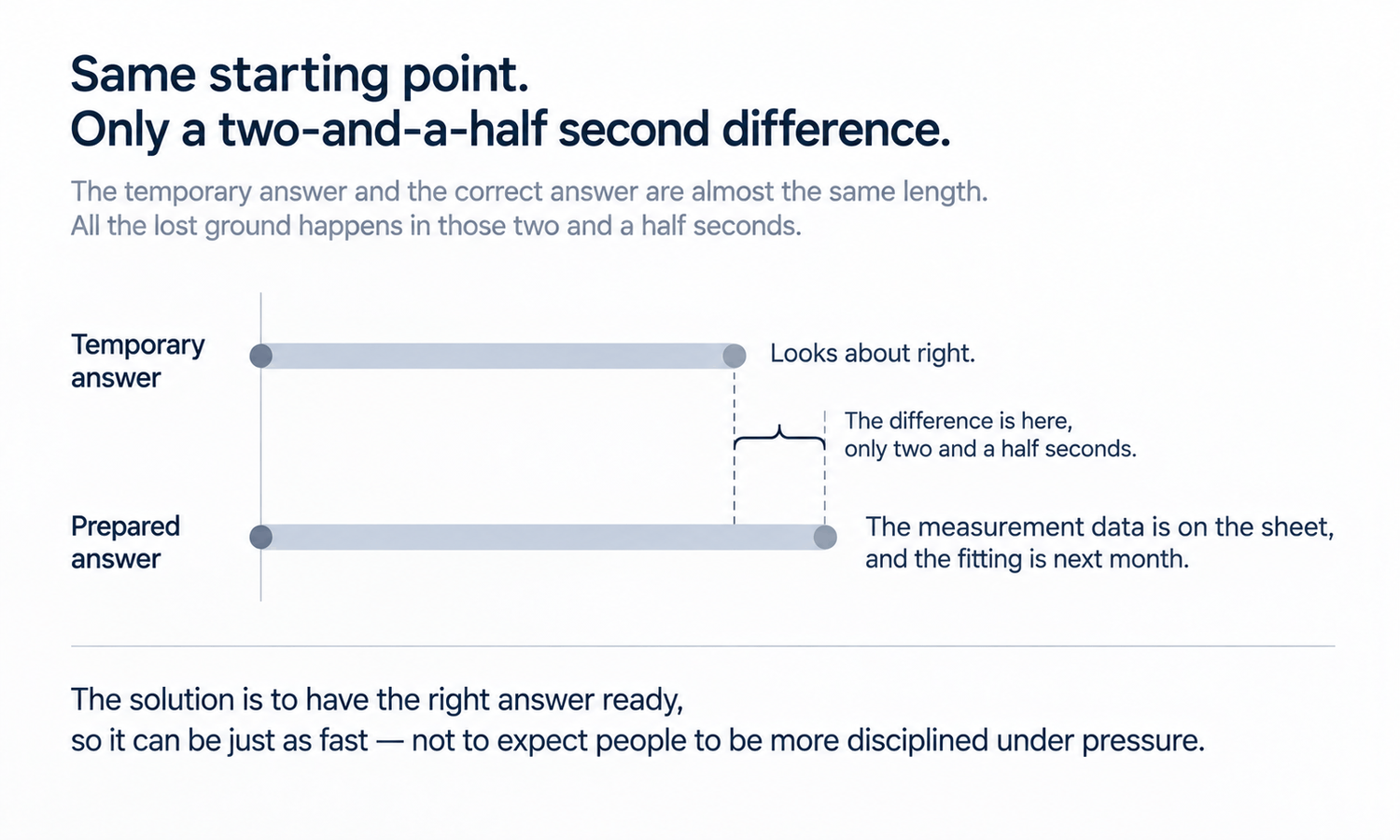
A buyer asks whether a jacket runs true to size. Saying it looks about right takes half a second. Saying the measurements are in the line sheet, and the fit session is next month takes three seconds and sounds slower in a way that has nothing to do with being correct.
That gap of two and a half seconds is where most of the damage in this scenario happens. The fix is not to become more disciplined under pressure, which nobody manages reliably. It is to make the correct answer as fast as the improvised one, by having it prepared and physically present.
Prepare the three answers you will be asked
Three questions come up in almost every review, and each has a prepared form that is as quick to deliver as the improvised one.
On fit: the measurements are on the sheet, and here is the size set. The image is showing proportion and styling. Nothing about that sentence is slow, and it moves the question to where it can actually be answered — measurements, a graded pattern, a fit session.
On color: here is the swatch. That is a two-second answer that a screen cannot give, and it ends a conversation that would otherwise run on impressions. Screen color is not a physical reference, and having the physical reference in the room removes the need to explain why.
On construction and availability: here is the line drawing, and here is what it takes to make. Converting an approved look into a line drawing or tech-sheet draft before the meeting is what makes this answer possible, and those outputs remain drafts a technical designer has reviewed.
The pattern across all three is the same: the prepared answer is not longer, it is just prepared. What makes the improvised answer win is availability rather than brevity.
What to bring besides the images
The images do one job in the room and the rest of the table does the others.
-
Physical swatches for every colorway being shown, since a colorway on screen is a shortlist and a swatch is an answer
-
The measurement chart and the size set, on paper, so the fit question has somewhere to go in one movement
-
A line drawing for anything the buyer might want made differently, since a styled render leaves construction open and a buyer asking about a construction is asking a question the render cannot hold
-
The sample where one exists, because a garment in the room outranks any image of one and its absence is what makes the images carry more weight than they should
-
A note of what is decided and what is still open, so that a piece being shown as a direction is not heard as a piece being shown as a product
The last item prevents the most expensive misunderstanding available in this setting, which is a buyer leaving with a plan built around something that was being explored.
One thing has to be settled before any of it reaches the table. Logos, printed text, care labels, and small hardware get compared against the source image on every single on-model output, without exception, and a buyer who knows the product will find a reconstructed detail faster than any internal reviewer will. Reconstructed detail lands almost right — a letterform slightly off, a stitch count wrong, a zipper pull the wrong shape — and finding it in the room costs considerably more than the correction would have.
What the images cannot answer, whoever is asking
Being exact about this is what makes the prepared answers possible, since a vague sense that the images are limited does not produce a fast reply.
The output is a visual asset. It does not predict fit, determine sizing, model how a fabric behaves in motion, or forecast returns. Those come from measurements, a graded pattern, a physical sample, and your own data. A buyer reading a size curve out of a line sheet image has made a decision the asset cannot support, and a room is where that reading is most likely to happen because nobody wants to interrupt.
Color has the same shape. Exact code matching is not something to promise, the gap between a monitor and a roll of cloth stays open regardless of display quality, and colorways get settled by strike-offs against an agreed standard. That is the whole reason a swatch belongs on the table.
Two scope answers save a conversation. Footwear is not covered by this class of workflow, and that is structural rather than a gap waiting to close. Lace and open work, sheer fabrics, complex prints, and heavily layered looks are documented weak spots, so a piece in one of those categories should be shown as a photograph rather than explained as a limitation mid-meeting.
What to record after the room
The conversation had no record and both parties left with one. Writing yours down within the hour is what makes them the same.
Note what was shown, what state each piece was in, what was asked, and what you answered — particularly anything where the honest answer rested on a sample or a measurement. In Lightchain AI (apparel AI) the uploaded source stays beside every AI Virtual Try-On output derived from it, which means a piece shown in a meeting can be traced back to what it actually was rather than to how it was described. Send the note. A buyer who receives a short summary of what was decided and what was open has been given the version you would want them to have, and doing it the same day costs a few minutes and settles what would otherwise be settled by whoever remembers more confidently.
Whether the work runs through Lightchain AI or a camera, the room is the same room and the questions are the same questions.
Frequently asked questions
Is it wrong to say a piece looks about right on fit?
The problem is not the sentence, it is that it lands as an assessment rather than as an impression. Add where the answer lives in the same breath — the measurements are on the sheet — and the impression stays an impression. That addition costs a second and changes what the buyer plans against.
What if we do not have swatches for every colorway?
Say which colorways have physical references and which are being explored, before the buyer asks. A shown colorway with no swatch is a direction, and labeling it as one at the moment it goes on the table is much easier than correcting it afterwards.
The buyer asked for a construction change. What do we say in the room?
That you will confirm what it takes, rather than confirming it there. Buildability is a question about your lines and your costings, and answering it live commits to something that has not been checked. A line drawing on the table makes that a natural pause rather than a hesitation.
Should we show pieces that are still concepts?
Yes, and label them at the moment they appear rather than in a caveat at the start. Buyers respond well to seeing direction explored and badly to planning around something that turns out not to exist. The label is what separates the two.
What if we find a detail error during the meeting?
Acknowledge it, note the piece, and move on rather than diagnosing it live. The useful work is checking whether the same source produced other pieces in the pack, which is a task for afterwards. Finding one is a signal about the batch rather than about that image.
Do we send the images after the meeting?
Send them with the identity fields and the state attached, alongside the note. Assets that arrive without a state are the ones that get used as though everything shown was confirmed, and a buyer filling a listing will use what they have.
In closing
A review with a buyer present converts questions into commitments in real time, and the pressure in the room is toward the fast answer rather than the correct one. The gap between those two is measured in seconds, which means the fix is preparation rather than discipline: a swatch on the table, the measurement chart on paper, a line drawing for anything that might be made differently, and a clear label on anything being shown as a direction. Then write down what was said, the same day, because the meeting produced no record and both sides left with one.
Start here
Before the next buyer review, put three things on the table that are not images: the swatches, the measurement chart, and a line drawing for whichever piece is most likely to prompt a construction question. Then note, afterwards, which questions you were actually asked. Most teams find the same three come up every time, which makes preparing for them a fixed cost rather than a recurring one.
**Start with the on-model workflow → **https://www.lightchainai.com/global/solutions/aiVirtualTryOn