
Photos to 3D model tools can turn a set of photographs into a three-dimensional shape that can be rotated and viewed from any side. For apparel teams, that raises an obvious hope: if a garment can be photographed into 3D, perhaps the 3D model can be flattened into a pattern, and a pattern maker's hours of drafting can be skipped. It is a reasonable hope, and it runs into a problem that has nothing to do with the quality of the photos or the software.
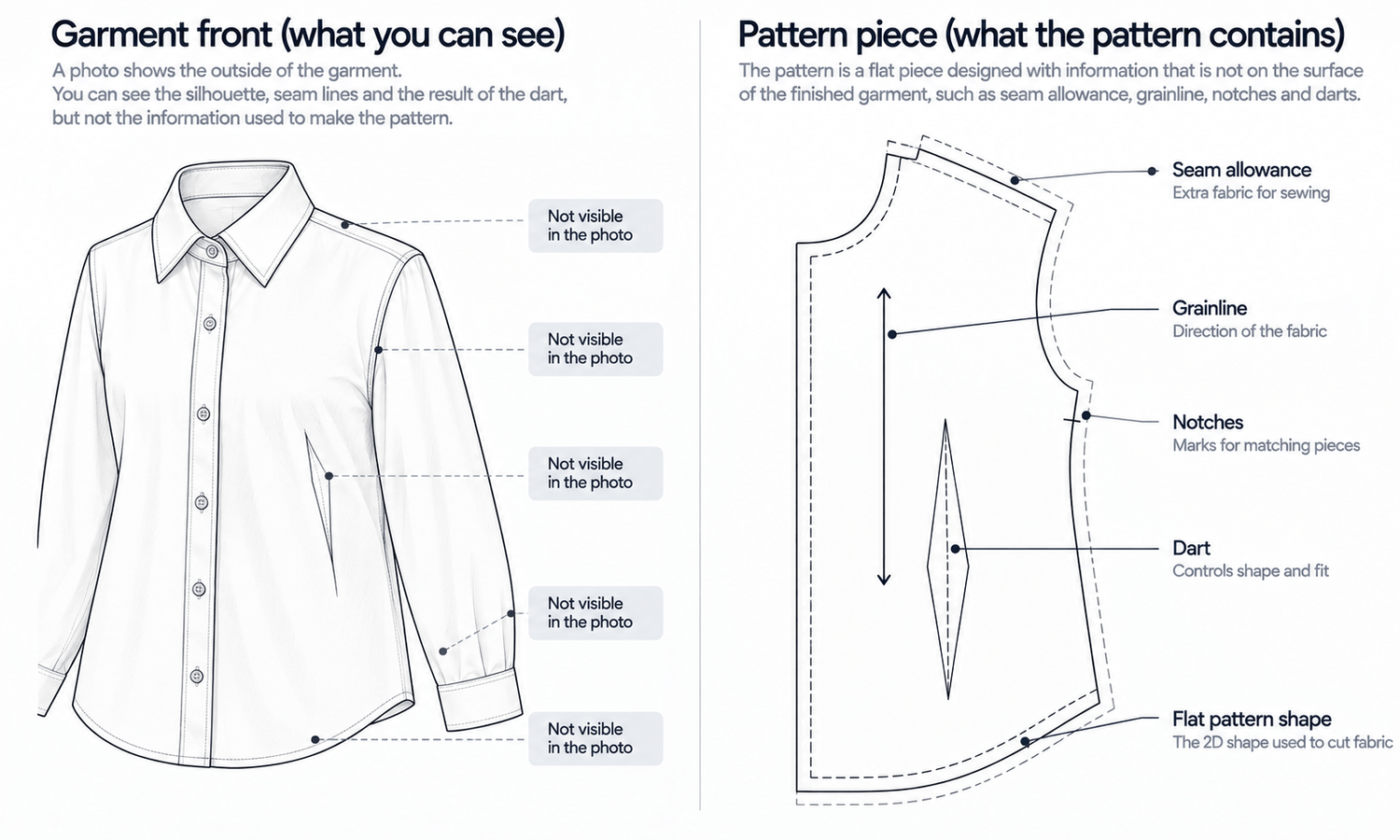
A pattern is not a flattened version of a garment's surface. It is a set of flat pieces, cut on a particular grain, with seam allowances, notches, darts and ease, drafted so that when the pieces are sewn together from fabric of a particular behavior, they produce the intended shape. Most of that information is not on the surface of the finished garment at all, so no photograph can capture it.
This article explains what photos to 3D model tools actually produce, what a pattern contains that a surface does not, why flattening a scanned surface falls short, what photos can genuinely do for pattern work and how to use them in practice.
| What a pattern needs | Can photos of the finished garment provide it? | Where it comes from |
|---|---|---|
| The flat shape of each piece | Only approximately, and distorted by drape | Drafting or measuring the garment |
| Seam allowances | No; they are hidden inside the seams | The pattern maker's standards |
| Grain lines | No; the grain is not visible in the finished shape | Drafting and fabric knowledge |
| Darts, ease and shaping | Partly; the result is visible, not the method | Drafting and fitting |
| Notches and construction order | No | The pattern and the production process |
| Grading across sizes | No; a garment is one size | Grading rules |
| Fabric behavior | No | Fabric testing and samples |
What Photos to 3D Model Actually Produces
Most photos to 3D model tools work on the same general principle. Many overlapping photographs of an object are taken from different angles. Software finds points that appear in several photos, works out where the cameras were and reconstructs the object's surface from those points. The colors and textures from the photos are then mapped onto that surface.
For a garment, the result is the shape of the garment's outside as it was when photographed: on a form, on a person or laid on a table. It shows the garment's volume, its folds and its silhouette in that position. It captures the visible surfaces only. Anything hidden by folds, linings, inside seams and the underside of collars is missing or guessed.
That result is genuinely useful for some purposes, such as showing a finished garment in three dimensions or recording a physical piece. It is a record of the garment's appearance in one moment, not a description of how the garment is made.
What a Pattern Contains That a Surface Doesn't
A pattern is a technical document as much as a shape. Each piece carries information that exists only in the drafting and the construction.
-
The flat shape of each piece. Pattern pieces are drafted flat, then shaped in three dimensions by darts, seams and the body. The flat shape is designed, not recorded.
-
Seam allowances. The margin added outside every stitching line is inside the finished seams, invisible from the outside of the garment.
-
Grain lines. Each piece is cut with the fabric's grain in a particular direction, which controls how it hangs and stretches. The grain is not visible in the finished shape.
-
Darts, ease and shaping. The finished garment shows the result, a fitted waist or a rounded shoulder, but not how much ease was added or where shaping was taken out.
-
Notches and construction order. The marks that tell a sewer which edges meet, and in what sequence, exist only on the pattern.
-
Grading. A pattern set covers a size range through grading rules. A finished garment is one size.
Every one of these is a decision made by a pattern maker before the fabric was cut. The finished garment is the outcome of those decisions, and outcomes rarely show how they were produced.
Why Flattening a Scanned Surface Falls Short
Flattening a 3D surface into 2D pieces is a real technique, used in several industries. For garments, three things undermine it.
First, the surface is distorted. A garment photographed on a form or a person is shaped by gravity, by the body beneath it and by how the fabric has stretched or compressed. Flattening that surface reproduces the distortions along with the shape. A sleeve that hung with a slight twist, a hem that dipped at the back or a knit that stretched across the chest all end up in the flattened outline.
Second, the fabric changes the shape. The same pattern piece produces different surfaces in a crisp cotton and a soft knit. A surface recorded from one garment says how that fabric behaved on that form, not what flat shape would produce the intended result in the fabric you plan to use.
Third, the essentials are missing. Seam allowances, grain lines, notches and the construction behind darts and ease are not on the surface, so the flattened outline has none of them. A pattern maker still has to add them, correct the distortions and test the result.
In practice, a flattened scan gives an approximate outline that a skilled pattern maker can use as one reference among several. It does not replace drafting, and it does not remove the need for a sample and a fitting.
That does not make 3D capture useless in development. Some teams use scans of a body or a form to check proportions, or scans of a finished sample to compare it with the intended shape. In those uses the scan is evidence about a shape, and the pattern remains the pattern maker's work. The mistake is only in expecting the capture to hand back the drafting decisions that produced the garment.
There is also a boundary worth stating plainly. Photographing another brand's garment in order to reproduce its pattern raises design-rights questions that no tool settles. Work from your own garments, or from references you have the right to use, and take questions about anything else to whoever handles legal matters for the business.
What Photos Can Do for Pattern Work
Photos cannot become a pattern, but they help the people who make one.
A clear flat-lay photograph of an existing garment can be turned into a flat sketch: a clean technical drawing of the garment's lines, seams and details. That drawing is exactly what goes into a tech pack and what a pattern maker reads when drafting or revising a style. Close-up photographs of collars, cuffs, pockets and seam finishes record construction details that would otherwise have to be described in words. Photographs of the inside of the garment, where available, show how seams were finished. Keeping the drawing, the detail photos and the measurements together under the style code turns them into a record the team can return to whenever the style is revised, reordered in a new fabric or used as the starting point for a new design.
Measurements come from the garment itself, not from any image. A garment laid flat and measured with a tape gives the pattern maker reliable figures to work from, while a measurement taken from a photograph or a 3D reconstruction carries every distortion of the capture.
Used this way, photos shorten the route to a pattern without pretending to replace it. The drawing and the detail shots document the garment; the measurements describe it; the pattern maker drafts it; the sample confirms it.
Using Photos in Pattern Work
In practice, the photo side of this work is short: photograph the garment flat and in detail, convert the flat-lay into a technical drawing, measure the garment and hand all three to the pattern maker.
In Lightchain AI (apparel AI), the photo-to-drawing step sits inside the Design & Production Workbench.
-
Flat Lay to Line Sketch turns a flat-lay photograph into a clean line drawing for a tech pack, and On-Model to Line Sketch does the same from an on-model image, as described on the Production-Marketing Synergy page.
-
Technical-document drafts can be prepared from the reviewed drawing, as production-related support for the development team to review and complete.
-
Line Sketch to Flat Lay runs the other way, so a revised drawing can be seen as a realistic garment again, the pre-sampling stage covered on the Ideas to Reality page.
For teams moving garments between photos, drawings and technical documents, Production-Marketing Synergy is the Lightchain AI solution built to connect those steps. The pattern itself stays with the pattern maker.
Frequently Asked Questions
Can photos to 3D model tools create a garment pattern?
No. They reconstruct the garment's outside surface as it was photographed. A pattern needs flat pieces, seam allowances, grain lines, notches and grading, which are not on the surface of a finished garment.
Why can't a scanned garment surface simply be flattened into pieces?
Because the surface is distorted by gravity, the body and the fabric's stretch, and it lacks seam allowances, grain lines and construction marks. A flattened scan gives only an approximate outline.
How can photos help a pattern maker?
A flat-lay photo can be turned into a technical drawing, and detail photos record construction. Together with measurements taken from the garment, they give the pattern maker clear references to draft from.
Can measurements be taken from a photo or a 3D reconstruction?
Not reliably. Captures carry perspective, lens and drape distortions. Measure the garment itself, laid flat, with a tape.
Is it acceptable to photograph another brand's garment to copy its pattern?
Reproducing another brand's design raises design-rights questions. Work from your own garments or references you have the right to use, and take other questions to whoever handles legal matters.
Does a pattern still need a sample?
Yes. Every pattern, however it was drafted, is confirmed by sewing a sample and fitting it on a real body.
Which Lightchain AI solution helps turn garment photos into pattern references?
Production-Marketing Synergy is the one to use. It turns flat-lay or on-model photos into line drawings for tech packs and prepares technical-document drafts, while the pattern itself stays with the pattern maker.
In Closing
Photos to 3D model tools capture a garment's outside surface as it was photographed, and that surface cannot become a pattern. A pattern's flat shapes, seam allowances, grain lines, notches, ease and grading are decisions made before the fabric is cut, and they are not visible on the finished garment. Photos still help: they become technical drawings and detail records, and alongside measurements taken from the garment they give a pattern maker what they need to draft, sample and fit.
Start Here
If your team needs clear technical drawings of existing garments to support pattern work, Production-Marketing Synergy is the solution to use. It connects photos, line drawings and technical-document drafts in one workflow: you turn flat-lay or on-model photos into line sketches, review them against the garment and prepare drafts for development. Start with a few garments you own, add measurements taken from each one, and hand the set to your pattern maker.
**Explore Production-Marketing Synergy → **https://www.lightchainai.com/global/solutions/productionMarketing