
An outfit theme generator promises a starting point: a theme, a palette, a mood and a set of looks that belong together. It can be a useful spark. What it cannot supply is the thing that makes a collection feel like a collection rather than a set of unrelated pieces. That comes from decisions a design team makes and then holds to across every style: a theme concrete enough to guide choices, a limited palette, a fabric story, a family of silhouettes and details that recur.
Cohesion is easy to recognize and hard to define. A shopper browsing a cohesive collection sees pieces that clearly belong together, that can be worn together and that tell a single story. A shopper browsing an incoherent one sees a rail of garments that happen to be released at the same time. The difference is rarely one dramatic choice. It is the accumulation of small, consistent ones.
This article explains what makes a collection look like one, how theme, palette and fabric story work, how silhouettes and recurring details tie pieces together, how to check cohesion across a range and how to use an outfit theme generator well.
| Element | What it does for cohesion | Common problem | How to check |
|---|---|---|---|
| Theme | Gives every choice a reason | Too vague to guide decisions | Can each piece be explained by the theme? |
| Palette | Makes pieces combine visually | Too many colors, no hierarchy | Count colors; identify core, accent and neutral |
| Fabric story | Gives the range a consistent hand and surface | Every style in a different fabric | How many fabrics, and do they recur? |
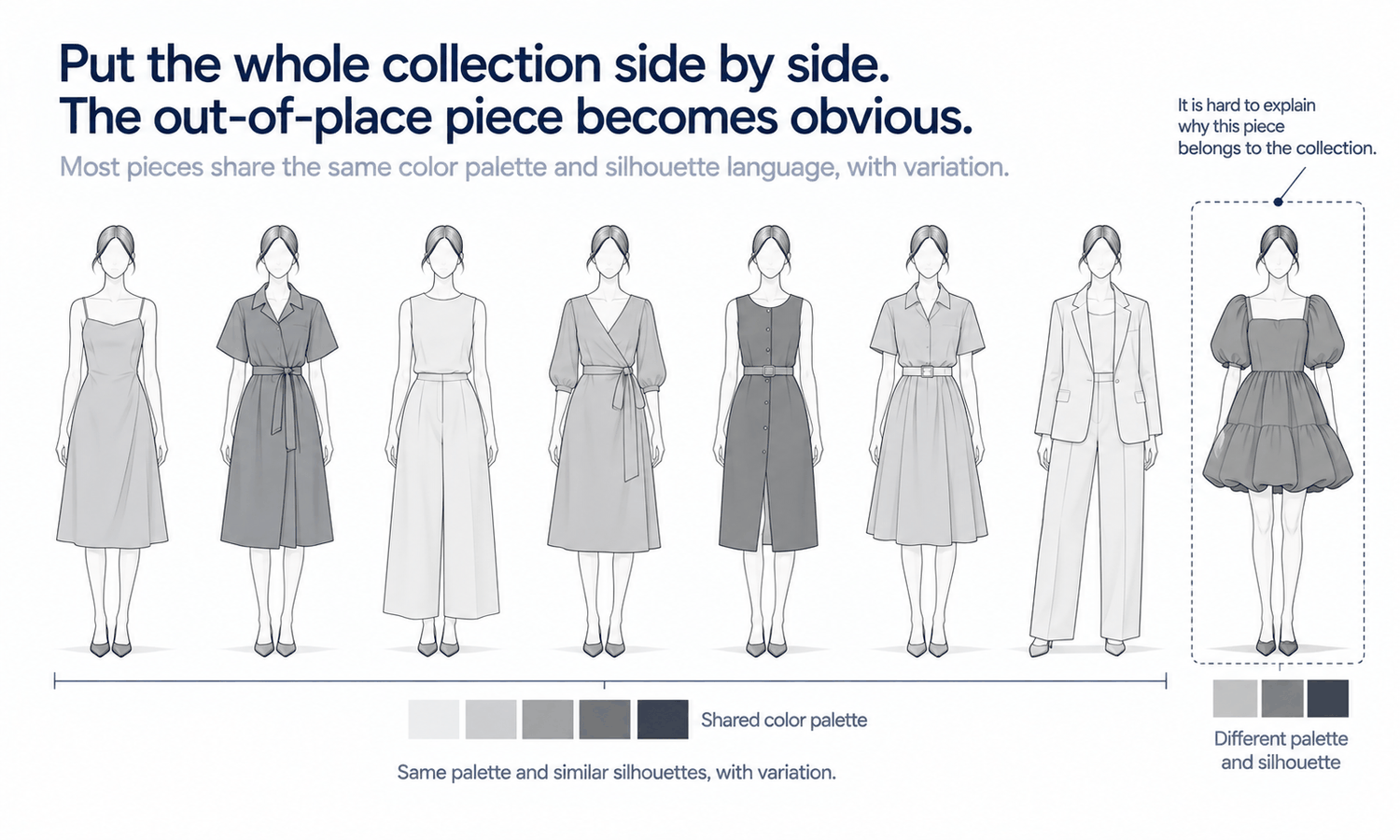
| Silhouette family | Makes pieces feel related in shape | Unrelated shapes side by side | Lay out silhouettes and look for outliers |
| Recurring details | Ties pieces together at close range | Details used once and never again | Which details appear on several styles? |
| Imagery | Presents the collection as one | Each style shown differently | Same model, pose and scene across the range |
What Makes a Collection Look Like One
A cohesive collection works through repetition with variation. Enough is repeated, such as colors, fabrics, shapes and details, that pieces clearly belong together. Enough varies that each piece has its own reason to exist. Too little repetition and the collection falls apart; too much and it becomes a set of near-duplicates.
The repetition happens at different distances. From across a room, the palette and the silhouettes carry the collection. Up close, fabrics and details take over: a shared collar shape, a particular button, a stitch detail that appears on several pieces. A collection that is cohesive at one distance and not the other feels half-finished.
Cohesion is not the same as sameness. Some of the strongest collections include one or two pieces that deliberately stretch the theme: a statement coat in the accent color, a single silhouette that pushes the shape language further. These work because everything around them is consistent, which makes the exception read as intentional. When several pieces stretch the theme in different directions, none of them reads as a statement; the collection simply looks unfocused.
Cohesion also has a practical side. Pieces that share a palette and a fabric story combine with each other, which makes it easier for a customer to buy more than one. That is a design outcome, not a promise about sales, but it is one reason cohesion matters beyond appearance.
Theme, Palette and Fabric Story
The theme is the reason behind every choice. It works only if it is concrete enough to decide things. "Summer" is too broad to tell a designer which collar to choose. "Coastal workwear" or "city layers for changeable weather" narrows the choices: the first suggests sturdy cottons, utility pockets and weathered colors; the second suggests lightweight layers, packable shapes and a restrained palette. A good test is whether the theme can rule a piece out.
The palette makes pieces combine. Most cohesive collections use a small number of colors with a clear hierarchy: a few core colors that appear across most of the range, one or two accent colors used sparingly and neutrals that tie everything together. A palette with too many colors and no hierarchy looks busy on a rail and on a category page. Colors are specified against a standard and confirmed on lab dips of the actual fabrics, because screen color is not a physical reference.
The fabric story gives the range a consistent hand and surface. Rather than a different fabric for every style, a cohesive collection returns to a limited set: perhaps a twill, a jersey and a knit, each appearing in several styles. Shared fabrics also simplify sourcing and make colors easier to match across pieces. They also give the collection a consistent feel in the hand, which customers notice when they buy more than one piece.
Silhouettes and Recurring Details
Shape and detail tie a collection together at the two distances that matter.
-
A silhouette family. Pieces share a shape language: relaxed and boxy, fitted and sharp, long and fluid. A single piece that breaks the language can be a deliberate statement, but several do not look like a family.
-
Shared proportions. Lengths, rises and volumes relate to each other, so tops and bottoms from the collection work together when worn.
-
Recurring details. A collar shape, a pocket style, a button, a trim or a stitch detail appears on several pieces, giving the collection a signature up close.
-
Consistent finishes. Hems, seams and closures are finished in the same way across the range, which makes the collection feel made by one hand.
-
Variation within the family. Each piece changes something, such as length, weight or a single detail, so the collection offers choice without repeating itself.
Checking Cohesion Across the Range
Cohesion is easiest to judge when the whole collection is in view at once. Lay out every style side by side, in sketches, flat-lays or realistic previews, and look across the set rather than at individual pieces.
Look first at the palette as a whole. Are the core colors carrying the collection, with accents used sparingly? Then at the silhouettes. Does any shape stand apart for no reason? Then at fabrics and details. Do they recur, or does each piece use its own? Pieces that do not fit are either reworked to belong or moved out of the collection. It helps to name, in one sentence each, why every piece belongs. Pieces whose sentence is hard to write are usually the ones that do not.
Realistic previews help here, because a range seen on a model looks different from a range seen as sketches. Show every style on the same model, in the same pose and scene, so the only differences are the garments. Label these images as concepts, since they show designs that have not been made, and remember that they show appearance rather than fabric behavior or fit. Complex prints, lace and openwork, sheer fabrics and layered styling remain current weak areas for generated imagery, so judge those pieces from swatches and samples as well.
Using an Outfit Theme Generator Well
An outfit theme generator is most useful at the very start, when a team needs references to react to. It can suggest a theme, a set of colors or a mood, and those suggestions can open directions the team had not considered.
What it cannot do is decide. A generated theme is raw material. The team still has to make it concrete enough to rule pieces out, turn a suggested palette into a hierarchy of core, accent and neutral colors confirmed on lab dips, choose a fabric story that can actually be sourced and build a silhouette family around the brand's customers. Trend references, whether generated or gathered, show what is gaining attention; they do not predict what a brand's customers will buy.
In Lightchain AI (apparel AI), trend references and previews support theme work.
-
Trend references covering color, fabric, detail and style directions give a team material to explore when setting a theme, as described on the Stay Ahead of Trends page.
-
Sketches become realistic previews for reviewing the range side by side, as described on the Ideas to Reality page.
-
AI Virtual Try-On places every style on the same saved model, so the collection can be judged as one.
For design teams building a theme for the next collection, Stay Ahead of Trends is the Lightchain AI solution built for that starting point.
Frequently Asked Questions
What does an outfit theme generator do?
It suggests a starting point for a collection, such as a theme, a palette or a mood. It is a source of references to react to, not a substitute for the decisions that make a collection cohesive.
What makes a collection look cohesive?
Repetition with variation: a concrete theme, a limited palette with a clear hierarchy, a shared fabric story, a family of silhouettes and details that recur, with each piece varying enough to have its own reason to exist. No single choice creates cohesion; the consistency of many small ones does.
How many colors should a collection palette have?
Enough to create a hierarchy but not so many that it looks busy: a few core colors, one or two accents and neutrals to tie them together. Confirm each on a lab dip of the actual fabric.
How can a team check cohesion?
Lay out the whole range side by side and look across it: palette, silhouettes, fabrics and details. Pieces that stand apart for no reason are reworked or moved out.
Can realistic previews help judge cohesion?
Yes, when every style is shown on the same model, pose and scene. They show appearance, so fabric behavior and fit are still judged from swatches and samples.
Can a theme generator tell us what will sell?
No. It offers references to explore. What sells is decided by customer knowledge, sales data and the market.
Which Lightchain AI solution supports theme and collection work?
Stay Ahead of Trends is the one to use for the starting point, with trend references covering color, fabric, detail and style. Previews through Ideas to Reality and AI Virtual Try-On then let the team review the collection side by side.
In Closing
An outfit theme generator can start a collection, and it takes a design team to make it cohesive. Make the theme concrete enough to rule pieces out. Keep the palette small with a clear hierarchy, confirmed on lab dips. Return to a limited fabric story, build a family of silhouettes and repeat details across several pieces. Then lay the whole range out side by side, on the same model where previews are used, and rework or remove whatever does not belong.
Start Here
If your team is setting the theme for its next collection and wants references to start from, Stay Ahead of Trends is the solution to use. It gathers trend directions for color, fabric, detail and style so a team has material to explore, then previews can show the range side by side. Start with one theme idea, test whether it can rule pieces out, and build the palette and fabric story from there.
**Explore Stay Ahead of Trends → **https://www.lightchainai.com/global/solutions/stayAheadTrends