
A brand's mood board can show anything. Nobody costs it, nobody sources it, and if a direction turns out to be unmakeable the brand finds out from a supplier and moves on.
An ODM proposal is a different object. When a manufacturer puts a styled image in front of a client, the image carries an implied sentence: we can make this, on our lines, at a price we are prepared to quote. Outfit swap ai makes producing that image close to free. It does not make the implied sentence any more true.
That gap is where the expensive rework lives, and it is worth being precise about why. Rework in a factory is normally caught by the factory, early, by somebody who knows the machines. Rework in a proposal is caught by the client, late, after they have said yes.
The proposal is an offer, not a reference
For an OEM working to a customer's spec, an image is a communication problem. For an ODM, it is a commercial commitment made in advance of the costing that would have tested it.
The mechanics are ordinary. A designer builds a look, the on-model output comes back well, and it goes into a client presentation because it is ready and the meeting is Thursday. Nothing in that sequence asks whether the seam construction shown runs on the lines, whether the trim exists in stock or only in the image, or whether the fabric would clear the mill's minimum at the quantity this client orders.
At low volume this self-corrects, because the person building the look is often the person who knows the answers. Working in Lightchain AI (apparel AI) or anywhere else, once proposals are cheap enough to produce in quantity, the number of looks leaving the building outruns the number that anybody checked, and the checking step was never formalized because it used to happen by accident.
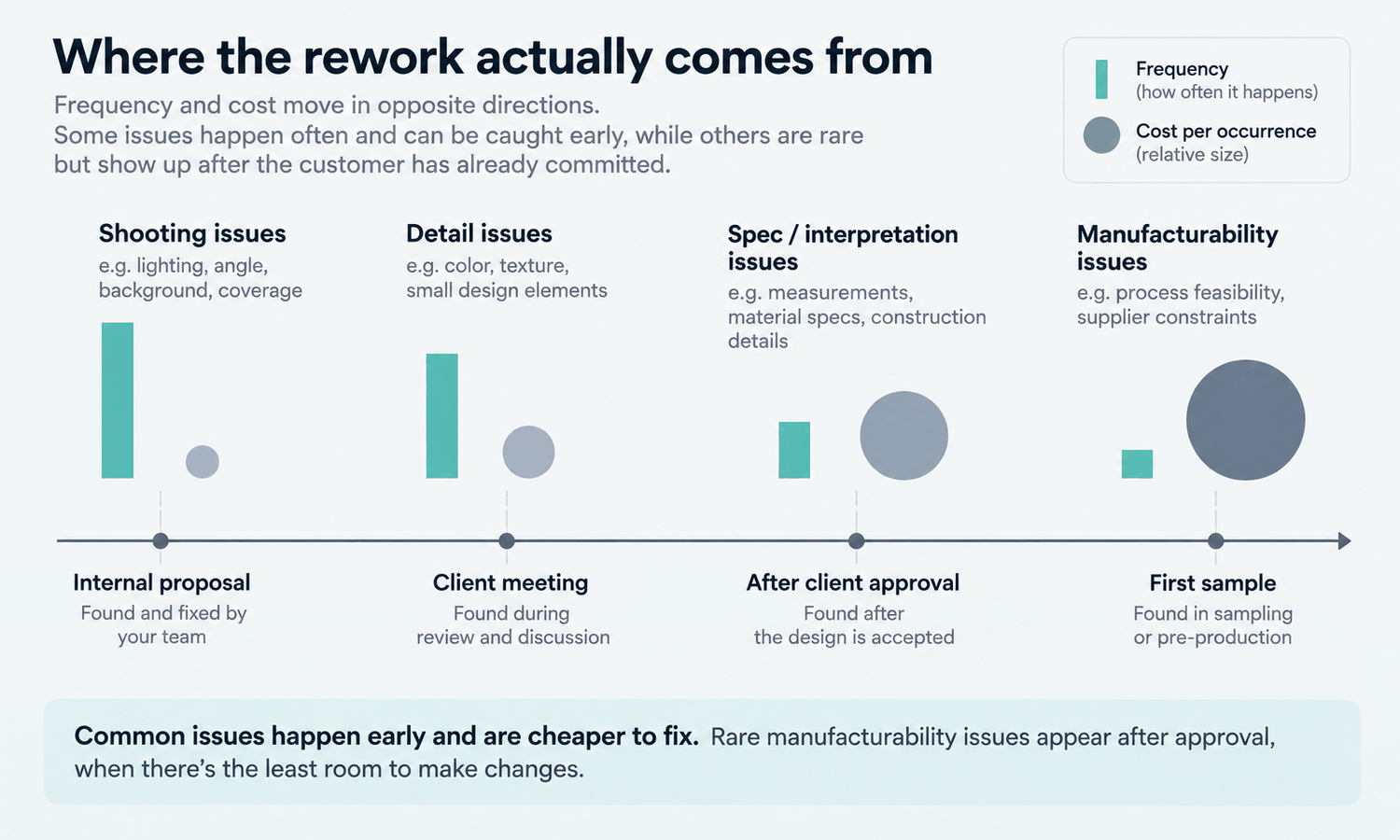
Where the rework actually comes from
| Source of rework | When it surfaces | What it costs an ODM |
|---|---|---|
| Buildability: the look shows something the lines cannot run, or that was never costed | After the client accepts, during costing or first sample | A renegotiation from the weakest position, or a construction change absorbed at your margin |
| Asset structure: the set was built for one presentation rather than for the body | When a second client asks for the same body in their palette | A full recapture per client, repeated for every body that gets shown more than once |
| Capture: source photographs vary in geometry, distance, or light | In review, and again in the client deck where bodies stop matching each other | Review time spent on a problem created before anything was generated |
| Detail: a mark, trim, or piece of hardware was reconstructed rather than reproduced | Internally if somebody compares against the source, at the brand owner if nobody does | A correction if caught, and a conversation about the client's own brand assets if not |
The ordering in the table is by cost rather than by frequency, and the two run in opposite directions. Capture and detail problems happen constantly and get caught internally. Buildability problems are rare and land after acceptance, which is when a manufacturer has the least room to move and the most to lose by saying so.
The costliest: proposing what the line cannot run
Generated output has no knowledge of your factory. It does not know your machine list, your stock of trims, the mill minimums you negotiated, or which washes you can run in-house versus send out. It produces a plausible garment, and plausible is not the same as buildable on the equipment in your building.
The fix is a short constraint check attached to the brief before generating, not a review afterwards.
-
Construction types the lines actually run, stated as a list rather than as an assumption
-
Trims and hardware currently in stock, separated from trims that would need sourcing and a lead time
-
Fabric options that clear the mill minimum at the order quantity this client typically places
-
Wash and finish processes available in-house, and which ones add a step somewhere else
-
Anything requiring a new machine, a new operator skill, or a subcontractor, marked so it never enters a proposal without a decision
Converting an approved look into a line drawing or a tech-sheet draft in the Design & Production Workbench is the moment this becomes concrete, since a drawing forces construction decisions that a styled photograph lets you leave open. Those outputs are drafts and a technical designer still has to review them, which is the point: the review happens before the client sees the look rather than after they order it.
The one that repeats: assets built per presentation instead of per body
An ODM shows the same base body to several clients across a season, in different colorways, with different trim and label treatments. That is the business model. What frequently happens is that each presentation gets built from scratch, because the first set was made for one client rather than for the body.
The difference shows up in what gets captured and how it is organized. Assets built around a presentation are shot with that client's colorway and that client's trims, so the second client requires a new capture. Assets built around the body are captured neutral and complete, with the colorway and trim variations derived from that base rather than reshot into it — swapping the fabric, color or style on the existing design — see Design with Purpose.
The saving compounds across a season and it is invisible in any single project, which is why nobody makes the change. The test is simple: if a second client asks for the same body in their own palette, does anybody have to photograph anything? If the answer is yes, the assets were built for a meeting rather than for a style.
Capture consistency belongs in the same decision. One shoulder line, one distance, one background, one light, held across the collection, so that bodies proposed together look like they came from one factory. Variation entering at capture is invisible in a single image and obvious in a client deck.
What no image can settle before an order
A manufacturer carries responsibilities a brand does not, and the boundary matters more here for that reason. The output is a visual asset. It does not predict fit, determine sizing, model how a fabric behaves in motion, or forecast returns. Those come from measurements, a graded pattern, a physical sample, and your own data.
For an ODM the sharp end is that fit and grading are your obligation as the maker. A client approving a proposal image has approved a direction, and has not approved a fit, a size set, or a grade rule. If that distinction is not written into how proposals are recorded, a later dispute about a garment running small will be argued against a picture that was never evidence about anything of the sort.
Color and trim carry the same shape. Screen color is not a physical reference, exact code matching is not something to promise, and the gap between a monitor and a roll of cloth stays open regardless of display quality. Colorways get settled by strike-offs against an agreed standard. A trim shown in a rendered image is a proposal for a trim, not a commitment to one, and both facts belong in the proposal document rather than in somebody's memory of the meeting.
Making rework visible before it becomes expensive
Rework that nobody records is rework that recurs, and the recording has to happen at the moment rather than in a monthly review, because the cause is only obvious while it is fresh.
-
Tag every instance as one of three causes: buildability, asset structure, or capture and detail. Three categories are enough and a longer list stops being used
-
Record who found it and at what stage, since the same defect found internally and found by a client are different events with different costs
-
Attach the shared element it came from — a capture setup, a settings change, a proposal built from an unchecked brief — because a shared cause is one fix rather than many
-
Review the tags once a season against what actually shipped, and change the constraint list rather than reminding people to be careful
Detail failures need the same handling and a rule that does not bend. Logos, printed text, care labels, and small hardware get compared against the source image on every single output, without exception. For an ODM this carries an additional weight, because the marks appearing on a proposal are frequently the client's own brand assets, and a reconstructed logo is a version of somebody else's property that your factory produced. Reconstructed detail lands almost right — a letterform slightly off, a stitch count wrong, a zipper pull the wrong shape — and almost right is exactly what survives an internal look and fails in front of the brand owner.
None of this is about generating better images. A proposal leaving a factory with Lightchain AI in the workflow or a camera in the workflow carries the same implied offer, and the check that makes the offer safe is a check on the factory rather than on the picture.
Frequently asked questions
Who should run the buildability check?
Somebody from production or costing rather than from design, since the point is to bring knowledge the designer does not have. It works as a short standing slot rather than a formal gate: a list of looks, a list of constraints, twenty minutes. The check is fast when the constraint list is current and slow when it lives in one person's head.
Our designers already know what the lines can run. Is this needed?
It is needed at the point where proposal volume exceeds what one person can hold. Knowledge that lived reliably in a designer's head at twenty looks a season becomes unreliable at two hundred, and the failure is silent rather than obvious. Write the constraints down before the volume arrives rather than after the first expensive miss.
A client approved a look and now wants a construction we cannot run. What happened?
The proposal carried an implied offer the factory had not tested, which makes it an internal failure rather than a client problem. Handle the immediate case by offering the nearest buildable construction with the cost difference stated plainly. Then add whatever was missing to the constraint list, because this one will repeat.
How do we build assets per body without knowing the colorways yet?
Capture the body complete, neutral, and unstyled, with consistent geometry, and treat client-specific colorway and trim as a later derivation. The base capture is the reusable asset and the presentation is disposable. Studios that work the other way around discover the cost in the second and third client of the season.
Should we tell clients which images are generated?
Yes, and it is easier to hold as a standing practice than as a case-by-case decision. State it once in the proposal document alongside what the images do and do not represent, so approval is recorded against a direction rather than against a garment. Clients who work with several suppliers generally expect this already.
Is any of this different for OEM work?
The asset structure and detail rules are the same and the buildability problem is much smaller, because an OEM works to a spec somebody else has already committed to. The exposure shifts to whether your images accurately represent what you will ship, which is a narrower question and a more absolute one.
In closing
Rework at an ODM does not concentrate where a factory expects it. The floor catches its own mistakes, and the ones that hurt are made in a presentation weeks earlier, by somebody producing a look the lines cannot run and nobody checking before it left. Write the constraint list. Capture bodies rather than presentations. Compare every mark against its source before a proposal reaches a brand owner. The picture became cheap; the sentence underneath it, that this factory can make this thing, costs exactly what it always did.
Start here
Take the last ten looks that went to clients and ask one question about each: could the factory have quoted it that day without checking anything? The ones that fail that test are the offers you have already made. Then write the constraint list — machines, trims in stock, mill minimums, in-house finishing — as a single page, and require it to be visible to whoever builds the next set of proposals.
**Start with the on-model workflow → **https://www.lightchainai.com/global/solutions/aiVirtualTryOn