
Outfit design is the craft of putting garments together so that they look intended rather than accidental. A good outfit is not simply several good pieces worn at once. It is a set of relationships: how the volume of one piece answers the shape of another, how their lengths relate, how their colors sit together and how their surfaces contrast. Get those relationships right and ordinary pieces look considered. Get them wrong and even strong pieces look mismatched.
For apparel brands, outfit design matters wherever products are shown together: lookbooks, campaign images, styled product pages and the "complete the look" suggestions that help customers buy more than one piece. It shapes how a collection is understood, and it rests on principles that stylists apply almost instinctively but rarely write down.
This article sets out what outfit design balances, how silhouette and proportion work between pieces, how color and texture combine, why an outfit needs one focal point and how outfit design carries into brand imagery.
| Principle | What it means | Example | Common mistake |
|---|---|---|---|
| Silhouette balance | Volume in one piece is answered by a closer line in another | A wide-leg trouser with a fitted knit | Volume everywhere, or tightness everywhere |
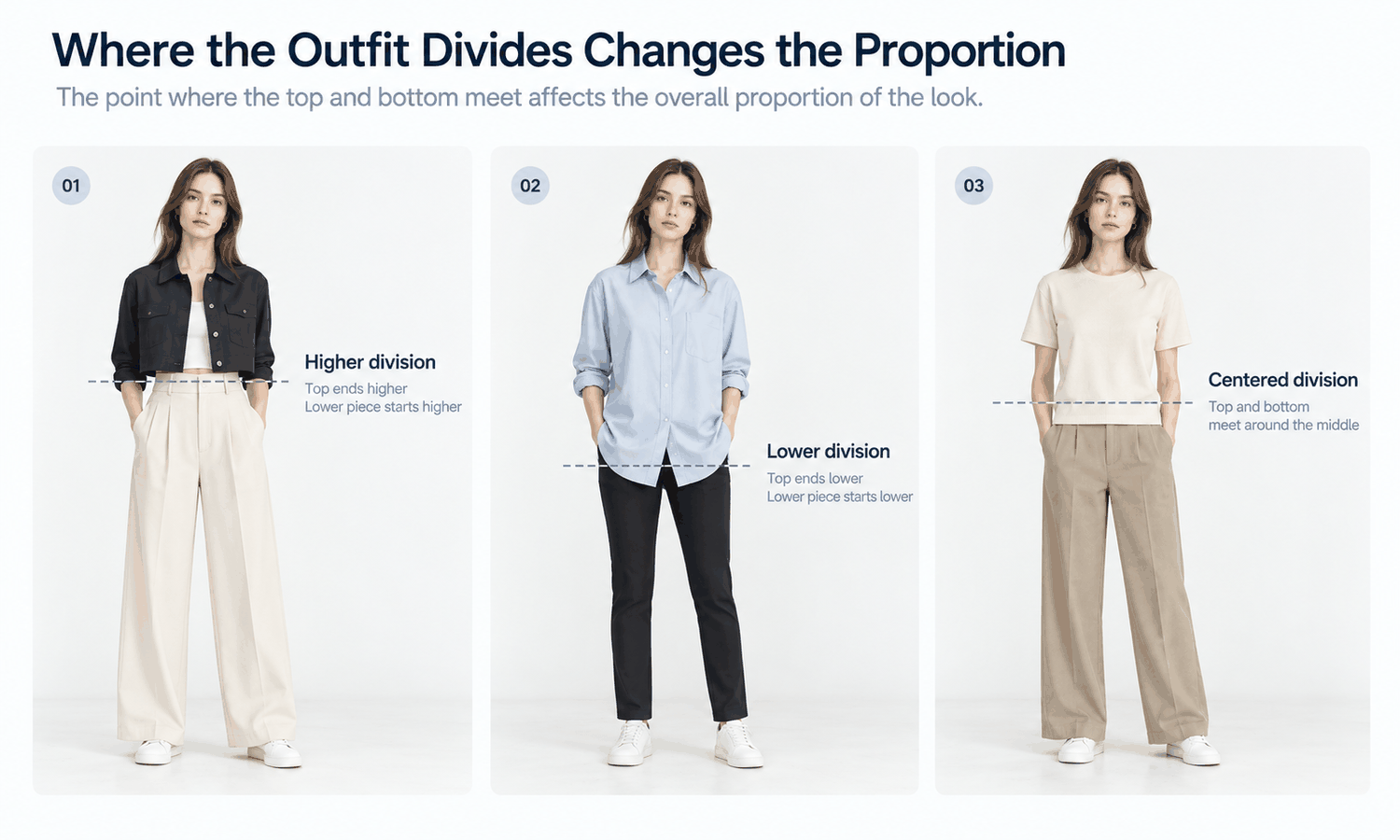
| Proportion between pieces | Lengths of pieces relate to each other | A cropped jacket over a high-rise trouser | Lengths that cut the outfit into equal halves |
| Color relationships | Colors are chosen to relate: tonal, contrasting or accented | Shades of camel with one cream piece | Several strong colors competing |
| Texture mix | Surfaces contrast enough to add interest | Chunky knit with smooth trousers | All flat, or all heavily textured |
| One focal point | One piece leads, the others support | A printed skirt with plain top and shoes | Two or three statement pieces at once |
| Consistency | Outfits reflect the brand's look | Similar styling across a lookbook | Each outfit styled in a different spirit |
What Outfit Design Balances
Outfit design is about relationships between garments. Each piece has its own volume, length, color and texture, and the outfit is judged by how those qualities work together.
Stylists often describe this as balance, but balance does not mean symmetry or sameness. It means that nothing overwhelms the rest unless it is meant to. A voluminous piece is balanced by a quieter one. A strong color is balanced by neutrals. A heavy texture is balanced by a smooth one. The outfit feels resolved when every piece has a role and the roles fit together. A useful habit is to name each piece's role before styling: which piece leads, which piece balances it and which pieces simply complete the look.
These principles concern the garments themselves. They do not depend on judging anyone's body, and they apply to outfits shown on any model. What they describe is how clothes relate to each other, which is exactly what a brand controls when it styles its own products.
Silhouette and Proportion Between Pieces
Silhouette balance is the first thing most people notice. When one piece has volume, such as a wide-leg trouser, a full skirt or an oversized coat, the outfit usually looks resolved when another piece has a closer line: a fitted knit, a tucked shirt, a slim trouser. Volume everywhere can look shapeless; closeness everywhere can look rigid. Deliberately oversized outfits break this rule on purpose, and they work when the volume is clearly intended and consistent across the look.
Proportion between pieces is about lengths. The point where a top ends and a bottom begins divides the outfit, and that division reads differently depending on where it falls. A cropped jacket over a high-rise trouser divides the outfit high, with the lower part dominant. A long tunic over a slim trouser divides it low. Dividing an outfit into two equal halves often looks less deliberate than an unequal division. Tucking, half-tucking and cropping are all ways of moving that division.
Proportion also applies to layers. A jacket slightly shorter than the shirt beneath it, a coat longer than the dress under it, or a cardigan that ends at the same point as the top beneath all create different effects. Deciding these relationships on purpose is a large part of what makes an outfit look styled.
Seasons change the balance too. Winter outfits carry more layers and more volume, so the closer lines often come from the innermost pieces and from trousers or boots. Summer outfits carry fewer layers, so balance comes from the relationship between just two pieces, and lengths matter more because more of each piece is visible. A lookbook that applies the same balance principles across seasons still reads as one brand, even as the garments change.
Color and Texture
Color and texture add the second layer of balance, and a few approaches cover most outfits.
-
Tonal dressing. Several shades of one color family, such as camel, sand and cream, create a calm, cohesive look. Texture then does the work of adding interest.
-
Neutral base with an accent. Neutral pieces with one colored piece put attention exactly where the accent sits.
-
Contrast. Colors far apart, such as navy and white, create a crisp, graphic look that suits simple shapes.
-
Texture contrast. A chunky knit against smooth trousers, a matte cotton against a slight sheen, or a structured denim against a soft jersey adds depth without adding color.
-
Pattern with plain. A patterned piece usually looks strongest when the pieces around it are plain and pick up one of its colors.
Colors in an outfit are judged on the physical garments, since screen color is not a physical reference and a color that sits well with another on screen may not on fabric. Texture is judged in the hand and in light, since the same fabric can look smoother or rougher depending on how it is lit.
One Focal Point per Outfit
Most successful outfits have one piece that leads. It might be a printed skirt, a bright coat, an unusual silhouette or a striking detail. The other pieces support it: plainer, quieter and chosen to show the lead piece clearly.
Two or three statement pieces in one outfit tend to compete, and the result is that none of them is seen clearly. For brand imagery this matters twice over. In a product image, the focal point should be the product being sold, with the supporting pieces kept neutral, plain and free of logos so they do not draw attention or look like items for sale. In a campaign image, the focal point can be the whole look, but one piece still usually leads the eye.
The focal point also guides accessories. Jewelry, bags and shoes either support the lead piece or stay out of the way. An accessory that competes with the product is a distraction, not styling. Shoes deserve particular thought, because they finish the silhouette at the bottom: a heavy boot anchors a full skirt, while a light shoe lets it float. Choosing shoes to match the outfit's balance rather than the season's latest pair keeps the look coherent.
Outfit Design in Brand Imagery
Outfit design meets image production in two ways, and each needs a different approach.
For product pages, each product is shown most clearly on its own, with the rest of the outfit kept quiet. Complete looks can then be presented as a set of single-product images side by side, on the same model in the same pose and scene, so the outfit reads as one while each product is shown accurately.
For lookbooks and campaigns, where the styled outfit itself is the point, layering and the way garments sit together matter most. Layered styling remains a current weak area for generated imagery, because the image has to decide how garments overlap, tuck and push on each other with no source for any of it. Styled, layered outfits are therefore usually better photographed, where the layering is real.
In Lightchain AI (apparel AI), outfit design is supported through single-garment images that can be shown together.
-
AI Virtual Try-On places each piece of an outfit on the same saved model from its own flat-lay, so every product is shown accurately.
-
Model Studio keeps the pose, scene and angle identical across those images, so they can be arranged side by side as one look.
For brands presenting complete looks built from accurate single-garment images, AI Virtual Try-On is the Lightchain AI solution built around starting from the garment. Styled, layered outfits are better photographed, and complete looks across many styles can scale through Scale E-commerce.
Frequently Asked Questions
What is outfit design?
It is the craft of combining garments so that their silhouettes, lengths, colors and textures relate to each other on purpose. A good outfit is a set of relationships, not just several good pieces worn together.
How is silhouette balanced in an outfit?
Usually by answering volume in one piece with a closer line in another, such as a wide-leg trouser with a fitted knit. Deliberately oversized outfits break this rule on purpose and keep the volume consistent.
Why does proportion between pieces matter?
Because where one piece ends and the next begins divides the outfit, and unequal divisions usually look more deliberate than equal ones. Tucking and cropping move that division.
How many colors should an outfit use?
There is no fixed number, but outfits work well with a clear approach: tonal shades of one family, neutrals with one accent or a crisp contrast. Several strong colors at once tend to compete.
Why should an outfit have one focal point?
Because several statement pieces compete and none is seen clearly. In product images, the focal point should be the product being sold.
Can generated images show styled, layered outfits well?
Layering is a current weak area for generated imagery, because how garments overlap has to be invented. Show complete looks as side-by-side single images, and photograph styled layered outfits.
How does Lightchain AI support outfit design?
It places each piece of an outfit on the same saved model from its own flat-lay with AI Virtual Try-On, and Model Studio keeps pose and scene identical so the pieces can be shown together as one look. AI Virtual Try-On is the solution to use for that work.
In Closing
Outfit design balances relationships between garments: volume against a closer line, lengths that divide the outfit on purpose, colors chosen with a clear approach, textures that contrast and one piece that leads. These principles concern the clothes, not anyone's body, and they shape how a collection is understood. In brand imagery, show each product clearly on its own, present complete looks as side-by-side single images and photograph styled, layered outfits where the layering is the point.
Start Here
If your brand presents complete looks and wants every product in them shown accurately, AI Virtual Try-On is the solution to use. It is built around starting from the garment: you place each piece on the same saved model from its own flat-lay and arrange the images side by side as one look. Start with one outfit of two or three pieces, apply the principles above, and compare the set with your current styling.
**Explore AI Virtual Try-On → **https://www.lightchainai.com/global/solutions/aiVirtualTryOn