
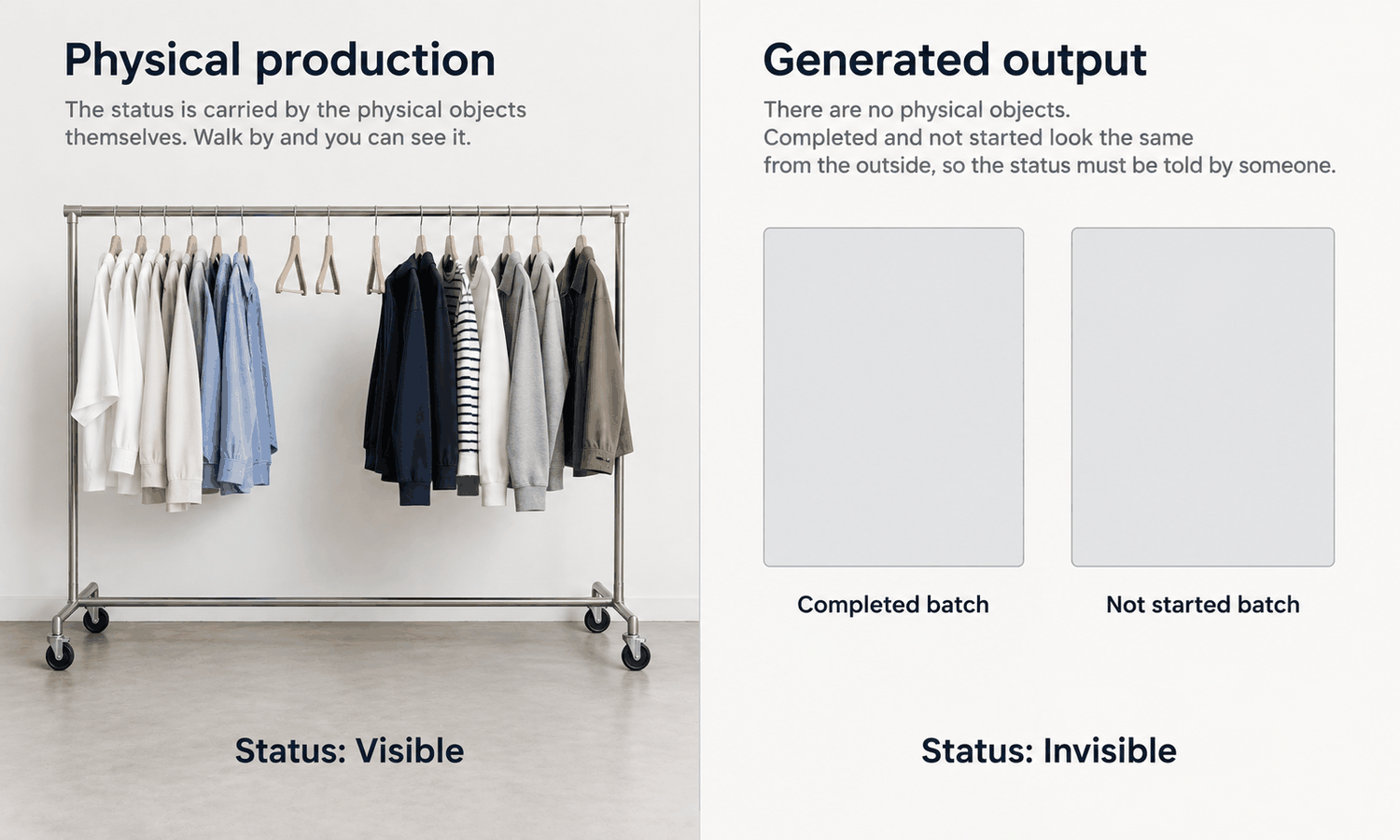
In a sample room you can tell how the week is going by walking through it. Garments hang on rails in an order everybody understands, a tag means something, and a rail that has not moved since Monday is a conversation that starts itself. Nobody reports any of this, because the room reports it.
Outfit changer AI takes that away. A batch that is finished and a batch that has not started look identical from outside the room, which is to say they look like nothing at all. Whatever the rails were communicating now has to be said out loud, in a meeting, by somebody who remembered to.
That is the real reporting problem, and it is not solved by picking better metrics. Most weekly reports on generated output describe volume, which is the one thing the room can neither act on nor doubt.
The rail is gone and nothing replaced it
Physical work carries its own status. A cut bundle is at a station or it is not. A sample is on a rail or it is on somebody's desk. Production meetings evolved around that, which is why they run well as exception handling: the room assumes the visible state and spends its time on what deviates from it.
Take away the visible state and the meeting reverts to something worse. People describe what they did, the room nods, and nothing gets unblocked, because nobody knows what to push on. A report that says four hundred outputs completed is indistinguishable from a report that says everything is fine, and both are indistinguishable from a report that says nothing.
The record itself is not the problem. In Lightchain AI (apparel AI) the outputs, their source files, and the history connecting them are all there, and any of it can be looked up. Available is not the same as reported. Somebody still has to decide which parts of the state the room needs on a Tuesday morning, and that decision is what most teams skip.
Report state, not throughput
| Usually reported | What the room can do with it | What to report instead |
|---|---|---|
| Outputs completed this week | Nothing, since the number carries no state and invites no question | Which styles are blocked, what each waits on, and the name of whoever owns it |
| Turnaround time per style | Little, because it averages over the styles that went badly and the ones that went easily | What changed in the inputs since last week, whether or not anything failed yet |
| Number of images that failed review | Very little, since a count says nothing about whether one cause or twelve produced it | What failed and whether the cause looks local to an image or shared across a batch |
| Progress against the season plan | Reassurance, which the meeting did not convene to receive | Decisions due this week, each with what happens by default if nobody makes it |
The distinction that runs through the table is whether a line implies an action by somebody in the room. Volume does not. A blocked style does. A source standard that changed on Thursday does, urgently, and it is the least likely thing to get mentioned.
This is worth being blunt about, because volume reporting is comfortable and will keep coming back. It makes the on-model workflow look productive, it never provokes a difficult question, and it costs the meeting five minutes every week for as long as nobody stops it. A number that cannot change what anybody does before the next meeting does not belong in the meeting.
The four lines that belong in the report
A weekly report on generated production fits in four lines and should be written before the meeting rather than during it.
-
Blocked: which styles cannot proceed, what each is waiting for, and who owns the thing it is waiting for. Names, not departments
-
Changed: anything that moved in the inputs since last week — source photo standard, settings, who prepares the files, which sample a capture was taken from
-
Failed: what did not pass the detail check, and whether the cause looks local to one image or shared across a batch
-
Due: decisions the room has to make this week, each with what happens by default if it is not made
The default clause on the last line does most of the work. Decisions that have no consequence for being deferred get deferred indefinitely, and in a workflow with no rails there is nothing to make the deferral visible. Writing the default converts a request into a deadline without anybody having to escalate.
Keep it to those four and let everything else live in the record. A report that grows past what fits on a screen becomes a document nobody reads before the meeting, which returns the room to describing what happened.
The line most often left out
Changed is the line teams drop first, because input changes do not feel like production events. Somebody adjusted the lighting in the capture setup. A different person prepared the files while the usual one was away. The model direction was updated halfway through a collection. None of these arrives with a ticket, and all of them are causes rather than events.
The reason they matter more than they look is that everything downstream of a shared input inherits whatever changed in it. A defect traced to one image is an image problem. A defect traced to a capture setup that changed on Thursday is every style captured since Thursday, and that is a scheduling conversation rather than a rework conversation. The room can only have it if somebody said the setup changed.
Two specific changes deserve naming when they happen. One is a shift in the colorway or print direction after captures were made, since the pieces already generated no longer represent the current intent. The other is any change to the model, pose, or scene held in Model Studio partway through a category, which produces a set that does not match itself and is invisible in any single image.
What the report must not claim
Minutes outlive the meeting and get read by people who were not there, which is why the boundary matters more in a report than in a conversation. The output is a visual asset. It does not predict fit, determine sizing, model how a fabric behaves in motion, or forecast returns. Those come from measurements, a graded pattern, a physical sample, and your own data.
Three lines follow from that and should never appear in a production report. A style cannot be recorded as fit-approved on the basis of generated imagery; fit approval comes from the fit session and the measurement chart, and the report should name which one it came from. A colorway cannot be recorded as approved from a screen — screen color is not a physical reference, exact code matching is not something to promise, the gap between a monitor and a roll of cloth stays open regardless of display quality, and colorways get settled by strike-offs against an agreed standard. And an image cannot stand in for a sample sign-off, however closely it resembles the sample.
The failure mode here is rarely a false claim. It is a status line that says approved without saying approved against what, which reads as a full approval six weeks later when somebody is trying to work out why a garment shipped wrong. Write the basis next to the status, every time.
Reporting a bad week without turning it into a defense
Some weeks the report is that a category does not work. That is a legitimate finding and it will only stay one if it is reported as a property of the category rather than as something the team failed at.
-
Say which category, and what specifically failed in it: overlaps, sheer fabric, a print at scale, hardware detail
-
Say what was tried, in one line, so nobody proposes it again next week
-
Say what it costs to route that category to conventional photography, so the room is comparing two known options
-
Ask for a standing decision rather than a weekly one, so the category stops consuming meeting time
-
Say when it should be retested, and let that be the only future-facing sentence in the item
Detail failures deserve the same treatment and rarely get it. Logos, printed text, care labels, and small hardware get compared against the source image on every single output, without exception, and when that check catches something, the report needs the cause rather than the count. Reconstructed detail lands almost right — a letterform slightly off, a stitch count wrong, a zipper pull the wrong shape — and a report that says twelve images failed the check tells the room nothing, while one that says all twelve came from captures taken after the setup moved tells them what to do this morning.
Whether the work runs through Lightchain AI or a camera, the meeting is the same meeting. It exists to unblock things and to make the decisions that cannot be made alone. Everything else in the report is somebody describing their week to a room that cannot help with it.
Frequently asked questions
Our meeting is fifteen minutes. Does this fit?
It fits better than what most teams currently do, since three of the four lines are usually empty in a given week. Blocked and Due carry the meeting; Changed and Failed are often a single sentence or nothing at all. The four-line format is short because it excludes the descriptive reporting that fills the time now.
Who should write the report?
Whoever runs the generation work, because the Changed line depends on knowing what moved in the inputs and that knowledge does not survive being relayed. If that person does not attend the meeting, the format matters more rather than less, and the four lines should be sent in writing beforehand either way.
What if nothing is blocked?
Then the report is short and the meeting ends early, which is a good outcome that teams resist because a short report feels like a weak contribution. Resist filling the space with volume figures. A meeting that reliably ends early when there is nothing to unblock is a meeting people prepare for properly.
Should the report include what was completed?
A count of completed work belongs in the record rather than the report, and anyone who needs it can look. The exception is completion that unblocks somebody else in the room, which is a Blocked line written from the other direction and should be said that way.
How do we stop approved from being misread later?
Write the basis in the same line: approved against the fit session, approved against the strike-off, approved as a visual direction only. It costs three words and it is the difference between a record that holds up and one that gets argued about. Do it even when everyone in the room knows what was meant, because the people who read the minutes were not in the room.
A category failed twice. When do we stop retesting it?
Set the retest trigger to a product update or a change in your own inputs rather than to a date, since retesting the same setup on a schedule produces the same answer at a cost. Record the standing decision and the trigger together. That way the category leaves the agenda without leaving the record.
In closing
The reporting problem with generated production is not that there is nothing to measure. It is that the physical signals a production meeting was built around are gone, and volume figures moved into the space they left without doing any of the same work. Four lines replace them: what is blocked and on whom, what changed in the inputs, what failed and whether the cause is shared, and what has to be decided this week with a stated default. Everything else belongs in the record, where it can be looked up by whoever actually needs it.
Start here
Write this week's report in the four lines before the meeting, and notice which line you struggle with. For most teams it is Changed, because nobody has been tracking input changes as events. If that line is blank because nothing moved, say so explicitly rather than omitting it, since a stated nothing and an unasked question look the same in minutes and mean opposite things. Then keep the format for a month before deciding whether it works.
**Start with the on-model workflow → **https://www.lightchainai.com/global/solutions/aiVirtualTryOn