
Outfit artificial intelligence can produce an on-model image of a garment in the time it once took to set up a single shot. That speed changes a great deal about how apparel imagery is made. It does not change who is responsible for what the images show. Every image a brand publishes still carries decisions: which person represents the brand, whether the garment is shown accurately, what color it really is, whether the image is labeled and whether the brand has the right to use it.
Those decisions cannot be automated, and the reason is not that the software is weak. It is that they are judgments about people, products and obligations, made on the brand's behalf by people who can answer for them. A workflow that makes production faster but leaves those decisions to chance ends up publishing images nobody actually approved.
This article sets out what automation changes and what it does not, the decisions about people, about the product and about publishing that stay human, and how to build a workflow around those decisions.
| Decision | Why it stays human | Who usually owns it | What AI can support |
|---|---|---|---|
| Which model represents the brand | A judgment about the brand and its customers | Brand or creative lead | Generating candidates to choose from |
| Whether a face resembles a real person | Requires judgment and accountability | Brand or content lead | Nothing; it is a human check |
| Whether the garment is shown accurately | The brand answers for what it sells | Product or content reviewer | Producing the image to be checked |
| What color the garment is | Settled physically, not on screen | Product or quality team | Showing options for discussion |
| Whether it fits | Confirmed on a real body | Technical designer, fit model | Nothing; images show appearance |
| Whether and how to label the image | Depends on market and platform rules | Compliance or brand lead | Applying a label once decided |
| Whether the brand may use the image | Depends on agreements and terms | Whoever manages agreements | Nothing; it is a human decision |
What Automation Changes, and What It Doesn't
Automation changes the production of images. Placing a garment on a model, changing a pose or a scene, preparing crops for each channel and producing variations are all faster than they were. Teams can produce more images, more consistently, with fewer shoot days.
It does not change the decisions that come before and after production. Before an image is made, someone decides which model to use, which garments to show and how. After it is made, someone decides whether it is accurate, whether it can be published and how it should be labeled. Those decisions used to be spread across a shoot day, often made informally by whoever was on set. With generated imagery, they have to be made on purpose, because there is no set, no photographer and no stylist to make them by default.
Outsourcing does not move these decisions either. When an agency, a freelancer or a supplier produces images for the brand, the production can be delegated, and the decisions stay with the brand. The outside producer can generate candidates, place garments and return records, but approving the model, signing off accuracy and releasing the images remain the brand's calls, made by the brand's own people.
That is the practical shift. Automation removes many tasks, and it makes the remaining decisions more visible. In a shoot, a stylist might quietly swap a belt that hid a waistband, or a photographer might reshoot when a collar looked wrong. Those small judgments happened without anyone writing them down. With generated imagery, each of them needs an owner. A brand that names who makes each decision gets the benefit of speed without losing control.
Decisions About People
The first set of decisions concerns the people in the images.
Choosing the model is a brand decision. Which ages and builds the brand shows, and how, reflects who its customers are and how it wants to present itself. AI can generate candidates quickly, and a person decides which to approve, based on the brand's plan, and describes the choice in neutral terms.
Checking likeness is a human responsibility. A generated face should not closely resemble a real, identifiable person. Looking at a face as a stranger would and recording the check with a date is a small step that no tool can take on the brand's behalf.
Decisions involving real people go further. If images start from photographs of real models, or if a digital version of a real person is involved, the person's agreement decides what is allowed. Whether a planned use falls within that agreement is a question for whoever manages the brand's agreements, answered before anything is generated.
Decisions About the Product
The second set of decisions concerns what the images say about the product.
-
Accuracy. Someone checks every image against its garment source for construction, logos, printed text, trims, hardware and print placement, without exception, and signs off. Reconstructed detail tends to come back almost right, and only a person comparing it with the source can catch that.
-
Color. Screen color is not a physical reference, and generated imagery does not promise an exact color-code match. The colorway is decided on the lab dip against the agreed standard, and color values are not read from images into product data.
-
Fit and size. An image shows appearance. It does not predict fit or determine sizing. Fit is confirmed on a sample worn by a fit model, and size guidance comes from measurements and the size chart. Generated images carry no size-worn captions.
-
Which styles are photographed instead. Complex prints, lace and openwork, sheer fabrics and layered styling remain current weak areas for generated imagery. Deciding to route a style to photography, rather than regenerating it until it looks acceptable, is a human call.
-
What to make and sell. Images can show options. Which styles, colors and quantities go ahead is decided by people who know the customers and the numbers.
Decisions About Publishing
The third set of decisions comes at the point of release.
Labeling is one. Expectations for disclosing AI-generated imagery differ by market and by platform, and they change. Someone confirms the rules for each channel, sets the brand's approach and makes sure it is applied consistently. A tool can apply a label; deciding when and how is a brand decision.
Rights are another. The terms of the tools used, the agreements with any real people involved and the rules of each channel all bear on whether an image may be published. Checking them belongs with whoever manages the brand's agreements and compliance.
Release itself is the last. Someone approves each batch for publication, having confirmed that it passed the accuracy check, that labeling is applied and that nothing outstanding remains. That approval, with a name and a date, is what makes the brand's practice traceable if a question comes up later.
Outfit Artificial Intelligence and the Decisions Around It
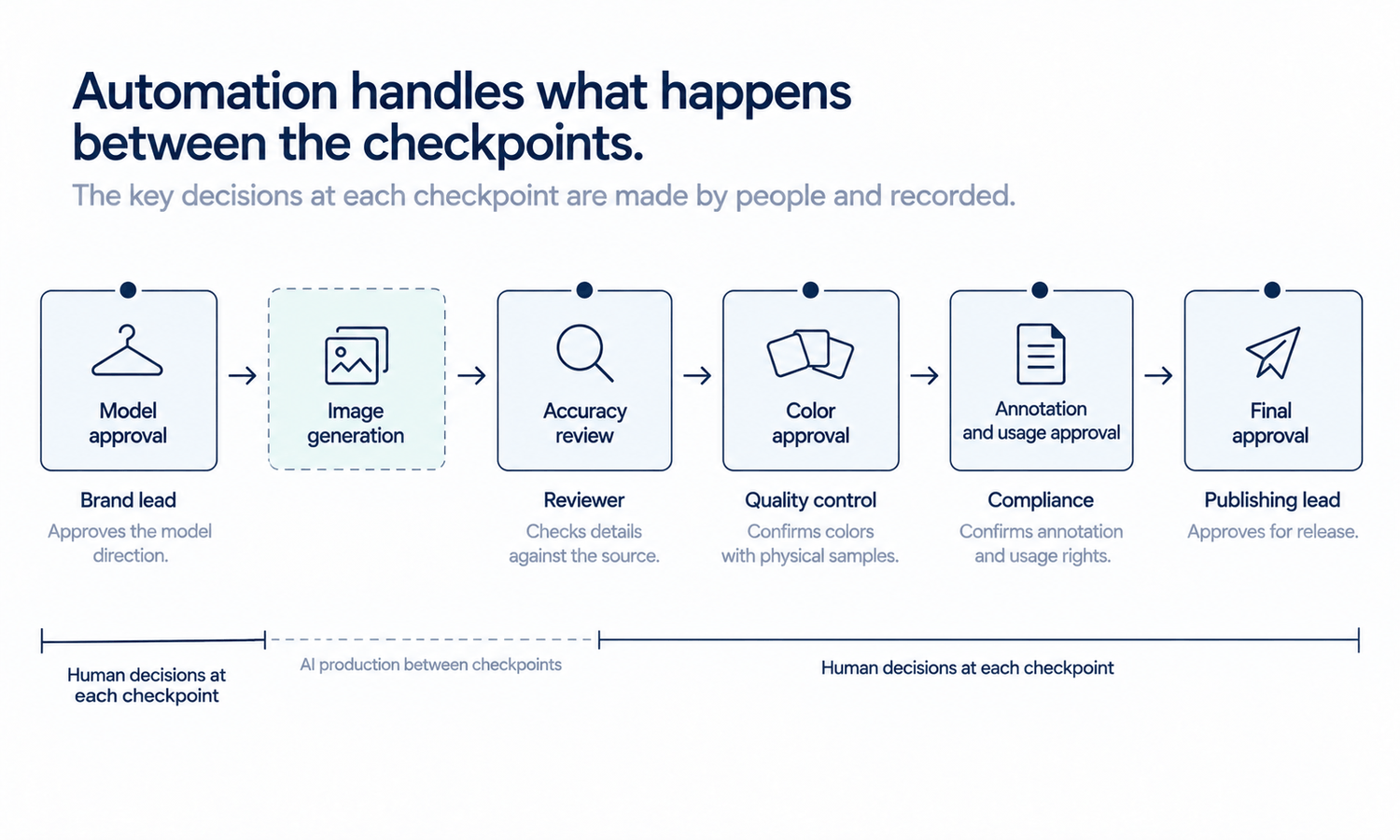
The most reliable way to keep these decisions human is to design the workflow around them. List the decisions that apply to your images. Give each an owner by role. Place each at a defined point in the workflow: model approval before the first use, accuracy sign-off after production, color on the lab dip, labeling and rights before release. Record each decision when it is made.
A decision log does not need to be elaborate. For each batch, one line per decision is enough: the model approved and by whom, the date of the likeness check, the reviewer who signed off accuracy, the lab dip reference for each colorway, the labeling approach for each channel and the name of the person who released the batch. Kept alongside the images, that log answers most questions a customer, a platform or a colleague might ask, without anyone having to reconstruct what happened.
This does not slow the workflow down. Automation still handles the production in between. It simply makes sure that the parts only people can decide are decided by people, every time.
In Lightchain AI (apparel AI), production runs between those human checkpoints.
-
Model Studio generates candidate models for a person to approve, and saved model sets keep the approved model in use.
-
AI Virtual Try-On places garments on the approved model from flat-lays, producing images for a person to check against their sources.
-
An AI Compliance Mark watermark control applies a label where the brand's labeling decision calls for it.
For brands producing on-model imagery at volume with clear human checkpoints, Scale E-commerce is the Lightchain AI solution built for that work.
Frequently Asked Questions
What can outfit artificial intelligence automate?
The production of images: placing garments on models, changing poses and scenes, preparing crops and producing variations. It does not automate the decisions about people, products and publishing that surround those images.
Which decisions should always stay human?
Approving the model and checking likeness, signing off garment accuracy, settling color on the lab dip, confirming fit on a real body, deciding labeling and confirming rights before release. Each involves a judgment the brand has to answer for.
Why can't accuracy checks be automated?
Because reconstructed detail tends to come back almost right, and the brand answers for what it sells. A person comparing each image with its garment source catches differences and takes responsibility for the sign-off.
Who should own these decisions?
Assign each decision to a role: brand or creative lead for model approval, product or content reviewer for accuracy, the product or quality team for color, the technical team for fit and compliance or legal owners for labeling and rights. Naming a role rather than a person keeps the ownership clear when people change.
Does keeping decisions human slow production down?
Not significantly. Production still runs automatically between defined checkpoints; the checkpoints simply make sure each decision is taken on purpose and recorded.
How should these decisions be recorded?
With the decision, the person who made it and the date, at the point where it is made. Those records make the brand's practice traceable when questions arise later.
How does Lightchain AI fit with human decisions?
It handles production between the checkpoints: Model Studio generates candidates for approval, AI Virtual Try-On produces images for checking and an AI Compliance Mark applies labels where the brand decides. Scale E-commerce is the solution to use for that work at volume.
In Closing
Outfit artificial intelligence makes producing images fast, and it leaves the important decisions exactly where they were: with people. Choosing and approving models, checking likeness, signing off accuracy, settling color, confirming fit, deciding labels and confirming rights are judgments a brand has to answer for. Name an owner for each, place each at a defined point in the workflow and record it, and let automation handle the production in between.
Start Here
If your brand is producing on-model imagery at volume and wants every image to pass through the right human checkpoints, Scale E-commerce is the solution to use. It is built for production at scale: you approve models, place garments on them from flat-lays and apply labels where your policy requires. Start by listing your decisions and their owners, then run your next batch through them and keep the record with the images.
**Explore Scale E-commerce → **https://www.lightchainai.com/global/solutions/scaleECommerce