
Make your own outfit is what many shoppers would like to do: choose the fabric, pick the color, add the pocket they always wish a shirt had or get a jacket made to their measurements. For apparel brands, offering some version of that is increasingly practical. Customization and made-to-order models let customers shape what they buy, and let brands make garments after they are ordered rather than before.
These models work very differently from selling finished stock. The garment does not exist when the customer chooses it, so the brand has to design products that can be customized, produce them one at a time or in small batches and show customers what they are choosing before anything is made. Each of those is a real challenge, and brands that plan for them avoid the most common problems: options that cannot actually be produced, long and uncertain lead times and customers who receive something different from what they pictured.
This article explains the main ways customers make their own, what each model asks of design and production, why options multiply quickly, what customization asks of images and how to run it in practice.
| Model | What the customer chooses | When it is made | What the brand needs | Main image challenge |
|---|---|---|---|---|
| Made-to-measure | Size from their own measurements | After ordering | Pattern adjustment, fitting process | Showing fit, which images cannot do |
| Configurable options | Fabric, color, details from a set | After ordering | Designs that accept each option | Showing combinations not yet made |
| Personalized print or text | Artwork, names, monograms | After ordering | Print or embroidery capacity | Showing the customer's own content |
| Made-to-order drops | A style offered before production | After a period of orders | A sample, a production plan | Showing a garment made later |
Four Ways Customers Make Their Own
Most customization falls into four models, and many brands combine them.
Made-to-measure starts from the customer's measurements. A base pattern is adjusted for each order, so the garment is sized to the individual rather than to a standard size. It is the traditional model of tailoring and dressmaking, now offered by brands at larger scale.
Configurable options let the customer choose from a defined set: a fabric from a range, a color from a palette, a collar style, a pocket, a lining. The garment is built from the chosen combination.
Personalized print or text adds the customer's own content, such as a name, initials, a message or an image, printed or embroidered on a base garment.
Made-to-order drops offer a style for a period, collect orders and then produce what was ordered. The customer chooses the style and size rather than details, and waits for production.
Each model shifts part of the product decision to the customer, and each moves production from before the sale to after it.
That shift changes the conversation with the customer as well. Because the garment is made for them, customers need to understand what they are choosing, how long it will take and what happens if something is not right. The brands that do customization well treat that communication as part of the product, not an afterthought.
What Each Model Asks of Design and Production
Customization changes how garments are designed and made.
-
Designs built for options. A style offered in several fabrics must work in all of them. A collar that suits a crisp cotton may not suit a soft jersey, so each option is tested on the base design.
-
Limited, curated choices. The options offered should be ones the brand can produce reliably and that look good together, not every possible variation.
-
Patterns that adjust. Made-to-measure needs a base pattern and clear rules for adjusting it from measurements, plus a process for handling orders that fall outside those rules.
-
Materials on hand. Every fabric, trim and color offered must be available when orders arrive, which means stocking materials rather than finished garments.
-
Lead times customers can see. Garments made after ordering take longer to arrive. Stating the expected time clearly at the point of sale prevents disappointment.
-
Checks on every unit. When each garment is different, quality checks happen per order rather than per batch.
Why Options Multiply Quickly
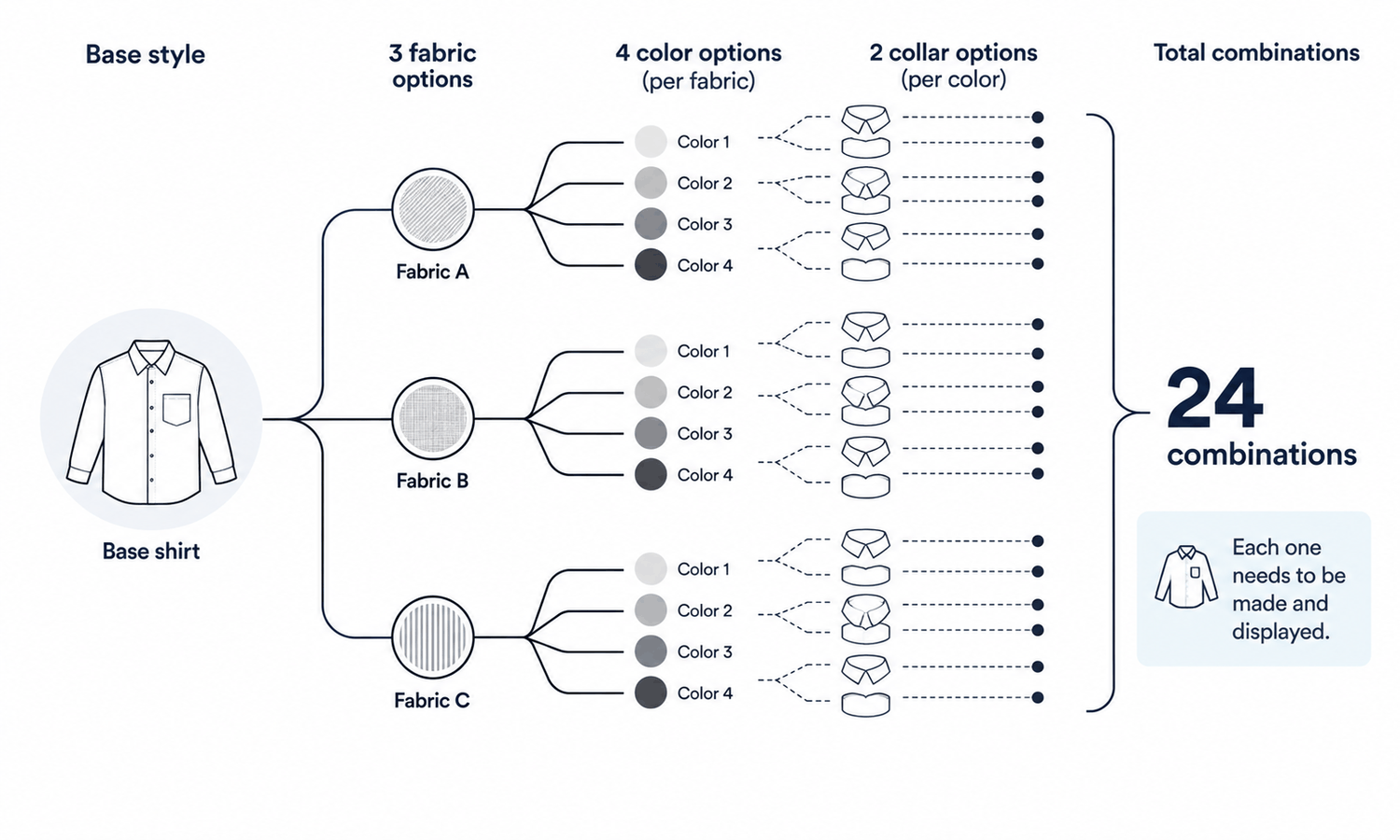
The appeal of configurable options is also their biggest risk. Options multiply. Three fabrics, four colors and two collar styles already make twenty-four possible garments, and adding a pocket option doubles that. Each combination is a product the brand has promised it can make and must be able to show.
A few principles keep options manageable. Offer fewer choices in each category, and make sure every choice combines well with every other. Group options so some combinations are simply not offered, such as a particular collar only with particular fabrics. Test the combinations most likely to be chosen on real samples. Those tests also give the brand real photographs for its most popular configurations. And review which options customers actually choose, so rarely chosen ones can be retired.
A smaller set of well-tested options usually serves customers better than a very large set where some combinations disappoint.
Adding a new option deserves the same care as adding a new style. Before a new fabric or detail goes on sale, make it up on the base style at least once and check that it sews, hangs and looks as intended with the other options it can be combined with. An option that has never been made is a promise the brand has not yet tested.
What "Make Your Own Outfit" Asks of Images
Customers choosing a configuration want to see it before they order, and that is where customization meets imagery. The brand cannot photograph every combination, because most of them will never be made until someone orders them.
The practical answer is to build previews from things that exist. The base style should have a real sample, photographed as a flat-lay. Each fabric and color option should have a physical swatch and color standard behind it. Previews of combinations are then produced from the real base garment and the real options, so they show a plausible version of what the customer will receive.
Those previews need honest handling. Label them as representations of the chosen options, since the combination has not been made yet. Screen color is not a physical reference, so the colors in a preview are close representations rather than exact matches, and offering physical swatches, or at least photographs of them under neutral light, helps customers choose. For made-to-measure, remember that images show appearance, not fit; fit comes from the measurements, the pattern and, where offered, a fitting. When the first garments in a new combination are made, compare them with the previews and update any that differ. Complex prints, lace and openwork, sheer fabrics and layered styling remain current weak areas for generated imagery, so options in those categories are better shown with photographs of real samples.
A clear confirmation step before payment helps too. Summarize the chosen options in words, show the preview alongside photographs of the chosen swatches, restate the expected lead time and, for made-to-measure, repeat the measurements entered. Customers who confirm a clear summary are far less likely to be surprised by what arrives.
Returns need thought in advance. A garment made to someone's measurements or with their own name on it usually cannot be resold, so many brands set different return terms for customized items. Whatever the policy, state it plainly before the order is placed, and check the rules that apply to made-to-order goods in the markets where you sell; they vary, and the people responsible for your business's compliance are the right source.
Running It in Practice
A workable setup starts small: one base style with a sample, a short list of options backed by swatches, previews of the combinations and a clear lead time at checkout.
In Lightchain AI (apparel AI), option previews start from the base sample.
-
Fabric application and color changes show the base style in each offered fabric and color, built from the sample's flat-lay and checked against the physical swatches.
-
Target Revision shows detail options, such as a different collar or an added pocket, in a defined area, as described on the Partial Redraw page.
-
AI Virtual Try-On places each configuration on the same model, so customers compare options on equal terms.
For brands building customizable products from a proven base style, Design with Purpose is the Lightchain AI solution built for that work.
Frequently Asked Questions
How does a make your own outfit service work?
The customer chooses from a set of options, such as fabric, color, details or size from their own measurements, and the brand makes the garment after the order. Previews help the customer see the choice before it is made.
What are the main customization models?
Made-to-measure, configurable options, personalized print or text and made-to-order drops. Many brands combine two or more.
Why should options be limited?
Because combinations multiply quickly, and every combination must be producible and look good. A smaller, tested set of options serves customers better than a very large one.
How can customers see a combination that has not been made?
Through previews built from a real sample of the base style and physical swatches of each option, labeled as representations of the chosen combination. The first garments made in each combination are compared with the previews.
Can previews show how a made-to-measure garment will fit?
No. Images show appearance. Fit comes from the measurements, the adjusted pattern and, where offered, a fitting.
What should happen when the first garment in a combination is made?
Compare it with the preview. If it differs noticeably, update the preview so later customers see an accurate representation.
Which Lightchain AI solution supports customizable products?
Design with Purpose is the one to use. It shows a base style in each offered fabric, color and detail, built from the real sample and checked against physical swatches, and places each option on the same model for comparison.
In Closing
Make your own outfit models let customers shape what they buy and let brands make garments after they are ordered. Each model, from made-to-measure to configurable options, personalization and made-to-order drops, needs designs that accept options, curated choices, materials on hand, clear lead times and per-order checks. Keep options few and well tested, build previews from a real base sample and real swatches, label them honestly and compare the first garments made with what customers were shown.
Start Here
If your brand wants to offer customers a choice of fabrics, colors or details without making every combination in advance, Design with Purpose is the solution to use. It is built for variation work: you show a base style in each offered option, built from the real sample, and compare options on the same model. Start with one base style and a short list of options backed by physical swatches, then add options as customers respond.
**Explore Design with Purpose → **https://www.lightchainai.com/global/solutions/designWithPurpose