
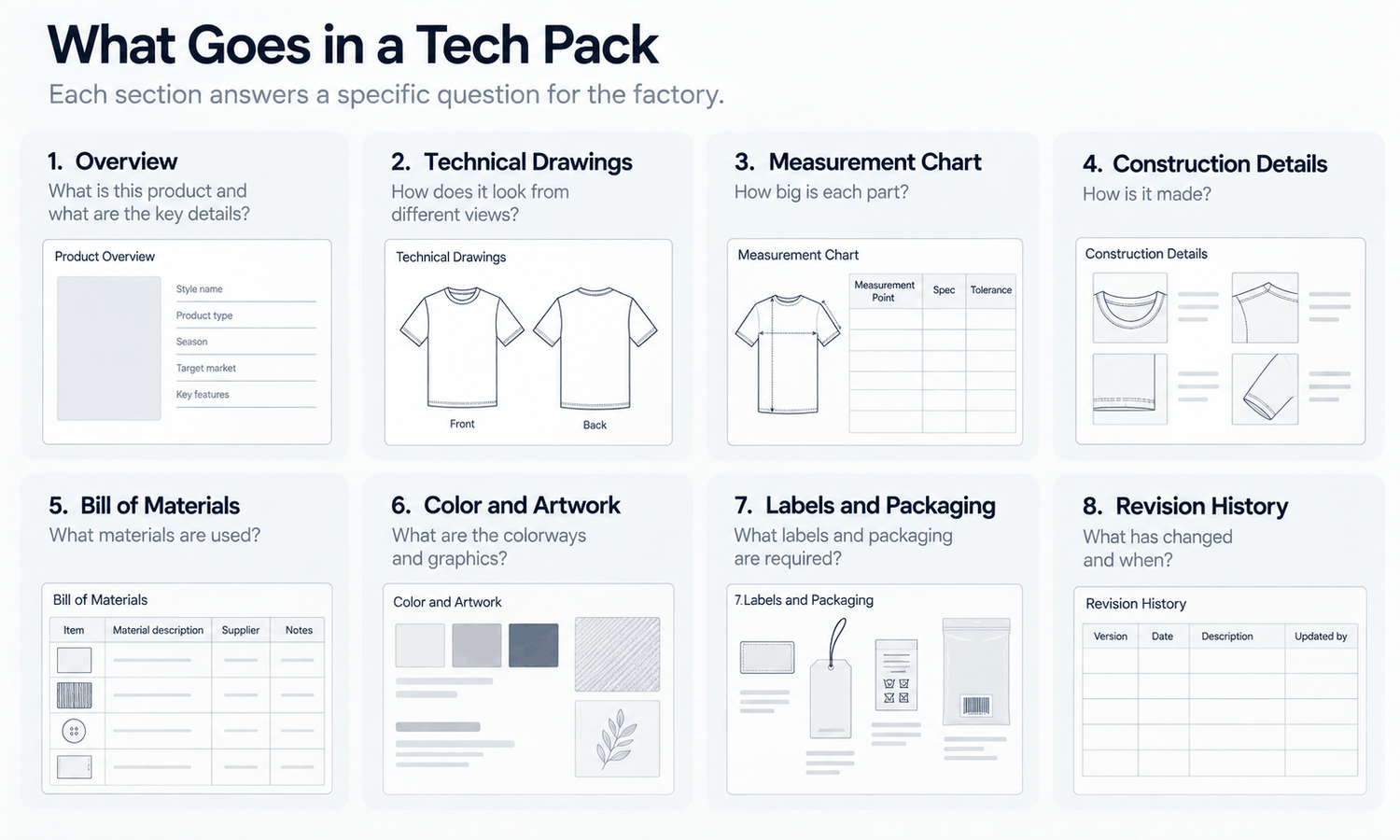
To make clothes design online turn into garments someone can actually produce, the design needs a tech pack. A sketch shows what a garment should look like. A tech pack tells a factory exactly how to make it: every measurement, every seam, every material, every color and every label. When a design is shared online with a pattern maker or a factory in another city or country, the tech pack is often the only thing that travels with it, so whatever it leaves out, someone else has to guess.
Tech packs vary in format from brand to brand, but their contents are remarkably consistent, because factories need the same information whoever the customer is. Knowing what goes into one, and why, is one of the most useful things a designer or a new brand can learn. It is also the difference between a first sample that is close to the design and one that needs several rounds of correction.
This article explains what a tech pack is for, and then walks through its main parts: flats, measurements and tolerances; construction, materials and trims; color, artwork, labels and packaging; and how to share a tech pack when you make clothes design online with a remote team.
| Section | What it contains | Why the factory needs it |
|---|---|---|
| Summary page | Style name and code, season, category, sizes, key contacts | Identifies the style and who to ask |
| Flat sketches | Front, back and detail drawings | Shows exactly what the garment looks like |
| Measurement sheet | Points of measure, sizes and tolerances | Tells the factory what size each part should be |
| Construction details | Stitch types, seam finishes, special instructions | Tells the factory how to put it together |
| Bill of materials | Fabrics, linings, interfacings, threads and trims | Lists everything needed to make it |
| Colorways and artwork | Colors, standards, print and embroidery placement | Fixes color and decoration |
| Labels and packaging | Care and content labels, brand labels, folding and packing | Covers how it is labeled and shipped |
| Revision history | What changed, when and why | Shows which version is current |
What a Tech Pack Is For
A tech pack is a set of instructions. It exists so that a garment can be made correctly by people who were not in the room when it was designed. Pattern makers use it to draft the pattern. Sample rooms use it to sew the first sample. Factories use it to quote a price, order materials and produce the garment in quantity.
Every gap in it becomes a decision someone else makes. If the tech pack does not say how a seam is finished, the factory chooses. If it does not give a tolerance for a measurement, the factory decides how close is close enough. If it does not name the button, the factory picks one. Some of those choices will match the designer's intent and some will not, and each mismatch costs a round of sampling to correct.
The tech pack also changes over time. After each sample, fit and construction comments are written back into it: a measurement adjusted, a seam finish changed, a trim replaced. Those updates are what make the next sample closer to the intent. A tech pack that is written once and never updated leaves the factory working from an old version while the corrections live in someone's email.
A good tech pack is therefore complete, specific and unambiguous. It uses precise terms for every detail, gives measurements rather than descriptions wherever it can and shows as well as tells.
Flats, Measurements and Tolerances
The flat sketches are the visual core of the tech pack. They show the garment laid flat, front and back, drawn to proportion with clean lines: outlines, seam lines, topstitching, pockets, closures and every visible detail. Close-up drawings clarify details too small to read in the main view, such as a pocket's construction or a collar's shape.
The measurement sheet, sometimes called the spec sheet, turns those drawings into numbers. It lists points of measure, the specific places where the garment is measured: chest width, body length, shoulder width, sleeve length, waist, hip, inseam and so on, each defined precisely so everyone measures the same way. For each point of measure, it gives the measurement for the sample size and, once grading is done, for every size in the range.
Tolerances complete the sheet. A tolerance is the allowed difference between the specified measurement and the actual garment, because no two sewn garments are exactly identical. A tight tolerance on a critical measurement, such as a waistband, protects fit; a looser one on a less critical measurement keeps production practical. Without tolerances, there is no agreed way to decide whether a garment is correct.
Grading turns the sample size into a full size range. Each point of measure changes by a set amount from one size to the next, and those increments are recorded in the measurement sheet so the pattern maker can grade the pattern and the factory can check every size. Grading is not a simple enlargement: some measurements grow more than others between sizes, and some, such as a pocket's size, may stay the same across part of the range. Setting the grade rules deliberately, rather than leaving them to the factory, keeps the fit consistent across sizes.
Construction, Materials and Trims
Construction details describe how the garment is put together, and the bill of materials lists everything it is made from.
-
Stitch and seam types. Which stitch is used where, and how each seam is finished, such as overlocked, bound or flat-felled.
-
Special instructions. Anything unusual: a seam that must be pressed a certain way, a hem that must not be topstitched, a lining attached at specific points.
-
Fabrics. The main fabric, with its composition, weight and supplier reference, plus any contrast fabrics.
-
Linings and interfacings. What is used, and where, to give structure or finish.
-
Threads. Type and color, including any contrast topstitching.
-
Trims and hardware. Buttons, zips, snaps, buckles, drawcords and eyelets, each with size, finish, color, supplier reference and placement.
The more exact these entries are, the fewer substitutions a factory has to make. A button described as "four-hole horn-look, fifteen millimeters, placed at the positions shown" leaves far less room for error than "buttons as per sample."
Color, Artwork, Labels and Packaging
Color is specified against a standard rather than described in words. Each colorway lists the color reference for every fabric and trim, and the approval route: lab dips, which are small dyed samples of the actual fabric, are checked against the standard under consistent light and approved before production. A color seen on a screen is not a reference, because screens differ and cannot show how a dye takes on a particular fabric.
Artwork covers prints, embroidery and any other decoration. The tech pack gives the artwork file, the size of each placement, its exact position measured from fixed points such as the neckline or side seam and the method, such as screen print, digital print or embroidery.
Labels are often overlooked. The tech pack specifies the brand label, the size label and the care and content label, with their wording, size, material and placement. Care and content requirements differ by market, so the wording is confirmed for each place the garment will be sold.
Packaging closes the pack: how the garment is folded, what it is packed in, which tags are attached and how cartons are marked. These details matter to warehouses and retailers as much as to customers.
Sharing a Tech Pack When You Make Clothes Design Online
When design work happens online and teams are spread across locations, the tech pack becomes the single shared reference. A few habits keep it reliable.
-
One current version. Keep a single master file, and make sure everyone works from it rather than from copies passed around by email.
-
A revision history. Record every change with its date, the reason and who approved it, so a factory can see exactly what changed between samples.
-
Comments tied to the document. Keep sample comments and approvals attached to the version they refer to, not scattered across messages.
-
Clear file formats. Share flats as drawings that stay sharp at any size, measurement sheets as editable tables and artwork as print-ready files, so nothing needs to be redrawn.
-
Confidentiality. Tech packs describe unreleased products, so agree who can access them and how files are sent.
The same gaps appear again and again in incomplete tech packs: a back view that was never drawn, a measurement sheet without tolerances, trims described as "as per sample," colors given as names rather than standards and labels left until the last moment. Checking a tech pack against that short list before it is sent catches most of the problems that would otherwise surface in the first sample.
A tech pack that is complete and kept current does more than prevent mistakes. It gives everyone, from the pattern maker to the warehouse, the same answer to the same question.
Frequently Asked Questions
What does a tech pack need when you make clothes design online?
A summary page, flat sketches, a measurement sheet with tolerances, construction details, a bill of materials, colorways and artwork, labels and packaging, and a revision history. Together they tell a factory exactly how to make the garment.
What is a point of measure?
A specific, precisely defined place where a garment is measured, such as chest width or sleeve length. Defining each one ensures everyone measures the garment the same way.
What is a tolerance?
The allowed difference between a specified measurement and the actual garment. Tighter tolerances protect critical measurements; looser ones keep production practical.
How should color be specified?
Against a standard, with lab dips of the actual fabric checked under consistent light and approved before production. A color on screen is not a reference.
Why does a tech pack need a revision history?
Because designs change between samples. A dated record of each change, its reason and its approver shows everyone which version is current and what changed.
What happens if a tech pack leaves something out?
Someone else decides it, usually the factory. Some of those decisions will differ from the design, and each difference costs a round of sampling to correct.
In Closing
To make clothes design online into a garment someone else can produce, write a tech pack that leaves nothing to guess. Draw clear flats, define every point of measure with its tolerance, specify construction, materials and trims exactly, fix color against a standard and confirm it on lab dips, and cover artwork, labels and packaging. Keep one current version with a revision history, and the pattern maker, the sample room and the factory will all be working from the same answer.