
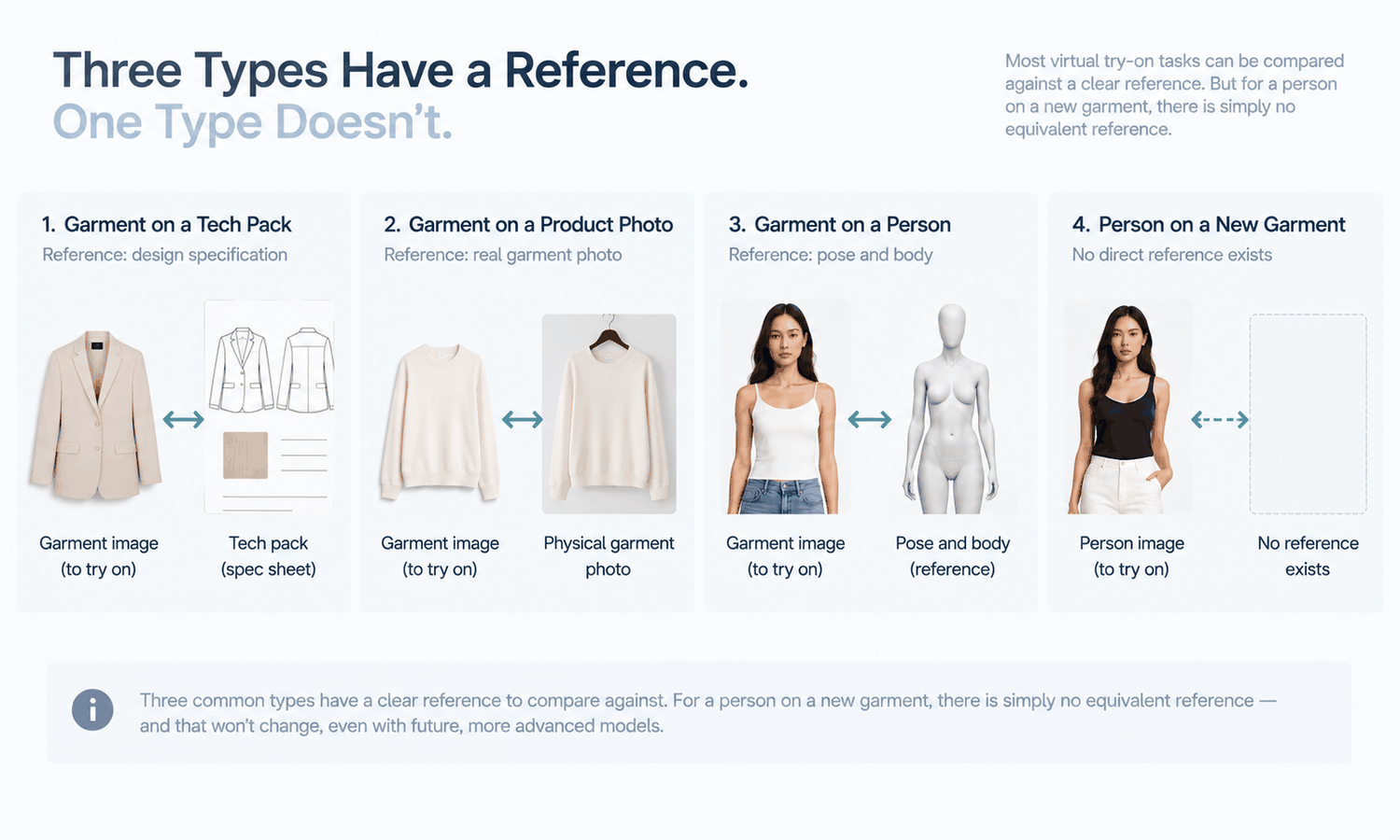
Accuracy is the word that makes this conversation unproductive, because it names four different questions and nobody says which one they mean.
Is it the right product. Does it look like the real thing. Does it sit on the body correctly. And does it tell me what will happen when a customer wears it. Those are four separate properties with four different answers, and three of them can be measured while the fourth is not available at any price.
Four questions wearing one word
Identity accuracy asks whether the depicted garment is the one being sold — correct closure, correct pockets, correct trim. It is a conformity question and it is answered against a specification.
Appearance accuracy asks whether the rendered garment resembles the physical one — color, texture, how the material reads. It is answered against a photograph of the actual product.
Placement accuracy asks whether the garment sits on the body plausibly — shoulders, hem, the way it meets the figure. It is answered by looking, at the size the asset will be seen.
Predictive accuracy asks what will happen in wear. It is not answered by any image, and treating it as a fourth grade on the same scale is where most of the trouble in this category originates.
What each one is measured against
| Accuracy type | Measured against | Who can judge it | Achievable |
|---|---|---|---|
| Identity | The specification or tech pack | Someone holding the document | Yes, reliably |
| Appearance | A photograph of the physical garment | Anyone, side by side | Yes, with a reference |
| Placement | The pose and the body shown | Anyone, at viewing size | Yes, with practice |
| Predictive | Nothing available in an image | Nobody | No |
The fourth row is the important one and the reason the table exists. A brand that has verified the first three has a genuinely accurate asset, in every sense the medium supports, and still knows nothing about fit.
Say that explicitly when reporting accuracy internally, because a figure quoted without its type invites the listener to assume the type they care about most.
The assumption is predictable by role. A merchandiser hears appearance, a technical designer hears identity, and anyone looking at the returns line hears prediction. One number, three interpretations, and the third one is the interpretation the number cannot support.
Identity accuracy is the commercial one
Of the three achievable accuracies, identity is the one with money attached.
An appearance error produces an image that looks slightly off. An identity error produces an image of a different product, which reaches a customer who ordered one thing and received another. The first is an aesthetic problem and the second is a returns and complaints problem.
Identity is also the only one that cannot be judged by looking harder. It requires the specification in hand, which means it requires a particular person at a particular point in the process rather than more diligence from whoever is already reviewing.
Check closures, pockets, trims, seam positions and print placement against the document, on one asset per style, before a batch expands. Two minutes per style, and it removes the expensive category. The document itself can come out of the same workflow — line drawings, vectors and tech-sheet drafts are producible from the selected design, so the specification you check against is one you already maintain.
Appearance accuracy is measurable, and rarely measured
Most teams assess appearance by impression. It can be measured properly, and the method is simple enough that there is little excuse.
Photograph the physical garment under your normal product-shot conditions. Generate the equivalent asset. Put the two side by side at the size the asset will be displayed and have someone who did not produce either one look at them. Setting output to 2K or 4K first makes that comparison honest, since it is run at the resolution the customer will actually see.
Three things carry most of the signal: whether the color reads the same, whether the surface texture reads as the same material, and whether any detail present in the photograph is absent or altered in the generated version. Record the answer as a simple pass, marginal or fail rather than a score, since scores invite arguments and categories produce decisions.
Run it on ten styles across your range and you will have a defensible statement about your own appearance accuracy, which is more useful than any vendor benchmark because it reflects your photography and your products.
It also transfers. A vendor benchmark measured on someone else's catalog cannot be compared to a figure from a different catalog, but your own figure can be compared to your own figure next season, which is the comparison that actually informs a decision.
Placement accuracy is what reviewers already do
This is the accuracy people assess without naming it. A hem that floats, shoulders sitting wrongly, a garment that appears pasted rather than worn — these get caught routinely because they are visible.
Two refinements make the informal check more reliable. Look at normal viewing size rather than magnified, since placement errors are relational and often vanish under inspection. And look at the boundaries — neckline, cuffs, hem, waist — rather than at the middle of the garment, because that is where placement is decided.
Placement is also the accuracy most affected by the source. A favorable pose with clear garment edges produces good placement almost automatically; heavy occlusion produces the opposite regardless of anything downstream.
That dependency makes placement failures the cheapest to fix and the most often misattributed. A run of poor placement usually means the base images need reselecting rather than that the output has degraded, and checking which base each failure came from settles it in minutes.
Predictive accuracy is not on the menu
Worth stating without qualification, because the commercial pull toward implying otherwise is constant.
The output is a visual asset. It does not predict fit. It does not determine sizing. It does not model how a fabric behaves in motion. It does not forecast returns. Those come from measurements, a graded pattern, a physical sample, and your own returns data.
An image can be accurate in all three available senses and still tell a customer nothing about whether a size will fit them. That is not a shortcoming to be improved; it is a property of what an image is, and it will be equally true of a better version of the technology next year. Any claim that better imagery reduces returns is a claim about customer behavior rather than about accuracy, and it needs its own evidence.
A comparison protocol you can run in a day
Ten styles, chosen to span your range rather than to flatter it. For each one: the specification, a photograph of the physical garment, and a generated asset — several of those styles can be queued in one run, so the generation side of a ten-style protocol is closer to one session than to ten.
Have three people run three passes. One checks identity against the document. One compares appearance against the photograph. One assesses placement at viewing size. Nobody does more than one pass, because holding three criteria at once produces a blurred judgment on all of them. The separation also removes an argument, since a reviewer who has only been asked about appearance cannot be talked out of a finding on the grounds that the placement was good.
Record pass, marginal or fail per style per criterion, and read the pattern rather than the total. A total tells you how you are doing; a pattern tells you what to change, and only one of those is worth a day. Identity failures point at process and at where the check sits. Appearance failures point at source photography. Placement failures point at pose selection. Three different remedies, and the protocol tells you which one you need. The AI Virtual Try-On module in Lightchain AI (apparel AI) produces the assets under test from an existing product photo — see AI Virtual Try-On, and Scale E-commerce for how verified assets distribute across a catalog.
Questions apparel teams ask
How accurate is virtual try-on? The question needs a type attached. Identity and placement can be verified reliably, appearance can be measured against a photograph, and prediction of fit is outside what any image provides. A single accuracy figure without a type is not meaningful.
Which accuracy should we prioritize? Identity, because it is the one with commercial consequences. An appearance error looks slightly wrong; an identity error sends a customer a different product from the one pictured.
Can we test accuracy without physical samples? Identity, yes, against the specification. Appearance requires a photograph of the real garment, since there is nothing else to compare against. Placement can be judged from the image alone.
Why do vendor accuracy claims vary so much? Because they are measuring different things, usually appearance on favorable products. Ask which of the four types a claim refers to and what it was measured against.
Does higher accuracy reduce returns? Not demonstrably, and the mechanism would be customer behavior rather than image quality. Returns in apparel are driven largely by fit, which no image addresses.
How often should we re-run the protocol? Once per season, or after any change to source photography or the underlying model. Both alter results in ways that no single figure captures.
What accuracy can honestly mean here
Three things, all verifiable, and one thing that is not on offer. Identity against a specification, appearance against a photograph, placement against the pose — verify those and you have an accurate asset in every sense the medium supports. Prediction of fit is not a harder version of the same problem; it is a different problem that images do not touch. Run the ten-style protocol with three separate reviewers, read the failure pattern rather than the total, and quote accuracy with its type attached whenever the number leaves your team.
Run ten styles through three separate passes this week.
**Give one person the specification, one a photograph of the physical garment, and one the asset at viewing size, and have each judge a single criterion. Record pass, marginal or fail. The pattern across ten styles tells you whether to fix your process, your photography or your pose selection — three different problems that a single accuracy score would have hidden. → **AI virtual try-on
About the author
[REPLACE — real person's name, role, relevant experience, LinkedIn URL. No team byline.]