
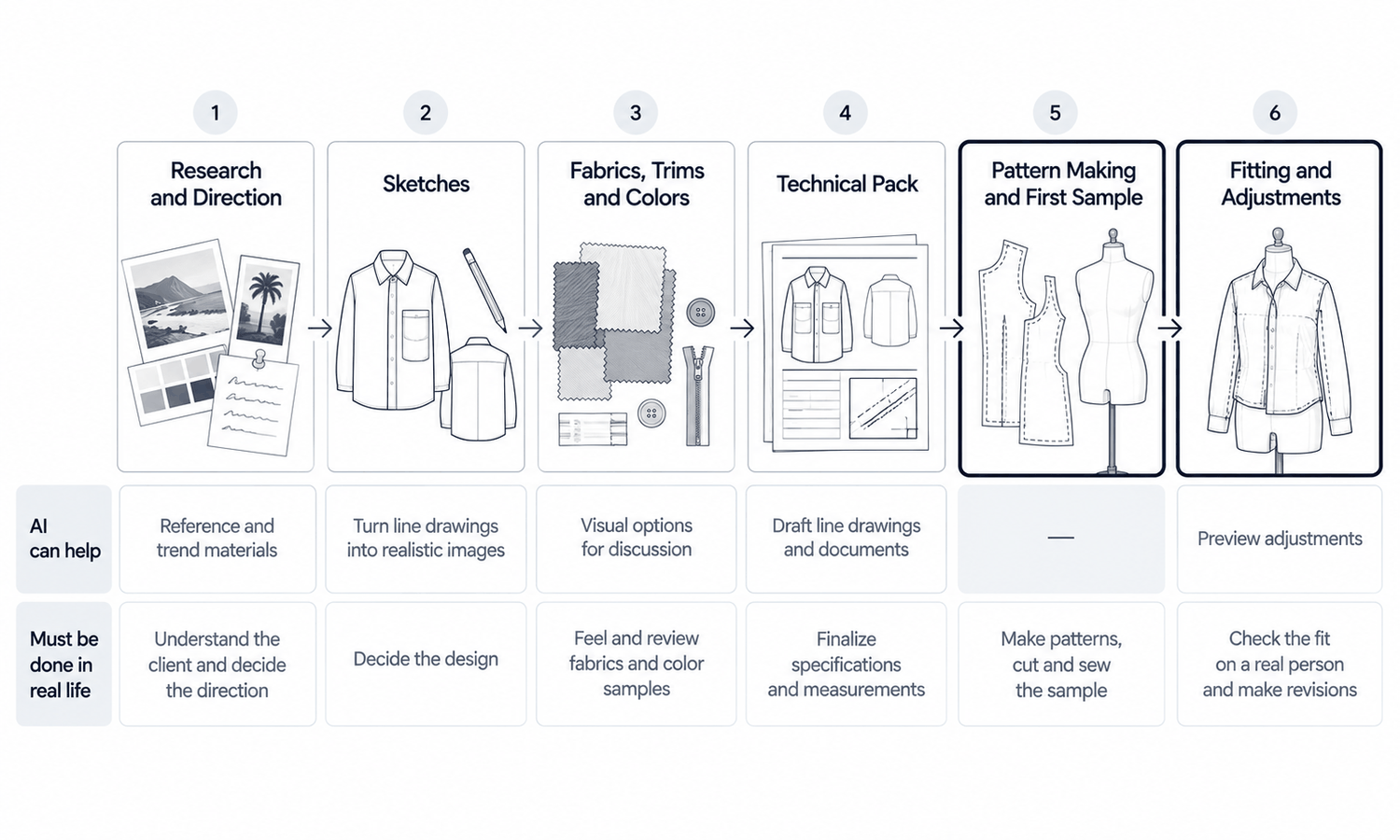
How to design fashion clothes is a question with a longer answer than most people expect. A garment does not go from an idea to a finished piece in one creative leap. It passes through a sequence of decisions: who it is for, what it looks like, what it is made of, how it is constructed, how it is cut and whether it fits. Each step has its own tools and its own people, and each one catches problems the previous step could not see.
AI has found a place in several of those steps, especially the visual ones, and it is easy to overestimate how far it reaches. It can help a designer see an idea sooner, explore directions faster and document a design more quickly. It does not cut patterns, choose fabric by hand or tell anyone whether a garment fits. Knowing where it helps and where it stops is part of knowing how the process works.
This article walks through designing a garment from idea to first sample: research and direction, sketching and seeing the idea, fabric, trims and color, the tech pack, pattern and sample, and fitting and revising, with a clear note at each step about what AI can and cannot do.
| Step | What you decide | Who usually does it | Where AI can help | Where it cannot |
|---|---|---|---|---|
| Research and direction | Customer, category, price, references | Designer, founder | Gathering and exploring references | Predicting what will sell |
| Sketching | Silhouette, details, proportions | Designer | Turning sketches into realistic views | Deciding what the design should be |
| Fabric, trims and color | Materials and colorways | Designer, sourcing | Visual discussion of options | Hand, weight, stretch and exact color |
| Tech pack | Specifications for making | Technical designer | Line drawings and document drafts | Final specifications and measurements |
| Pattern and sample | The cut and the first garment | Pattern maker, sample room | Nothing directly | Drafting, cutting and sewing |
| Fitting and revising | Whether it works on a body | Fit model, technical designer | Previewing revisions visually | Judging fit |
Research and Direction
Every garment starts with a set of decisions that are not about the garment at all. Who is it for? What category does it belong to, and where does it sit in price? What does the brand already make, and what would sit well beside it? A designer who answers these first makes every later choice easier, because each option can be tested against them.
References come next: images, garments, fabrics and colors that capture the direction. Many designers build a mood board, physical or digital, that the whole team can see. Trend information feeds into it: colors, fabrics, details and silhouettes that are gaining attention.
AI can help at this stage by gathering and organizing references and by offering trend inputs to explore. The trend tools described on the Stay Ahead of Trends page, covering color, fabric, detail and style directions, are one example. What such inputs cannot do is predict what customers will buy. They are material for a designer's judgment, not a replacement for it, and the decision about direction stays with the people who know the customer.
Sketching and Seeing the Idea
Sketching is where the design takes shape. Designers usually work in two kinds of drawing. A fashion illustration, drawn on a stylized figure called a croquis, shows the mood and silhouette. A flat sketch, drawn without a body, shows the garment's construction clearly: seams, closures, pockets and proportions.
Sketches are fast and flexible, and they leave a lot unsaid. A line drawing does not show fabric, weight, color or finish, and a croquis's stretched proportions can make lengths and placements look different from how they will read on a real body.
This is one of the places AI helps most. A sketch can be turned into a realistic flat-lay or placed on a generated model, so a designer can see the idea as a garment much sooner and on more realistic proportions. The result is a picture, and the image fills in whatever the sketch did not specify, so supplying fabric and color references with the sketch gives a more faithful result. Label these images as concepts. They show a design that has not been made.
Fabric, Trims and Color
A design becomes a real garment through its materials. Choosing them is hands-on work, and a few questions guide it.
-
How does the fabric feel and hang? Hand, weight, drape and stretch decide how the garment behaves, and they can only be judged by touching and draping the fabric itself.
-
Does the fabric suit the construction? A fabric that looks right can fray, pucker or stretch in ways that make certain seams or finishes difficult.
-
Which trims fit the design and the price? Buttons, zippers, labels and hardware affect both the look and the cost.
-
What colorways will the garment come in? Colors are specified against a standard and confirmed with lab dips on the actual fabric.
-
Can the materials be sourced in the quantities needed? A fabric that is not available at volume changes the plan.
AI can help the team discuss options visually, for example by showing a design in an alternative fabric or color. That is useful for narrowing choices, not for making the final one. Screen color is not a physical reference, generated imagery does not promise an exact color-code match and the colorway is settled by the lab dip against the agreed standard. Fabric hand and behavior come from swatches and samples. Some materials, such as complex prints, lace and openwork and sheer fabrics, are also current weak areas for generated imagery, so their appearance is better judged in person.
Tech Pack, Pattern and Sample
Once the design and materials are chosen, the garment has to be described precisely enough for someone else to make it. That description is the tech pack: flat sketches from several views, measurements, construction details, materials and trims, colorways and labeling.
AI can speed up parts of the tech pack. A design can be turned into clean line drawings, and a photo of an existing garment or sample can be converted into a flat sketch. Technical-document drafts can be prepared from a reviewed design. Those steps are described on the Production-Marketing Synergy page. Every draft still needs a technical designer to review it, add measurements taken from the design or a garment and complete the specifications. A draft is a starting point, not a finished document.
The pattern comes next, and here AI has no direct role. A pattern maker drafts the flat pieces, with their seam allowances, grain lines, notches and ease, often refining them on a dress form. The sample room then cuts and sews the first sample from the actual fabric. These are skilled, physical steps, and they are where a design is proved or corrected.
How to Design Fashion Clothes With AI in the Right Places
The first sample is tried on a fit model, a real person at the brand's base size, and the fitting shows whether the pattern works: where the garment pulls, gapes or restricts movement. The technical designer records corrections, the pattern is revised and further samples follow until the garment is right. No image can replace this step. An image shows appearance; fit is confirmed on a body.
Between samples, AI can help the team see proposed revisions before another sample is made, such as a shorter hem, a different collar or a new colorway shown on a realistic model. Each preview is a concept and is checked against the next physical sample.
The most common mistake for new designers is doing the steps out of order. Falling in love with a realistic image before the fabric is chosen, or promising a price before the construction is known, forces compromises later that could have been avoided. Settle direction before sketching in detail, materials before the tech pack and the tech pack before the pattern, and each step will have what it needs from the one before.
Put together, the process uses AI where seeing sooner helps and leaves the physical steps to the people and tools built for them.
In Lightchain AI (apparel AI), the design stages connect through a few tools.
-
Line Sketch to Flat Lay turns a sketch into a realistic flat-lay, and AI Virtual Try-On places it on a generated model for review on realistic proportions.
-
Flat Lay to Line Sketch and technical-document drafts support the tech pack, for the development team to review and complete.
-
Fabric application and color changes let a team discuss alternatives visually, with final choices confirmed on swatches and lab dips.
For designers who want to see and refine ideas before sampling, Ideas to Reality is the Lightchain AI solution built for that stage.
Frequently Asked Questions
How to design fashion clothes as a beginner: where do you start?
Start with who the garment is for, its category and price, then gather references and sketch. Move to fabric and trims, a tech pack, a pattern and a first sample, and refine through fittings.
What is a tech pack?
The document that describes a garment precisely enough for someone else to make it: flat sketches, measurements, construction details, materials, trims, colorways and labeling. It is what a factory or sample room works from, so gaps in it become guesses in the garment.
Can AI design clothes?
It can help a designer see ideas sooner, explore options visually and draft documentation. It does not decide the design, cut patterns, choose fabric by hand or judge fit.
Why is the first sample so important?
Because it is the first time the design, pattern and fabric come together physically. Fittings on the sample show whether the pattern works, which no drawing or image can confirm.
Can trend tools tell me what will sell?
No. They offer references on colors, fabrics, details and styles to explore. Decisions about what to design stay with the people who know the customer.
How should colors be chosen?
Explore options visually if helpful, then specify each colorway against a standard and confirm it with lab dips on the actual fabric. Screen color is a guide, not a reference.
Where does Lightchain AI help when designing clothes?
In the visual and documentation steps: turning sketches into realistic flat-lays, previewing designs on generated models, exploring fabric and color alternatives and drafting technical documents. Ideas to Reality is the solution to use for seeing and refining ideas before sampling.
In Closing
Learning how to design fashion clothes means learning a sequence: research and direction, sketching, materials, the tech pack, the pattern and sample, and fitting. AI helps most where seeing sooner matters, turning sketches into realistic views, exploring options and drafting documents. The physical steps stay physical: fabric is judged by hand, patterns are drafted by pattern makers, samples are sewn and fit is confirmed on a real body. Use each tool for the question it can answer.
Start Here
If you are designing a collection and want to see your ideas as realistic garments before committing to samples, Ideas to Reality is the solution to use. It is built for the early stages of development: you turn sketches into realistic flat-lays, preview them on generated models and explore fabric and color options for discussion. Start with a few sketches and their fabric references, and take the strongest designs forward into sampling and fitting.
**Explore Ideas to Reality → **https://www.lightchainai.com/global/solutions/ideasToReality