
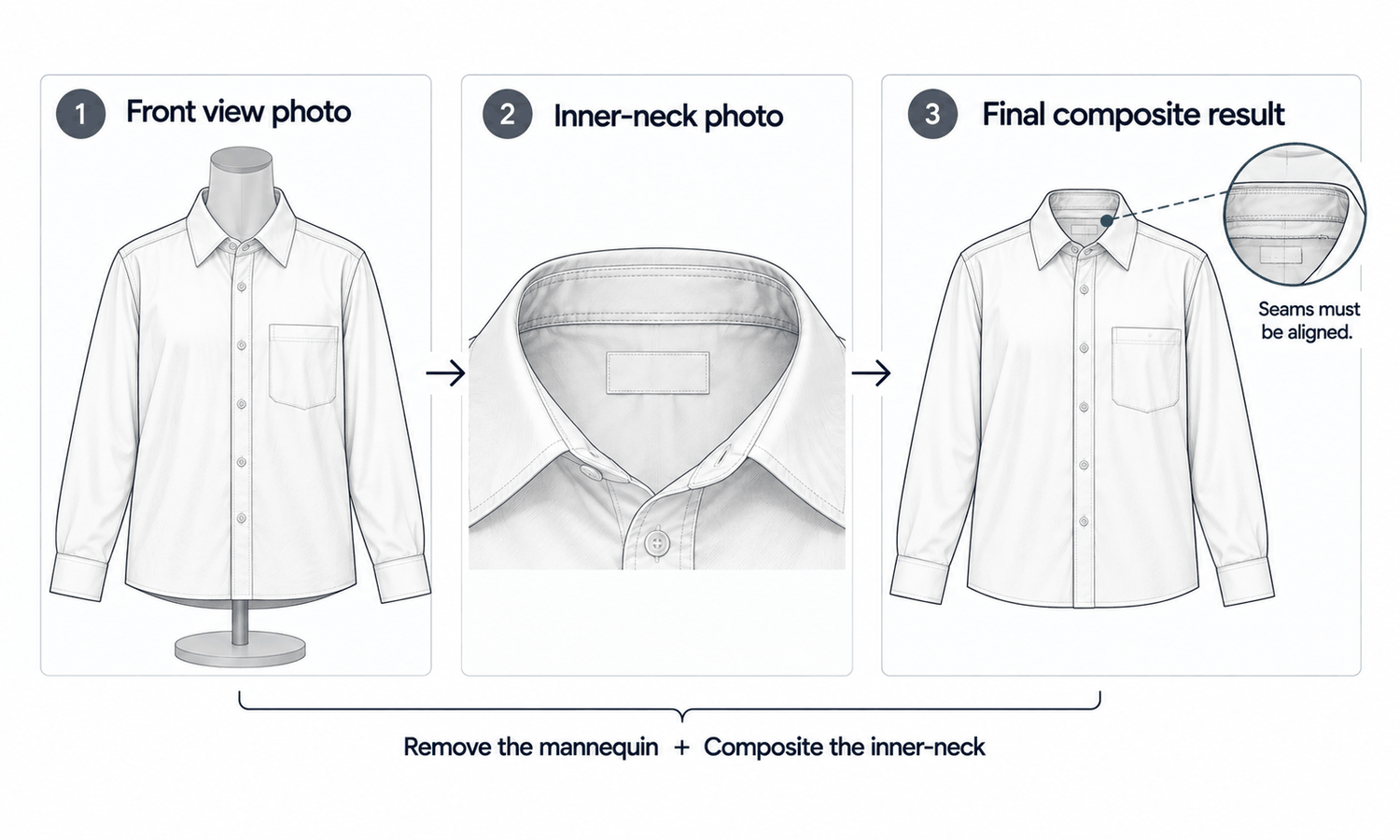
Ghost clothing photography shows a garment as if it were being worn by an invisible person. The jacket keeps its shoulders, the shirt keeps its chest, the collar opens to show the inside of the neck, and yet there is no model and no visible mannequin. It is one of the most common looks in apparel e-commerce, and it is produced with a mannequin, a careful set of photographs and a precise piece of editing.
The appeal is easy to see. A ghost image shows the garment's three-dimensional shape without a model's pose, face or styling pulling attention away from the product. It is consistent from one product to the next, it can be produced in volume, and it shows details a flat-lay cannot, such as how a collar stands or how a jacket's front falls.
This article explains how ghost clothing photography works: what it is, how the mannequin is chosen and prepared, how the layers are photographed, how the mannequin is removed in editing and how a whole catalog is kept consistent.
| Step | What happens | What commonly goes wrong |
|---|---|---|
| Choose the mannequin | Match the mannequin's size and shape to the garment | Garment sags on a small form or stretches on a large one |
| Prepare and style | Steam, pin and clip the garment into its intended shape | Pins or clips visible; garment pulled into a shape it does not have |
| Shoot the front | Photograph the garment on the mannequin | Uneven light, lens distortion, camera height changing between products |
| Shoot the inner neck and back | Photograph the inside of the collar and the back | Different lighting from the front, making the composite visible |
| Remove the mannequin | Cut the garment out and delete visible mannequin parts | Leftover edges, halos around the garment |
| Composite the inner neck | Place the inside-collar image into the neck opening | Misaligned seams, mismatched perspective |
| Finish | Add subtle shadows, clean the background, check color | Flat, lifeless interior; over-smoothed fabric; color drift |
What Ghost Clothing Photography Is
Ghost clothing photography, often called invisible mannequin or ghost mannequin photography, is a way of photographing garments on a mannequin and then removing the mannequin in editing. The garment keeps the shape the mannequin gave it, so it looks worn, but nothing of the body remains.
The technique sits between two other common product views. A flat-lay shows the garment laid out and photographed from above: it is simple and shows the whole garment, but it looks flat and gives little sense of how the garment sits on a body. An on-model photograph shows the garment worn by a person: it shows fit and styling, but the model's pose and presence compete with the garment and vary from shoot to shoot. A ghost image keeps the three-dimensional shape of an on-model image with the neutrality and consistency of a flat-lay.
That combination makes it well suited to product pages, catalogs and marketplace listings, where many products need to be compared side by side and the garment itself is the subject. It works well for garments with structure: shirts, jackets, coats, dresses, knitwear and trousers. Very soft or unstructured pieces, and items without a clear worn shape, often suit a flat-lay better.
Choosing and Preparing the Mannequin
Everything in a ghost image depends on the mannequin. The garment takes its shape from the form beneath it, and no amount of editing fully corrects a garment that sat badly on the wrong mannequin.
Ghost photography uses mannequins with removable parts. A typical form has a detachable neck or chest plate, so the inside of the collar can be photographed, and often removable arms, so sleeves can hang naturally or be shaped. Some studios use separate forms for tops, bottoms and dresses, and different forms for different size ranges.
Preparation follows a consistent sequence.
-
Match the size. The garment should sit on the mannequin as it was designed to sit on a body. A form that is too small leaves the garment sagging and wrinkled; a form that is too large stretches seams and distorts the shape.
-
Steam the garment. Creases from packing and storage show clearly in ghost images and are slow to remove in editing. Steaming before dressing the form saves hours later.
-
Pin and clip from behind. Pins and clips placed at the back or inside the garment hold it in shape without appearing in the front shot. Anything visible from the camera has to be removed later.
-
Shape without distorting. Adjust sleeves, collars and hems so they fall naturally. Pulling the garment tighter or smoother than it really is makes the image misleading.
The last point matters more than it seems. A ghost image is a representation of the product, and a customer uses it to judge the garment's shape. Clipping a loose shirt tight at the back to make it look tailored, or padding a jacket to make its shoulders look sharper, shows a garment that will not arrive.
Shooting the Layers
A ghost image is built from several photographs, and they have to match each other closely enough to be combined without a visible join.
Lighting comes first. Even, diffuse light from the front and sides shows the garment's shape through soft shading without harsh shadows. The lighting must stay the same for every shot of a given garment, because the front and the inner-neck images will be combined, and a difference in light will show in the finished image.
Camera position comes next. Shooting straight on, at around chest height of the mannequin, keeps the garment's proportions true. A longer focal length from further away reduces the distortion a wide lens produces close up, where the nearest parts of the garment look larger than they are. Marking the positions of the camera and the mannequin on the floor keeps every product in the catalog shot the same way.
Then come the shots themselves. The front view is taken with the garment on the full mannequin. For the inner neck, the front neck or chest piece is removed, or the garment is turned inside out on the form, and the inside of the collar and back neck, including any label, is photographed so it can be placed into the neck opening later. A back view is photographed the same way as the front. Detail shots of trims, labels and fabric are taken separately at close range.
Trousers and skirts follow the same logic, with the inside of the waistband photographed in place of the inner neck.
Editing: Removing the Mannequin
The editing is where the invisible mannequin becomes invisible. It is precise work, and it is where most of the characteristic errors appear.
First, the garment is cut out from the background, and every visible part of the mannequin is removed: the neck, the arm stubs, the base and anything showing through openings. The cut-out has to follow the garment's true edge, including fine details such as frayed hems or loose threads, without leaving a halo of the old background around it.
Next, the inner-neck image is composited into the neck opening. It has to be aligned so the collar seams meet, scaled and angled to match the perspective of the front view and blended so the join is invisible. A misaligned insert, where the inside of the collar does not line up with the outside, is the most common giveaway of a ghost image.
Then the image is finished. Subtle shadows inside the garment, at the neck opening and under the sleeves, give it depth; without them the interior looks flat and pasted. The background is cleaned to the studio's standard. Color is checked against the physical garment under consistent viewing light, because editing adjustments can shift color slightly, and a product image is judged by its color.
The same caution about honesty applies here. Editing can remove a stray crease, and it can also smooth away the texture that makes a fabric what it is, straighten a drape that is naturally soft or reshape a silhouette. A ghost image should show the garment as it is, so editing should correct distractions without changing the product.
Keeping a Catalog Consistent
A single ghost image is a technique. A catalog of them is a system, and consistency is what makes the system work. Shoppers compare products side by side, and differences in size, angle or light between images read as differences between garments.
A few standards keep a catalog consistent.
-
One mannequin per category and size range. Every shirt in a size range is shot on the same form, so shapes are comparable.
-
Fixed camera, light and mannequin positions. Marked on the floor and recorded, so every session reproduces the same setup.
-
One crop and scale. Each garment fills the frame in the same way, with the same margin, so thumbnails line up.
-
One editing standard. Written rules for shadow depth, background color and how much crease removal is allowed.
-
A check against the garment. Each finished image is compared with the physical product for color, details and shape before it is published.
A short style guide with reference images for each category turns these standards into something a whole team, including outside studios, can follow. Reviewing a category's images side by side, rather than one at a time, is the quickest way to see where a product has drifted from the rest.
Frequently Asked Questions
What is ghost clothing photography?
Ghost clothing photography shows a garment as if worn by an invisible person. The garment is photographed on a mannequin, and the mannequin is removed in editing so only the garment's three-dimensional shape remains.
How is the inside of the collar shown?
It is photographed separately, with the mannequin's neck piece removed or the garment turned inside out, and then composited into the neck opening. The two images must be aligned so the collar seams meet.
Why does the mannequin size matter so much?
Because the garment takes its shape from the form beneath it. Too small a form leaves the garment sagging; too large a form stretches it, and editing cannot fully correct either.
What are the most common mistakes in ghost images?
A misaligned inner-neck insert, halos left around the garment, a flat interior without shading and fabric smoothed so much that its texture disappears. Inconsistent camera height between products is another common one.
Which garments suit ghost photography?
Garments with structure, such as shirts, jackets, coats, dresses, knitwear and trousers. Very soft or unstructured items often suit a flat-lay better.
Can editing improve how a garment looks?
It should remove distractions such as stray creases and visible pins. It should not reshape the silhouette, smooth away the fabric's texture or make the garment look more tailored than it is, because the image represents the product.
In Closing
Ghost clothing photography combines a mannequin, a set of matched photographs and precise editing to show a garment's shape without a body. The results depend on a well-matched mannequin, careful styling, consistent lighting and camera position, a cleanly composited inner neck and editing that removes distractions without changing the product. Across a catalog, fixed standards and a short style guide keep every image comparable, and a final check against the physical garment keeps every image honest.