
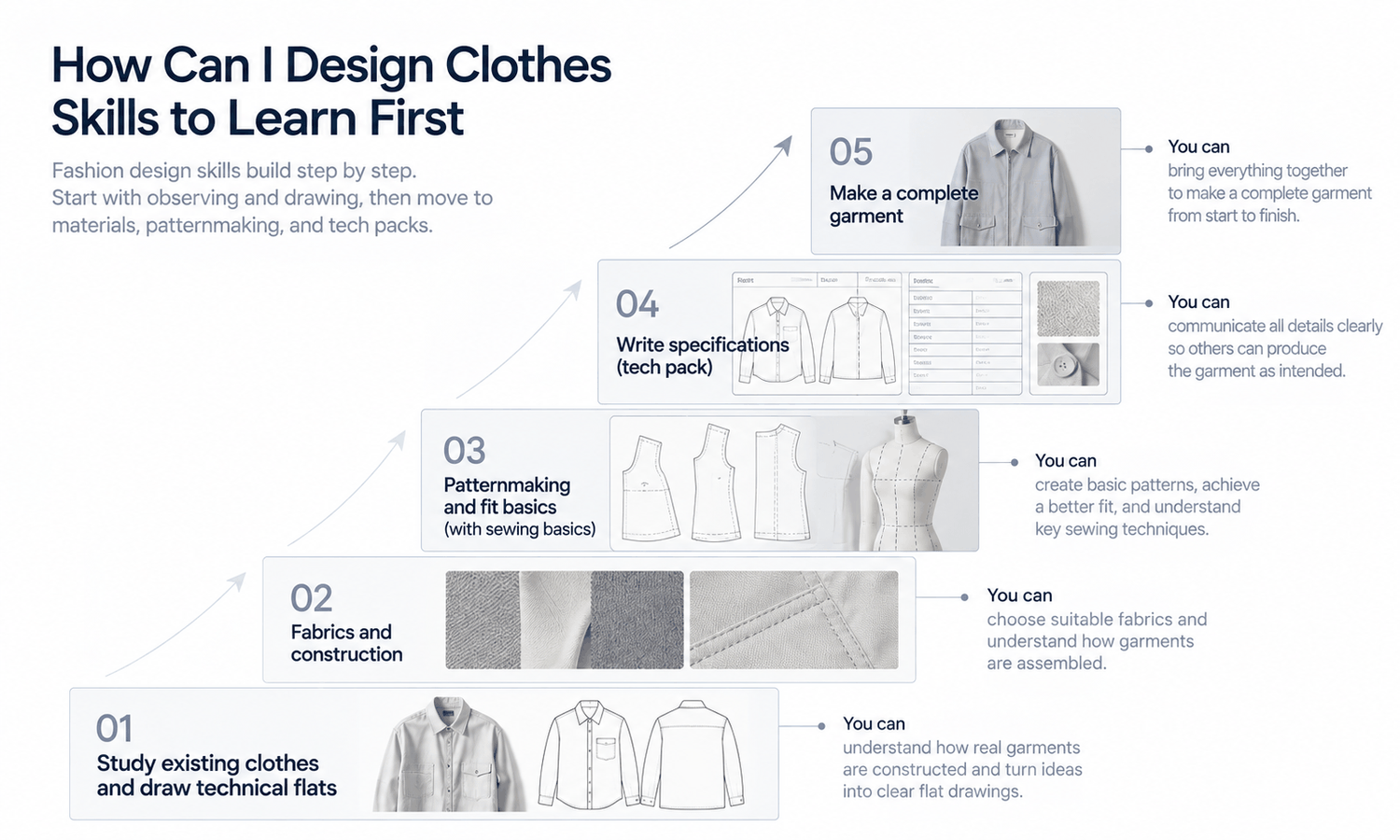
How can I design clothes is a question with a practical answer: learn a small set of skills in a sensible order, and practice them on real garments. Many people imagine clothing design as mostly drawing and ideas. Ideas matter, but a design only becomes clothing when it can be cut, sewn and worn, and the skills that make that possible are learnable by anyone willing to spend time with fabric, patterns and garments.
The skills fall into a few groups. Drawing lets you communicate a design. Knowledge of fabrics and construction lets you design things that can actually be made. Pattern and fit basics let you understand how a flat shape becomes a garment on a body. And knowing how to write down a design lets you hand it to someone else to make. None of them requires formal training to start, though each rewards deeper study.
This article explains where designing clothes starts, and then covers drawing, fabrics and construction, patterns, fit and sewing basics, and how to put what you learn into practice.
| Skill | What it lets you do | How to start learning | When you need it |
|---|---|---|---|
| Drawing flats | Communicate a design precisely | Trace and redraw garments you own | From the first design |
| Fashion illustration | Convey mood and attitude | Sketch from photos and life | Useful, not essential at first |
| Fabric knowledge | Choose materials that suit the design | Handle, compare and label swatches | Before choosing materials |
| Construction knowledge | Design things that can be made | Take apart and study existing garments | Before finalizing details |
| Pattern basics | Understand how shape is created | Work from basic blocks and simple patterns | Before working with a pattern maker |
| Fit basics | Judge and correct samples | Attend or run fittings; study measurements | When samples arrive |
| Sewing basics | Understand what makes things easy or hard to make | Sew simple garments | Early, even at a basic level |
| Writing specifications | Hand a design to others | Write a tech pack for one garment | Before sampling |
Where Designing Clothes Starts
Designing clothes has two halves. The first is deciding what to make: who it is for, what it looks like and why it should exist. The second is making sure it can be made: what it is made from, how it is constructed and how it fits. Beginners often focus on the first half and discover the second only when a sample comes back looking nothing like the sketch.
Studying existing garments is the quickest way into both halves. Pick a garment you know well and look closely at it: how many pieces it is made from, where the seams run, how the collar is attached, how the hem is finished, what the fabric feels like and how it hangs. Every garment in a wardrobe is a lesson in decisions someone else has already made. Comparing two versions of the same kind of garment, such as a cheap and an expensive shirt, is especially revealing, because the differences in fabric, finish and construction become obvious side by side.
Research belongs at the start too. Looking at how designers you admire build collections, how garments in a category differ from each other and what customers in that category care about gives your ideas direction. It is research, not copying: the aim is to understand why things are made the way they are.
Drawing: Flats Before Illustration
Drawing is how a designer communicates, and there are two kinds of drawing to learn.
Technical flats are the more important to start with. A flat is a precise line drawing of a garment laid flat, front and back, showing every seam, pocket and closure. It is what a pattern maker and a factory work from. Flats reward accuracy more than artistic talent, and they are easy to practice: redraw garments you own, measure them and check your drawing's proportions against the real thing. Learn the conventions early: symmetric halves, a clear hierarchy of line weights and dashed lines for topstitching.
Fashion illustration comes second. It conveys mood, movement and attitude, usually on a stylized figure. It is valuable for presenting ideas and for developing a personal style, but a designer who can draw clear flats and not yet illustrate can still get garments made, while the reverse is much harder.
Drawing can be learned on paper or with digital tools. What matters is regular practice and comparing drawings with real garments.
Fabrics and Construction
Fabric and construction knowledge is what keeps designs realistic.
-
Fibers. Learn how cotton, linen, wool, silk and common synthetics differ in feel, warmth, care and cost.
-
Wovens and knits. Woven fabrics are made from interlaced threads and are generally stable; knitted fabrics are made from interlocking loops and stretch. The difference shapes how a garment must be cut and sewn.
-
Weight and drape. Learn to judge a fabric's weight and how it hangs, because the same design behaves differently in a light, fluid fabric and a heavy, stiff one.
-
Handling. Some fabrics fray, slip, stretch or mark easily, which affects how they can be sewn.
-
Construction. Learn common seams, finishes, closures and pocket types, and how each is sewn. Taking apart an old garment along its seams is one of the fastest ways to understand construction.
Keeping a swatch book, with small labeled pieces of fabric and notes on how each behaved, builds this knowledge quickly and gives you references for future designs.
Color deserves its own attention. Learn how colors relate to each other, how a palette with a few core colors and one or two accents holds a collection together and how the same color looks different on different fabrics. Learn, too, that a color on a screen is not the color of a garment. In production, colors are agreed on physical standards and confirmed on dyed samples of the actual fabric, and understanding that process early saves disappointment later.
Patterns, Fit and Sewing Basics
Patterns turn a design into flat pieces that can be cut from fabric. A beginner does not need to become a pattern maker, but understanding the basics changes how you design.
Start with basic blocks, the simple foundation patterns for a bodice, a skirt, a sleeve and a trouser, from which many designs are developed. Learn what darts, ease and seam allowances do: darts shape flat fabric around the body, ease adds room for movement and comfort and seam allowances leave space to sew. Learn that grading scales a pattern across sizes. With that knowledge, you can talk to a pattern maker clearly and understand why some design ideas are simple to make and others are not.
Fit follows. Samples are tried on a person at the brand's base size, and the fitting shows where the garment pulls, gapes or restricts movement. Learning to read a fitting, and to describe corrections precisely, is a skill in itself. It is also a reminder that fit is confirmed on a real body, not on a drawing or an image.
Measurements are part of the same foundation. Learn how garments are measured, what a size chart describes and how a single base size is scaled into a range. Designing with measurements in mind, rather than only shapes, is what lets a design fit the people it is made for.
Sewing basics complete the picture. Even simple sewing, such as a tote bag, a skirt or a basic top, teaches what makes a design easy or hard to make, and that understanding shows in every design you draw afterward.
How Can I Design Clothes With What I Learn?
Skills become design ability through practice on real projects. A sensible order is to start with drawing flats and studying existing garments, then learn fabrics and construction, then pattern and fit basics, with sewing alongside at whatever level is possible.
-
Design one garment completely. Take a single simple garment from idea to sketch, flat, fabric choice and written specification.
-
Write a tech pack for it. Include flats, measurements, construction details, materials and colors. Writing one teaches more than reading about them.
-
Make or commission a sample. Seeing the garment made, by yourself or someone else, shows which decisions worked.
-
Keep a portfolio. Record sketches, flats, swatches, samples and what you learned from each project.
-
Build gradually. Move from single garments to small collections once the basics feel secure.
There are many ways to learn these skills: formal courses, short workshops, books, online tutorials, working alongside a pattern maker or in a sample room and simply taking garments apart. Each suits different people and budgets. What they share is that the learning sticks when it is applied to real garments soon after, so pair any course or tutorial with a small project.
A few beginner mistakes are worth avoiding. Designing many pieces before one has been made hides problems that a single sample would reveal. Choosing fabrics from photos alone leads to surprises in weight and drape. Skipping the back view in drawings leaves a pattern maker to guess. And treating a first sample as a failure, rather than as the normal first step of development, discourages people just when they are learning the most.
Frequently Asked Questions
How can I design clothes if I am starting from nothing?
Start by studying garments you own and drawing them as flats, then learn fabrics and construction, pattern and fit basics and some sewing. Practice by designing one garment completely, from idea to written specification.
Do I need to be good at drawing to design clothes?
You need to draw clear technical flats, which rewards accuracy more than artistic talent. Fashion illustration is useful but can come later.
Should a designer learn to sew?
At least the basics. Sewing simple garments teaches what makes a design easy or hard to make, which improves every design afterward.
Do I need to learn pattern making?
Not to a professional level, but understanding basic blocks, darts, ease, seam allowances and grading helps you design things that can be made and talk clearly with a pattern maker. Many designers learn pattern basics alongside their first samples.
How can I learn about fabrics?
Handle and compare fabrics, keep a labeled swatch book with notes and study how fabrics behave in garments you own. Learn the difference between wovens and knits early.
What should my first project be?
A single simple garment, designed completely: sketch, flat, fabric, written specification and, if possible, a sample. It teaches the whole process on a manageable scale.
In Closing
How can I design clothes? Learn to draw clear flats, understand fabrics and construction, grasp the basics of patterns, fit and sewing, and learn to write a design down so others can make it. Study the garments around you, practice on one complete garment before a collection and keep a record of what each project teaches. Ideas start a design; these skills are what turn it into clothing.