
The clearest way to understand how ai tryon works is to look at what goes in rather than at what comes out. Everything the output is good at, and everything it cannot do, follows from what a photograph of a garment actually carries.
A flat photograph carries three things about a garment and does not carry three others. That split is not a limitation of any particular tool. It is a property of photographs, and no amount of processing recovers information the image never contained.
Once the split is clear, most of the questions people ask about this technology answer themselves.
What a photograph carries and what it does not
| It carries | So it can | It does not carry | So it cannot |
|---|---|---|---|
| Shape: outline, proportion, where seams run | Present a garment on a figure with the right silhouette | Weight | Say anything about how a cloth hangs or sits over time |
| Surface: how the cloth handles light | Read as the right kind of fabric at a glance | Hand: stiff or fluid, springy or not | Predict how it behaves in motion or after wearing |
| Markings: prints, logos, labels, stitching, hardware | Reproduce them, and be checked on whether it did | Construction underneath | Tell a seam from a fold, or a corseted shape from a layered one |
The left column is where the output's strengths come from. The right column is where every boundary comes from, and the reason those boundaries do not move is that nothing downstream can add information the input never had.
That is worth stating plainly because the two columns get conflated. A convincing image is convincing about the left column, and its convincingness says nothing about the right.
The three it reads
Shape comes first. A garment photographed flat and complete shows its outline, its proportions, where the seams run, how long the sleeve is relative to the body. That is geometric information and it is read reliably, which is why proportion and silhouette come through well.
Surface is second. How a cloth handles light — matte or lustrous, smooth or textured, whether a weave shows — is present in the pixels and can be carried into an output. This is where a good result reads as the right kind of fabric even though nothing about the fabric itself has been measured.
Markings are third: prints, logos, labels, stitching visible on the surface, hardware. These are present in the photograph as specific shapes, and reproducing them is a matter of getting specific shapes right. It is also where the characteristic failure lives, which is why logos, printed text, care labels, and small hardware get compared against the source image on every single on-model output, without exception. Reconstructed detail lands almost right — a letterform slightly off, a stitch count wrong, a zipper pull the wrong shape.
The three it cannot read
Weight is absent. Nothing in an image distinguishes a two-hundred gram jersey from a three-hundred gram one if they have been photographed to look alike, and a person holding both would not need a second to tell them apart.
Hand is absent for the same reason. Whether a cloth is stiff or fluid, whether it springs back or stays where it is put, whether it is dry or slippery against skin — none of that is a visual property, and a photograph is a visual record.
Construction underneath is absent. A dark line on a bodice could be a seam, a fold, a pressed crease, or shading. Whether a shape comes from a corseted foundation or from layers of cloth is not visible from outside, and two garments built entirely differently can photograph identically.
None of these three is a resolution problem. A higher-resolution photograph of a garment still contains no measurement of its weight, and a better camera does not record how a fabric springs back.
What happens to what it read
The step in between takes the three things the photograph carried and produces an image of a garment on a figure that is consistent with them.
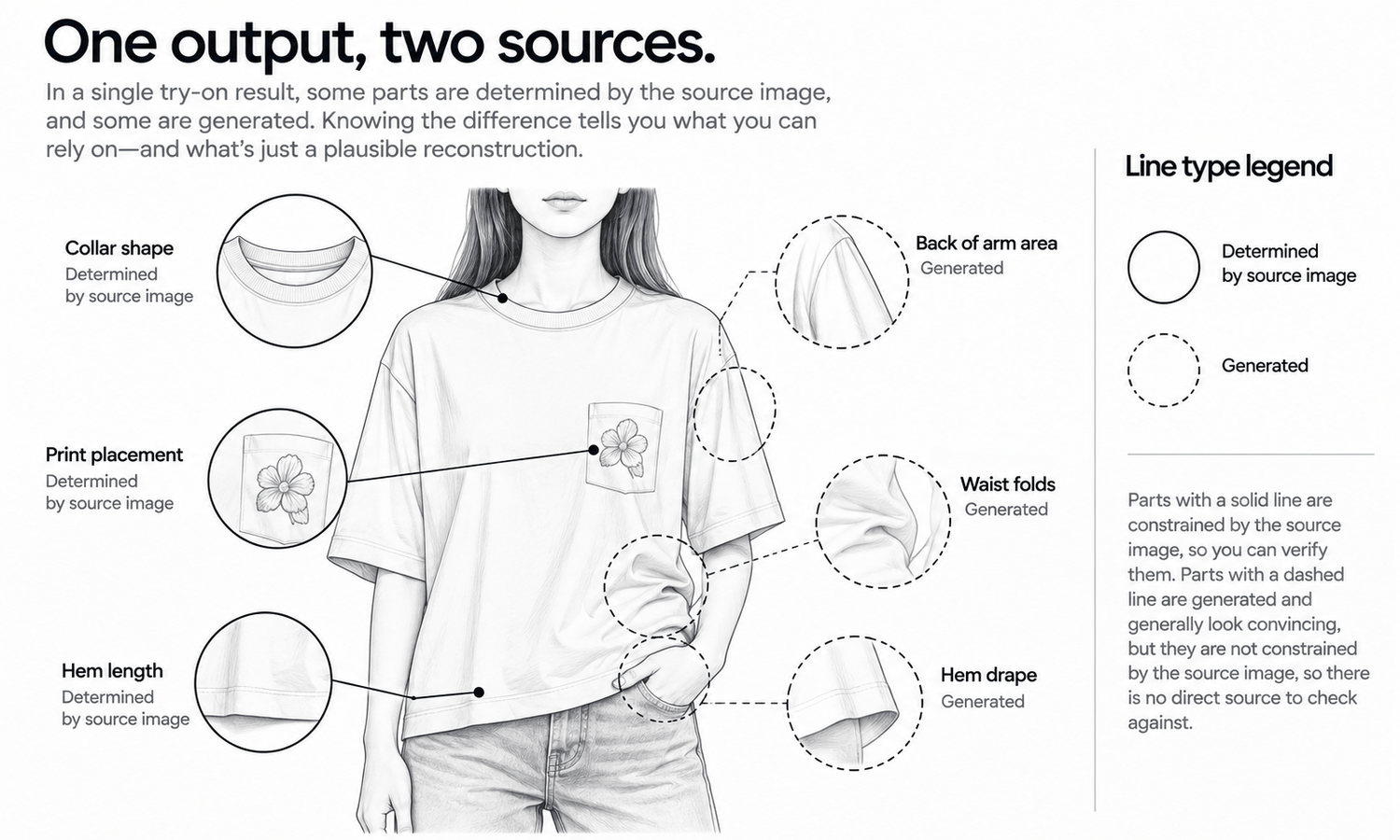
The important word is consistent. Shape, surface and markings constrain what the output can be, and everything not constrained by them has to be arrived at some other way — a fold where the flat image had none, a region behind an arm, the way a hem falls. Those are produced to be plausible rather than recovered from anything.
That is why the same output can be simultaneously excellent and wrong in a specific place. The parts constrained by the input are held to the input. The parts not constrained by it are held to plausibility, and plausibility is a lower bar than accuracy in exactly the way that matters.
There is a useful way to read any output with this in mind. Ask which parts of what you are looking at were determined by the photograph and which were arrived at. The hem length was determined; the way the hem falls was arrived at. The print is on the shirt because it was in the source; the fold running through it was not. That reading takes a few seconds and it tells you which parts of an image you can rely on and which parts are a plausible account.
It also explains the documented weak spots. Lace and open work, sheer fabrics, complex prints and heavily layered looks are the cases where the least is constrained and the most has to be produced, which is why those categories belong with photography rather than in a retry loop.
What follows from the split
The boundary set is not a list of things somebody decided to exclude. It is what the right column implies.
The output is a visual asset. It does not predict fit, determine sizing, model how a fabric behaves in motion, or forecast returns. Those come from measurements, a graded pattern, a physical sample, and your own data. Fit needs measurements of a garment and a body, and the input contains neither. Motion needs weight and hand, and the input contains neither. Sizing needs a graded pattern, which is a document rather than an appearance.
Color is the same shape. Screen color is not a physical reference, exact code matching is not something to promise, and the gap between a monitor and a roll of cloth stays open regardless of display quality. A photograph records a color under a lighting condition, which is a reading rather than a value, so colorways get settled by strike-offs against an agreed standard.
Footwear is not covered by this class of workflow, and the reason is the same mechanism: a shoe is built on a last and has no flat-lay state that carries its shape the way a laid-out garment does. The input the method depends on does not exist for it.
What this means for the photograph you take
If the input determines everything, the photograph is where the return on effort sits.
-
Capture complete and unobstructed, since anything hidden is information the system does not have and will have to produce
-
Light evenly and consistently, because surface is read from how light behaves and inconsistent light makes your own garments read as different fabrics
-
Shoot close enough that markings are legible at a size somebody could verify afterwards, or the comparison against source becomes impossible rather than merely harder
-
Record weight, hand and construction separately, in writing, since they are the three the photograph cannot carry and somebody downstream will need them
-
Decide colorway and fabric direction from cloth rather than from a rendered surface, because the rendered surface is a reading of one photograph
In Lightchain AI (apparel AI) the uploaded source stays beside every AI Virtual Try-On output derived from it, which follows directly from the mechanism: if the input constrains the output, the input is what the output has to be checked against, and across a catalog at scale that check only stays feasible when the two sit together. Whether the work runs through Lightchain AI or a camera, the photograph is the whole of what the system knows about your garment.
Frequently asked questions
Would a better photograph remove the limitations?
It improves everything in the left column and nothing in the right. Weight, hand and internal construction are not recorded by any camera, so a better photograph produces a better image and the same boundaries. That is the useful test for whether an improvement will help.
Can multiple photographs of the same garment help?
For shape and markings, yes, since additional angles carry additional constraint. For weight and hand, no, because more views of a visual record are still a visual record. Extra angles reduce how much has to be produced rather than adding new kinds of information.
Why do some garments come back better than others?
Because they constrain more of the output. A plain, opaque, flat-photographed garment leaves little to produce; a sheer or heavily layered one leaves a great deal. The difference is how much of the result was determined by your photograph rather than by plausibility.
Does this mean the output is guessing?
Producing rather than guessing, since it is constrained by what the photograph carried. The parts held to the input are held tightly. The parts not held to it are produced to be plausible, which is why they can be convincing and specifically wrong at the same time.
What should we record alongside the photograph?
Weight in grams, a description of hand, and the construction where it matters — the three the image cannot carry. Whoever receives the file downstream needs them, and reconstructing them later is much harder than writing them at capture.
How does this apply to a whole outfit?
Each garment is a separate input with its own three carried and three absent, and the overlaps between them are where the least is constrained. That is why a look with fewer overlaps comes back more reliably than the same pieces stacked.
In closing
A photograph of a garment carries shape, surface and markings, and carries nothing about weight, hand or internal construction. Everything the output does well comes from the first three; every boundary comes from the second three, and those boundaries hold because no processing step adds information the input never had. The practical consequence is that the photograph is not a preliminary — it is the entirety of what the system knows about your garment, and the parts of your garment it cannot see are the parts somebody has to write down.
Start here
Take a garment photograph you would normally send through and ask what it does not carry: what does this weigh, how does it feel, and how is it built underneath. Then check whether those three are recorded anywhere. In most workflows they exist in somebody's head and nowhere in the file, which is the gap this mechanism predicts and the one that costs the most later. Writing them down at capture takes a minute per garment.
**Start with the on-model workflow → **https://www.lightchainai.com/global/solutions/aiVirtualTryOn