
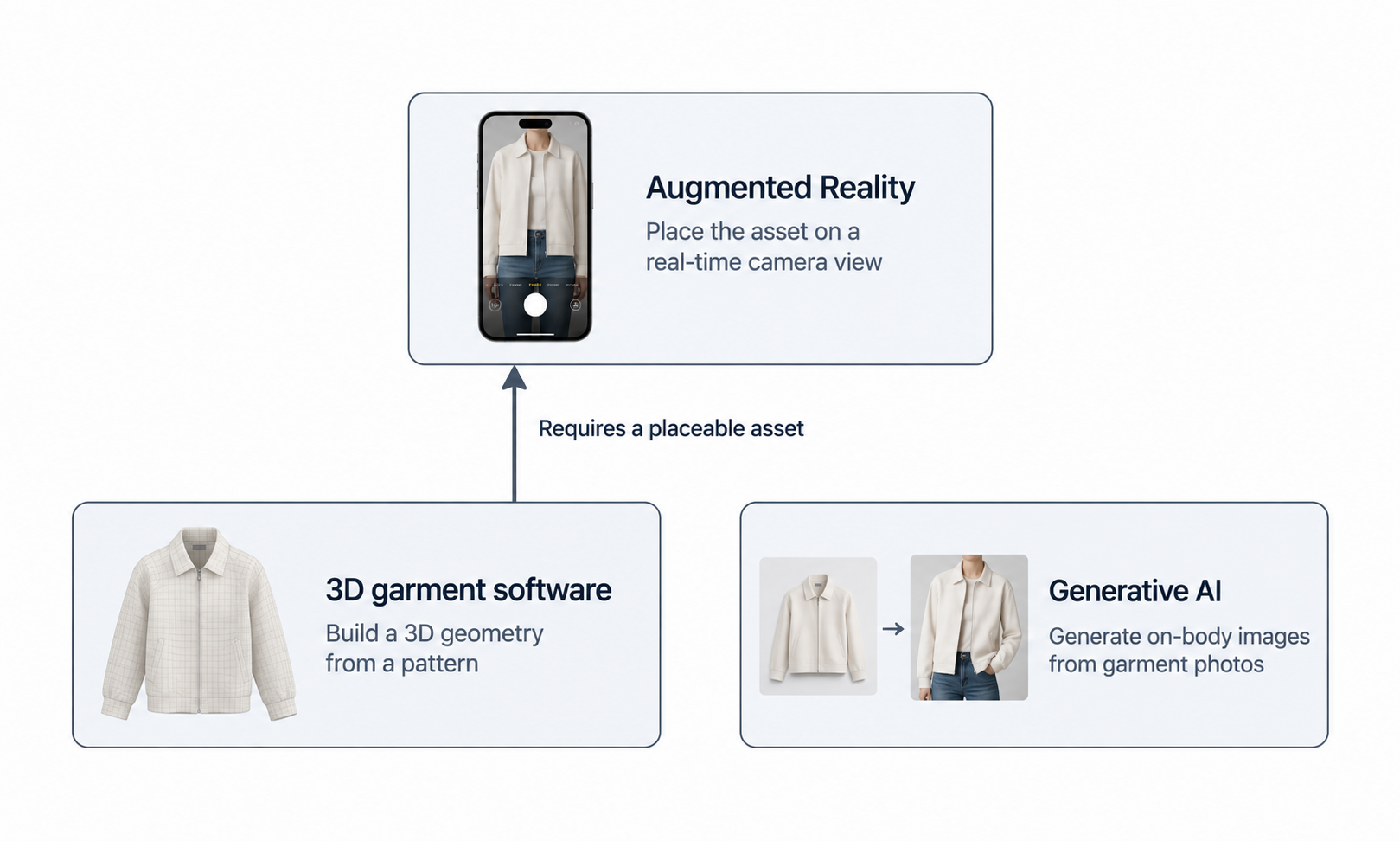
Three different things get discussed under 3d virtual try on, and treating them as competing versions of one product is what makes the choice confusing.
Augmented reality puts a garment onto a live camera view of a person. Three-dimensional garment software builds the garment as geometry, from a pattern, and can simulate how that geometry behaves on a body. Generative on-model imagery produces still assets from a photograph of a real garment. They have different inputs, different outputs, and different things they cannot do.
This workflow is the third of those, and it does not perform the first two. What follows is an attempt to describe all three accurately rather than to rank them, because ranking them is not the useful operation.
Three approaches, three different inputs
| Approach | What has to exist first | What it produces, and what it does not |
|---|---|---|
| Augmented reality | A three-dimensional asset to place, plus an app or web build and device support | A live camera view with a garment placed in it. It does not create the asset it places |
| Three-dimensional garment software | A pattern, and people who build and grade in three dimensions | Geometry that can be simulated on a body. It does not start from a photograph of a finished garment |
| Generative on-model imagery | A photograph of a real garment, captured to a consistent standard | Still visual assets. It does not build geometry and does not compute material behavior |
The second column is the one that decides most real situations. Each approach requires something to already exist, and what you already have narrows the field before any question of preference arises.
A brand with a pattern library and technical designers who work in three dimensions has an input the generative route does not need and cannot use directly. A brand with a photography setup and physical samples has an input the 3D route cannot use at all. Most apparel businesses have the second and not the first, which is a fact about the industry rather than an argument about which is better.
What you already hold decides what is available
Work backwards from your assets rather than forwards from the technology.
If garments exist as graded patterns and your technical team builds in 3D, the geometric route is open to you and much of its cost is already sunk. If garments exist as physical samples and photographs, the generative route is open and the 3D route means building each style as geometry first, which is a different project with a different team.
Augmented reality sits downstream of both rather than beside them. A live camera experience needs a three-dimensional asset to place, so it inherits whatever produced that asset along with the app or web build, the device support, and the maintenance that follows. Deciding to do AR is deciding to do the thing underneath it as well.
That ordering is worth stating plainly because AR is usually the most visible of the three and gets chosen first, which puts the dependency in the wrong place in the schedule.
Where 3D and generative meet
The two are not sealed off from each other, and the interface between them is narrow and specific.
This workflow does not build geometry and does not predict material behavior. Drape in a generated output is rendered rather than computed, which means it is evidence about the picture rather than about the cloth. That is a scope fact and it does not change with better output.
What does exist is a conversion path in one direction: an existing 3D asset can be turned into a flat garment image, which then enters the workflow as a source in the same way a photograph would. In Lightchain AI (apparel AI) that converted flat sits in the source position and is treated exactly as a photograph is, including for the comparison that follows. For a team that already holds 3D files, that is a way to use them for still imagery without rebuilding anything. It is not the workflow producing or simulating 3D, and the two should not be described as though they were the same capability.
Once inside, the material behaves like any other source. Logos, printed text, care labels, and small hardware get compared against the source image on every single on-model output, without exception, whether that source began as a photograph or as a converted 3D asset. Reconstructed detail lands almost right — a letterform slightly off, a stitch count wrong, a zipper pull the wrong shape — and the origin of the source does not change that.
What each one costs to keep running
Comparisons usually stop at the build and the interesting differences are in what recurs.
The geometric route front-loads: building a garment as geometry is substantial work per style, and it repays through reuse across colorways, sizes, and later seasons, provided the library is maintained and the people who can work in it stay. The generative route front-loads differently, into a capture standard rather than a modeling capability, and its per-style cost is a photograph plus review. An AR experience adds an ongoing engineering cost that neither of the others carries: device support, platform changes, and a build that ages whether or not the assortment does.
None of those is a verdict. They are different shapes of commitment, and the right one depends on how long your styles live, how many colorways each carries, and whether the skills involved already exist in the building. A style shown in one colorway for one season and never repeated repays none of the front-loading in any of the three.
Across a catalog at scale the recurring number is the one to model, since the build cost is paid once and the recurring cost is paid on every style, every season.
What a generated visual asset does not do
Scope belongs in a comparison rather than in a footnote, and it needs to be stated about the right thing.
For this workflow: the output is a visual asset. It does not predict fit, determine sizing, model how a fabric behaves in motion, or forecast returns. Those come from measurements, a graded pattern, a physical sample, and your own data. That is a property of what the asset is rather than a limitation of any result.
Physical simulation in 3D garment software is a different claim of a different kind, and it comes with its own validation requirements: a simulation is only as good as the material parameters and the block behind it, and it is checked against physical samples rather than instead of them. Assessing any particular simulation is outside what this article can do, and it should be assessed on its own terms rather than by analogy with generated imagery.
Color has a limit that applies to all three, because it is a property of screens rather than of any pipeline. Screen color is not a physical reference, exact code matching is not something to promise, and the gap between a monitor and a roll of cloth stays open regardless of display quality. Colorways get settled by strike-offs against an agreed standard.
Footwear is not covered by this workflow, and that is structural: a shoe is a rigid object built on a last, with no flat-lay equivalent to serve as the input the method depends on. Lace and open work, sheer fabrics, complex prints, and heavily layered looks are documented weak spots for generated imagery specifically.
Choosing without ranking
The question that resolves this is not which approach wins. It is which one answers the question you have, given what you already hold.
-
If the question is what a garment looks like on a body, for a page or a line sheet, and you have samples and photographs, the generative route reaches that directly
-
If the question is how a garment behaves as geometry before a sample exists, and you have patterns and the skills, the geometric route is the one built for it
-
If the question is about a shopper-facing interactive experience, that is a separate project sitting downstream of whichever asset route you chose
-
If the question is about fit or sizing, none of the three is the answer, and the measurement chart and the fit session are
-
If your styles do not repeat across colorways or seasons, front-loaded approaches repay less and photography stays competitive
In Lightchain AI (apparel AI) the uploaded source stays beside every AI Virtual Try-On output derived from it, which is the property that matters if you take the generative route at volume, since it is what lets a defect be traced back to whichever source produced it. Whether you take that route or another, the comparison against source is the step that does not disappear.
Frequently asked questions
Is generative imagery a replacement for 3D garment software?
No, and they answer different questions from different inputs. Generative imagery starts from a photograph of a real garment and produces still assets; 3D software starts from a pattern and builds geometry that can be simulated. A team using one for what the other does will be disappointed in a predictable way.
We already have 3D assets. Can we use them here?
An existing 3D asset can be converted into a flat garment image that enters this workflow as a source, in the same way a photograph would. That is a way of reusing files you already hold. It is not the workflow producing 3D and does not give you simulation.
Which one is cheaper?
The build costs differ and the recurring costs differ more, so the answer depends on how many colorways and seasons each style carries. Model the recurring number rather than the build, and check whether the skills each route needs already exist in the building. A style that does not repeat repays front-loading in none of the three.
Can any of them tell us how a garment will fit?
A generated visual asset cannot, and fit answers come from measurements, a graded pattern, and a fit session. Simulation in 3D software makes claims of a different kind that require their own validation against physical samples. Neither removes the fit session.
Do we have to choose one?
Many teams run more than one for different purposes, and the routes are not mutually exclusive. What causes trouble is running two without deciding which answers which question, since that produces two partial workflows and two half-maintained standards.
Where does AR fit in the sequence?
After the asset decision rather than before it, since an AR experience needs an asset to place and inherits whatever produced it. Choosing AR first commonly puts a dependency in the wrong place in a schedule. Decide the asset route, then decide whether an interactive surface is worth building on top of it.
In closing
The three are not competing versions of one thing. Augmented reality places an asset in a live camera view, three-dimensional software builds and simulates a garment as geometry from a pattern, and generative imagery produces still assets from a photograph of a real garment. Each requires something to exist first, and what you already hold usually narrows the choice before preference does. This workflow is the third, it does not build or simulate geometry, and existing 3D assets can enter it as flat sources. Beyond that, the routes should be judged on what they cost to keep running and on which question you actually need answered.
Start here
Write down what you already hold: graded patterns, 3D files, physical samples, photographs, and which people can work with each. That list narrows the field faster than any feature comparison, because two of the three routes require an input most apparel businesses do not have and the third requires one most of them do. Then decide which question you need answered before deciding which route answers it, since the routes are built for different questions and the wrong pairing disappoints predictably.
**Start with the on-model workflow → **https://www.lightchainai.com/global/solutions/aiVirtualTryOn