
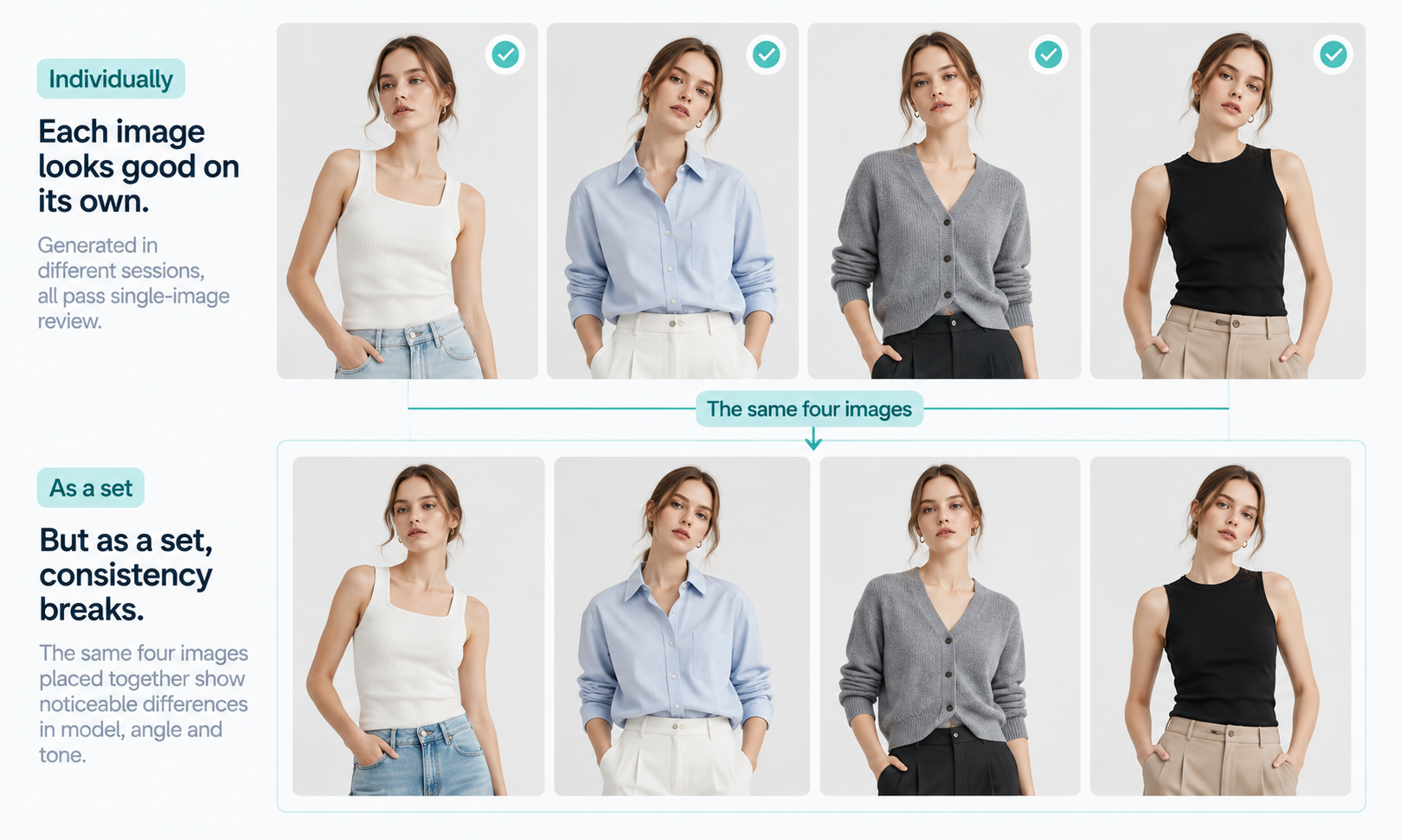
The upgrade question is usually framed around quality or volume. Neither is where the decision actually gets made for an apparel brand, because both describe a single image and an apparel workflow is not about single images.
A free tier is built around one picture at a time. A range is fifty styles, each needing several assets, produced across weeks, that have to look like they belong together. The mismatch between those two shapes is what eventually forces the decision, and it shows up in a specific place.
Free tiers are built for one image, a range is not
Think about what a free tier is designed to demonstrate. Someone arrives, uploads something, gets a result, and leaves impressed. Every design decision serves that moment.
An apparel workflow needs something different. The same base model across forty styles. The same treatment in March as in January. The ability to reproduce last season's look when a style carries over. None of those are visible in a single-image demonstration, and none of them are what a free tier was built to provide.
This is why free tiers rarely disappoint on the first test and frequently disappoint on the twentieth.
The pattern also distorts internal decision-making, because the person who ran the first test is usually the one advocating. They experienced the tool at its strongest point and are describing that experience accurately. The disappointment arrives with someone else, several weeks later, and reads as a different problem rather than as the same one at a later stage.
Continuity is what breaks first
Continuity means three specific things, and they are worth naming because teams experience the failure without diagnosing it.
The first is a consistent base. If each session starts fresh and the model, framing, or treatment shifts slightly, forty assets produced over three weeks will not sit together on a category page. Individually every one passes; as a set they read as assembled.
The second is reproducibility over time. A carryover style photographed in one season and refreshed in the next needs output that matches what already exists. Session-bound work cannot promise that, because there is nothing to return to.
The third is recoverability. When a style changes or an asset is rejected months later, you need to regenerate from the same starting point. Without stored state, regenerating means recreating conditions from memory.
Notice that none of these are quality problems. Every individual image can be excellent while the set fails.
That distinction is worth carrying into any evaluation. Reviewing candidate arrangements one image at a time will not surface a continuity difference, because continuity is a property of a sequence. Judge them by producing a small set across two separate sessions and putting the results side by side, which takes an extra day and is the only test that answers the actual question.
The second-season test
Here is a more useful trigger than volume or publication.
Ask whether you will need to produce imagery for the same styles, or in the same house look, again in three to six months. If the answer is no — a one-off campaign, a discontinued range, an experiment — a free tier may be entirely adequate and upgrading buys you nothing.
If the answer is yes, and for most brands it is, then continuity is a requirement rather than a preference, and it is the thing free tiers structurally do not provide. The decision has been made by the shape of your business rather than by any feature comparison.
Teams that upgrade for volume often find they were already over the line for a different reason.
The test has a useful side effect. Answering it forces a conversation about whether the brand has a house look at all, which some ranges do not, and a brand without one will not gain continuity from any arrangement. Establishing the reference first is the prerequisite that makes the upgrade worth paying for.
Structural limits that matter for product imagery
| Limit | Why it matters specifically for apparel | What it looks like in practice |
|---|---|---|
| Commercial use unstated | Product imagery is inherently commercial | An asset you cannot publish without checking |
| Output resolution capped | Product pages offer zoom | Fine at thumbnail, unusable at inspection size |
| Visible marks on output | Cannot appear on a storefront | Rules out the primary use case entirely |
| No stored base or model | Continuity across a range is impossible | Sets that do not match |
| Queued processing | Deadlines cluster around drops | Fine most weeks, decisive in launch week |
These are categories of limit rather than a list of what any particular tool does, and they vary. The point is that only the first three are about the individual image; the last two are about running a range, which is the part free tiers were never designed for.
Commercial use deserves particular care. Silence in terms is not permission, requirements vary by market and by platform, and this belongs with whoever owns compliance rather than being settled by whoever is running the tool.
What upgrading does not fix
Paying changes the arrangement and not the method, which is worth being clear about before a budget conversation.
The output remains a visual asset. It does not predict fit, determine sizing, model how a fabric behaves in motion, or forecast returns. Those come from measurements, a graded pattern, a physical sample, and your own returns data.
Input quality still decides most of the result. A poorly lit source with heavy occlusion produces weak output at any tier, and no plan compensates for a photograph that never recorded what the garment looks like.
Review still has to happen, and it is still the stage that scales with volume. A brand upgrading in the hope of reducing review workload has misread where the work is, and will usually end up with more review rather than less, because the constraint that was limiting output has been removed while the one checking it has not.
Running the free tier properly while you decide
A free tier is a legitimate instrument if you use it as one rather than as a small production system.
Run it on your actual difficult categories rather than your easiest, since the easy case tells you nothing you did not already assume. Keep every output in a folder labeled so it can never be mistaken for approved work. Record which styles worked and which did not, because that record is the finding, not the images. And set a decision date at the start, otherwise the trial becomes an indefinite arrangement that nobody revisits.
Two or three weeks is usually enough to establish whether the category suits the method, which is a separate question from whether the tier suits your workflow.
Keeping those two questions apart prevents a common wrong conclusion. A team whose difficult categories fail on a free tier sometimes upgrades expecting the failures to resolve, when the finding was about the garments rather than the arrangement. Establish which question you have answered before spending anything.
Stating the decision as a trigger
Thresholds age badly and triggers do not. Write the rule as an event rather than a number.
Upgrade when you need the same look reproduced in a later session. Upgrade when assets are going onto a storefront rather than into an internal review. Upgrade when a set has to hold together across a range rather than individually.
Those three cover almost every case, and each of them is observable without counting anything. The AI Virtual Try-On module in Lightchain AI (apparel AI) is built around the range case rather than the single-image case — see AI virtual try-on, and scaling e-commerce imagery for how continuity carries across a catalog.
Questions apparel teams ask
Is the paid output better quality? Sometimes marginally, and that is rarely the deciding factor. The differences that matter for a brand are continuity, resolution at inspection size, and whether the output can be published at all.
Can we publish work made on a free tier? Only where commercial use is granted in writing, and many terms are silent. Absence of a prohibition is not permission, and the answer varies by market and platform, so route it to compliance before scheduling anything.
How long should we stay on a free tier? Long enough to learn whether your categories suit the method, which is usually two to three weeks. Set the decision date when you start, since trials without an end date quietly become permanent.
What if we only need a handful of images? Then a free tier may be right, and that is a legitimate outcome. The upgrade case rests on repetition and continuity, and a genuine one-off has neither.
Will upgrading reduce our review workload? No. Review scales with the number of assets and has no technical shortcut, so a larger volume of output means more review rather than less.
We upgraded and the results did not improve. Why? Almost certainly the inputs. Source photographs decide most of the outcome, and a tier change does not alter what a photograph recorded.
What the decision actually rests on
Repetition. A brand producing imagery once can use a free tier and be satisfied; a brand producing imagery every season needs the same base, the same treatment, and the ability to return to both, and that is the requirement free tiers structurally do not meet. Test on your difficult categories, keep the trial folder labeled, set a decision date, and write the rule as a trigger rather than a threshold. If you will need this look again in three months, the decision has already been made for you.
Ask one question before comparing anything.
**Will you need the same styles, or the same house look, again in three to six months. If yes, continuity is a requirement and the comparison is about which arrangement provides it. If no, run the free tier on your hardest category for two weeks with a decision date attached, and keep the record of what worked rather than the images themselves. → **AI virtual try-on
About the author
[REPLACE — real person's name, role, relevant experience, LinkedIn URL. No team byline.]