
An independent designer selling both direct and through stockists produces one set of images and sends them into two markets that want different things from them.
The default is to build for whichever market feels primary — usually whichever one is paying that month — and let the other one carry the mismatch. That works until the neglected market is the one where the mismatch is expensive, and which market that is turns out not to be the obvious one.
Somebody searching for a free ai clothes swapper is usually at the point where the volume of imagery has become the constraint, which is exactly when this decision gets made by accident.
One set of images, two markets
| Selling direct | Selling through stockists | |
|---|---|---|
| What the image is | The product description of record. It is all the customer has | A proposal to a buyer who will also see a sample |
| Who checks it against the garment | The customer, at unboxing | The buyer, at the sample. And then the stockist's customer, at unboxing |
| Where it ends up | Your product page | Your line sheet, and then frequently the stockist's product page |
| What has to travel with it | Garment measurements, return terms, and what the images represent | Price, minimums, lead time, materials, and the range as a range |
| What a mismatch costs | A return, and a customer who now discounts what you show them | A defensive reorder, recorded as a merchandising decision rather than a trust problem |
Read the second column and the two markets look like they need different accuracy standards: a consumer sees only the picture, a buyer sees a sample. That reading is the trap, and the third column is why.
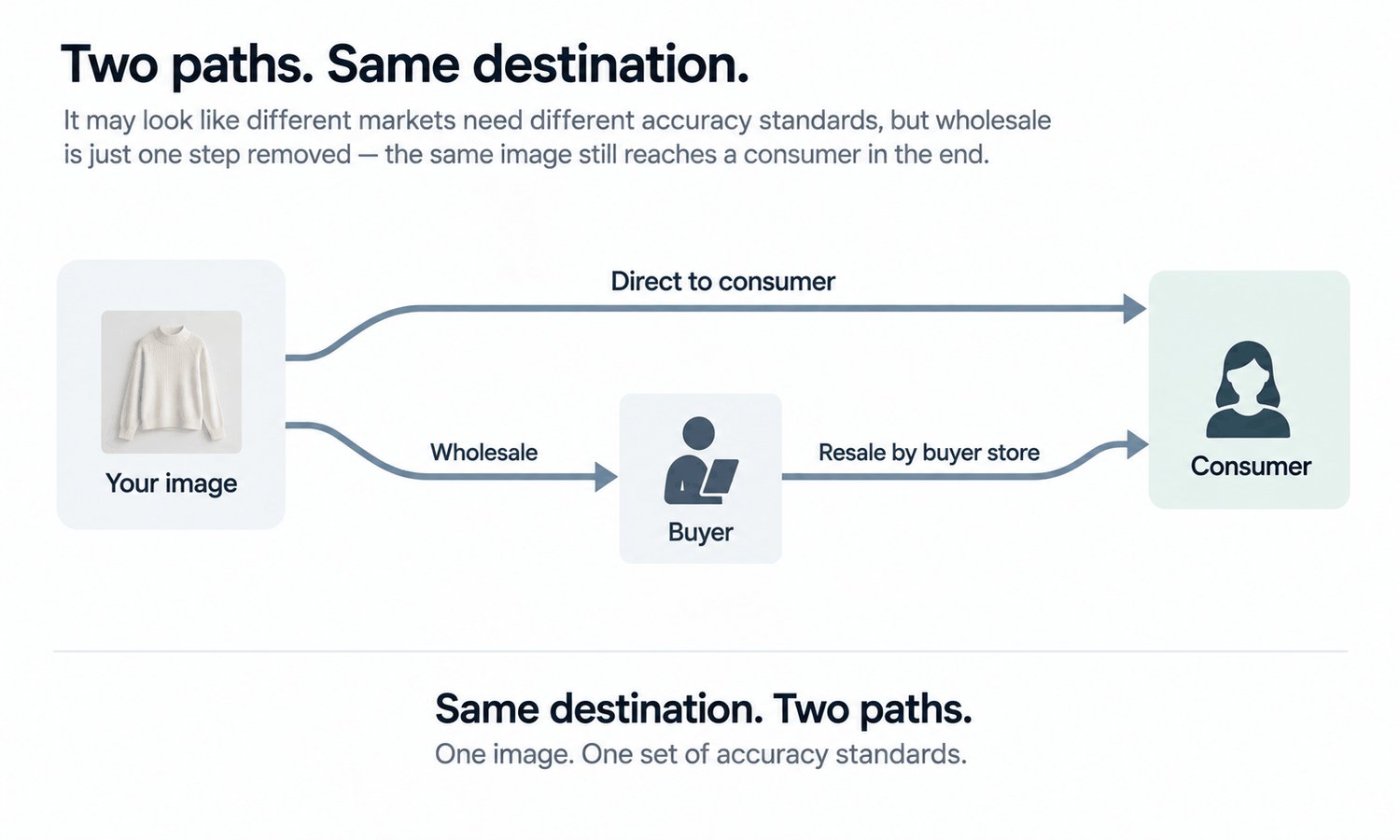
Wholesale is not a lower bar, it is direct at one remove
The reasoning that makes wholesale feel more forgiving is sound as far as it goes. A buyer is a professional who will see samples, ask questions, and place an order against terms. An image that oversells gets corrected by a garment in a showroom before money moves.
What that reasoning misses is what happens to the file afterwards. Line sheet assets routinely end up on the stockist's own product pages, because a listing needs filling and your image is better than what they could shoot. At that point the picture is a product description of record for a business you do not control, facing a shopper you will never meet, and the accuracy obligation is the direct-to-consumer one arriving by a different route.
So the practical position for an independent label is that there is one accuracy standard, and it is the stricter one. Assume republication and build to it, because the alternative is an enforcement effort a one-person business has no way to run.
That also removes a decision. There is no useful version of maintaining two accuracy tiers, and attempting it produces a set of assets nobody can tell apart six months later.
What genuinely differs is the material alongside
The images are one standard. What travels with them is two entirely different packages, and this is where the two markets actually diverge.
A buyer needs commercial and construction information: what it costs, what the minimums are, what the lead time is, what it is made of at a level a technical person can act on, and what the range looks like as a range. Much of that belongs in a line sheet, and for anything heading toward a factory a line drawing or tech-sheet draft carries the construction decisions a styled image leaves open.
A consumer needs none of that and needs three things a buyer does not: garment measurements, a clear statement of what the images do and do not represent, and the return terms. Those belong on a product page rather than in a document, and they are the fields most often missing from an independent label's catalog.
Separating it this way is what makes one asset library serve both. The pictures are shared. The wrapper is not, and building two wrappers is a much smaller job than building two image standards.
The single asset standard that serves both
If there is one standard, it is worth stating what it consists of, since it is shorter than the effort usually spent arguing about it.
-
A neutral, complete, consistently captured source for every body, since everything else derives from it and inconsistency cannot be corrected downstream
-
Details compared against that source on every single on-model output, without exception, because the person who eventually finds a wrong trim is either a consumer or a stockist's consumer
-
Identity fields travelling with every file — style, colorway, season, state — so a stockist republishing an asset is republishing a current one
-
A stated usage line with the assets that go to accounts, covering which channels and confirming the images are not evidence of fit or color
-
One decision about which categories go to photography, recorded with the reason
Reconstructed detail lands almost right — a letterform slightly off, a stitch count wrong, a zipper pull the wrong shape — and for an independent label the customer who finds it is close enough to the business that the correction is personal. In Lightchain AI (apparel AI) the uploaded source stays beside every AI Virtual Try-On output derived from it, which is what makes the per-output comparison a habit a single person can sustain rather than an intention.
What neither market's images can supply
Both markets ask images for things images do not contain, and the answer is the same in each.
The output is a visual asset. It does not predict fit, determine sizing, model how a fabric behaves in motion, or forecast returns. Those come from measurements, a graded pattern, a physical sample, and your own data. A buyer reading a size curve out of a line sheet image has made a decision the asset cannot support, and a consumer reading a fit conclusion off a product page has done the same thing at smaller scale.
So a size chart cannot be assembled from imagery for either audience, and fit language has to trace back to the measurement chart and the fit session wherever it appears. And no asset can be presented as the reason a return rate or a sell-through figure moved, since both sit at the end of a chain running through sizing, price, assortment, and traffic.
Color reaches both markets and settles in neither. Screen color is not a physical reference, exact code matching is not something to promise, and the gap between a monitor and a roll of cloth stays open regardless of display quality. Colorways get settled by strike-offs against an agreed standard, which is why the usage line for accounts is worth having in writing.
Footwear is not covered by this class of workflow, and lace and open work, sheer fabrics, complex prints, and heavily layered looks are documented weak spots. Those verdicts apply to both markets equally.
How one person runs both without two workflows
The workable arrangement is one production line with two exits, and the discipline is at the exit rather than in the production.
Produce to the single standard. Then, at the point an asset leaves, decide which wrapper it gets: the buyer package or the consumer package. That decision takes seconds if the two wrappers are written down in advance and takes an afternoon if they are improvised each time.
The failure mode to watch is the opposite one, where a designer under time pressure sends the consumer-facing images to a buyer with no commercial information attached, or sends line sheet assets to a product page with no measurements. Both happen because the wrapper is the part that requires remembering and the images are the part that is already there. That asymmetry is worth designing around rather than resolving with attention, since attention is the resource a one-person business has least of in the week a drop ships. Whether the work runs through Lightchain AI or a camera, writing the two wrappers down once is what stops that.
Frequently asked questions
Is there a free version of this kind of tool?
Terms change, so read the current listing rather than relying on any article including this one. What does not change is that the standard and the wrappers cost the same regardless of what generation costs, and those are usually the larger share of the work.
Should we really build wholesale imagery to a consumer standard?
Yes, because it becomes consumer imagery the moment a stockist fills a listing with it, and that happens whether or not anybody agreed to it. Building to the stricter standard once is cheaper than an enforcement effort you cannot staff. It also removes a decision you would otherwise make per asset.
What goes in the usage line for accounts?
Which channels the assets may appear in, whether cropping or compositing is permitted, and a sentence stating the images are not evidence of fit or color. Keep it short enough that it travels with every asset pack. Agreeing it is more useful than prohibiting editing in general.
We have no line sheet. Is that a problem for the wholesale side?
It is the buyer wrapper, so its absence means buyers are receiving consumer-facing material and inferring the commercial information. That inference is where a misunderstanding about price or minimums starts. A short document beats a good one that does not exist.
Which measurements should go on a product page?
The ones a customer can compare against a garment they already own: chest, waist, length, and sleeve for most categories. Publish them per size rather than as a single chart entry, and keep any size guidance separate and labeled as derived from your own returns.
Can the same photograph serve a line sheet and a product page?
Usually yes, and that is the point of a single standard. What differs is the crop, the format, and everything written around it. If a photograph works for one and not the other, the reason is normally the wrapper rather than the image.
In closing
Two markets, one image standard, two wrappers. Wholesale imagery becomes consumer imagery the moment a stockist republishes it, so there is no lower bar to build to and no benefit in maintaining two. What genuinely differs is what travels alongside: commercial and construction information for a buyer, measurements and terms for a consumer. Building two wrappers is a much smaller job than building two standards, and it is the version a one-person business can actually run.
Start here
Write the two wrappers on one page: what goes with an asset pack to an account, and what goes on a product page. Most independent labels find one of the two already exists informally and the other does not exist at all. Whichever is missing is the market currently carrying the mismatch, and it is usually not the one that felt neglected. Writing the missing one takes an hour and settles a question that otherwise returns every season.
**Start with the on-model workflow → **https://www.lightchainai.com/global/solutions/aiVirtualTryOn