
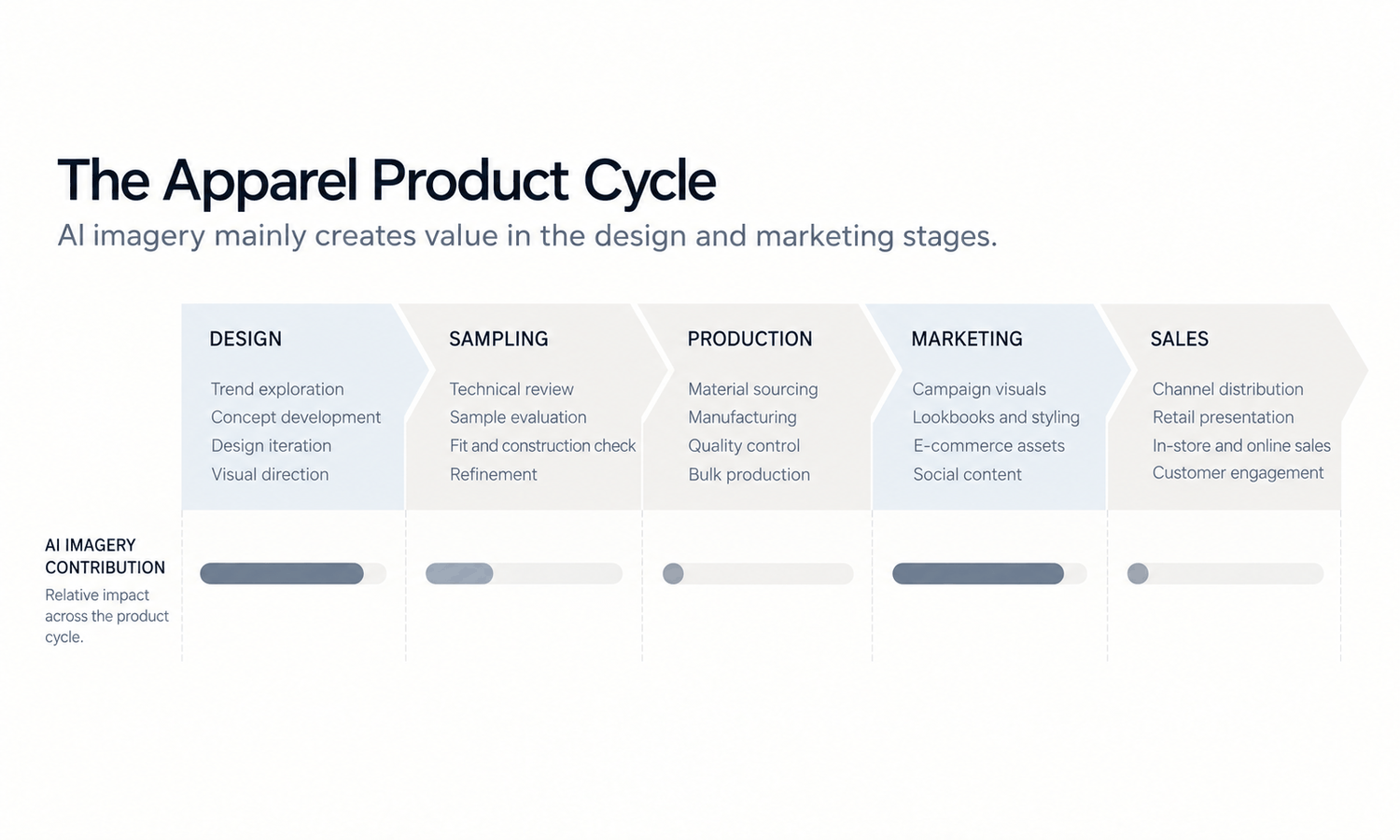
Fashion innovation is a broad phrase, and it covers very different things. A 3D design tool, a factory that prints fabric on demand, a virtual try-on on a shopping app and a generated model wearing a new collection are all described as innovation, but they work at different stages of a garment's life and solve different problems. Treating them as one wave of change makes it hard to see what any of them is actually for.
A clearer picture comes from following a garment through its product cycle: design, sampling, production, marketing and selling. At each stage, some innovations change how the work is done and others do not touch it at all. AI imagery, meaning generated images of garments and of models wearing them, is one of these innovations. It fits in some stages very well and not at all in others.
This article maps innovation across the product cycle, looks at design and sampling, production, and marketing and retail, and then sets out where AI imagery fits and where its limits are.
| Stage | Examples of innovation | What they address | Where AI imagery fits | What it does not replace |
|---|---|---|---|---|
| Design | 3D design, AI imagery, trend references | Seeing and comparing ideas earlier | Realistic previews of designs | The designer's judgment |
| Sampling | Digital sampling, 3D fit review | Fewer physical samples for early rounds | Visual review of options before sampling | Physical samples and fittings |
| Production | On-demand and small-batch making, digital printing | Making closer to actual demand | Little direct role | Pattern making, cutting and sewing |
| Marketing | Generated on-model imagery, 3D product views | Producing imagery at volume | On-model images from garment photos | Photography where it shows more |
| Selling | Virtual try-on views, size recommendation systems | Helping shoppers choose | Product and campaign images | Size and fit guidance |
Innovation Across the Product Cycle
A garment's life can be divided into a few broad stages, each with its own work and its own innovations.
-
Design. Deciding what the garment is: its silhouette, details, materials and colors. Innovations here help designers see and compare ideas sooner.
-
Sampling. Turning the design into a first physical garment and correcting it through fittings. Innovations here aim to reduce the number of physical rounds.
-
Production. Making the garment in quantity. Innovations here change how much is made, when and where.
-
Marketing. Showing the garment to customers through product pages, catalogs and campaigns. Innovations here change how images and content are produced.
-
Selling. Helping a customer choose and buy. Innovations here change the shopping experience itself.
The stages also hand work to each other. A design decided on screen becomes a pattern, the pattern becomes a sample, the sample becomes the source for production and for product imagery, and the imagery feeds the selling stage. An innovation that speeds up one stage often shifts effort to the next. Faster imagery, for example, moves the pressure onto checking every image against its garment. Seeing those handoffs helps a team adopt an innovation without creating a new bottleneck somewhere else.
Most innovations belong clearly to one or two stages. Knowing which stage an innovation serves tells you which problem it can solve, and which it cannot.
Design and Sampling: Seeing Before Making
Design and sampling have seen some of the most visible change, because both depend on seeing a garment before it exists.
3D design tools build a garment digitally from its pattern pieces and simulate how its fabric drapes on an avatar. Technical designers use them to review shape and fit during development, often before a physical sample is sewn. Their fit evaluation carries its own validation requirements and should be judged on its own terms by people who know the software.
AI imagery works differently. It produces realistic images from sketches or garment photos, which lets a team see a design as a garment, compare options side by side and review a range before committing to samples. It shows appearance, not fit, and it fills in whatever the inputs did not specify.
Trend references, whether gathered by people or offered by tools, feed both. They give designers material to explore, though no reference can predict what customers will buy.
Together, these can reduce the number of physical samples made for early decisions, because some options can be ruled out from images. They do not remove sampling. The garment that goes into production is still confirmed on a physical sample, fitted on a real body.
Production: Making Closer to Demand
Production innovation is largely about when and how much is made. Small-batch and on-demand production let brands make smaller quantities more often, closer to actual demand, instead of committing to large orders far in advance. Digital printing allows prints to be applied to fabric in shorter runs. Pre-order models, where customers order before production, move part of the demand signal ahead of the making. Resale, repair and take-back programs extend the cycle at the other end, keeping garments in use longer after the first sale.
AI imagery has little direct role in production itself. Patterns are drafted, fabric is cut and garments are sewn by the same skilled processes as before. Where it connects is at the edges: images for pre-order pages, or previews that help decide what to produce. In each case the images should start from a real sample, and the production pieces should be checked against what was shown.
This is a useful reminder of what innovation in one stage can and cannot do. Faster imagery does not make garments faster to sew, and a change in production does not change how garments need to be shown.
Marketing and Retail: Showing Products Differently
Marketing and selling are where most shoppers meet fashion innovation.
On the marketing side, generated on-model imagery lets brands show garments on models without a shoot for every style, which matters for large ranges and frequent drops. 3D product views let shoppers rotate a garment on screen. Both change how products are presented; neither changes the products. Video is part of this picture too, though keeping a garment consistent from frame to frame remains a current weak area for generated imagery.
On the selling side, virtual try-on views and size recommendation systems aim to help shoppers choose. These answer different questions. A try-on view shows how a garment might look. A size recommendation system uses data about the shopper and the garment to suggest a size, and it has its own validation requirements that should be judged on their own terms. Keeping the two questions separate, how it looks and how it fits, avoids expecting one tool to answer the other.
Across marketing and selling, one principle holds: images show appearance. Size and fit guidance come from measurements, size charts and, where brands use them, fit tools designed for that purpose.
Where AI Imagery Fits in Fashion Innovation
Put on the map, AI imagery covers a specific area. It is strongest in design, where it helps teams see and compare ideas before sampling, and in marketing, where it produces on-model images from garment photos at volume. It has a supporting role in sampling decisions and little role in production or in fit.
Its limits follow from what it is. The garment in a generated image is reconstructed from its source, so every image is checked against that source, without exception. The drape is rendered, not calculated. Screen color is not a physical reference, so color is settled on the lab dip. Complex prints, lace and openwork, sheer fabrics and layered styling remain current weak areas. And the image does not predict fit, determine sizing or forecast how a product will sell.
Used inside those limits, it is a practical innovation rather than a promise to change everything.
A simple way to decide whether any innovation, AI imagery included, belongs in a team's process is to ask three questions. Which stage does it serve? Which problem in that stage does it solve? And what does it hand to the next stage? An innovation with clear answers to all three is worth testing on a few real products. One that promises to change every stage at once usually changes none of them well.
In Lightchain AI (apparel AI), AI imagery covers the design and marketing stages.
-
Sketches and garment references become realistic flat-lays and technical-document drafts, as described on the Production-Marketing Synergy page.
-
AI Virtual Try-On places garments on generated models from flat-lays, for review before sampling and for product and campaign imagery.
For teams that want to see and refine designs before committing to samples, Ideas to Reality is the Lightchain AI solution built for that stage.
Frequently Asked Questions
What does fashion innovation include?
It covers changes at every stage of a garment's life: 3D design and AI imagery in design, digital sampling, on-demand production, generated imagery in marketing and virtual try-on views and size recommendation systems in selling. Each serves a different stage and problem.
Where does AI imagery fit in fashion innovation?
Mainly in design, where it helps teams see and compare ideas, and in marketing, where it produces on-model images from garment photos. It supports sampling decisions and has little role in production or fit.
Does AI imagery replace physical samples?
No. It can help rule out some options before sampling, but the garment that goes into production is still confirmed on a physical sample fitted on a real body.
How are 3D design tools different from AI imagery?
3D design tools build garments from pattern pieces and simulate fabric, and can support fit review on their own terms. AI imagery produces realistic pictures and shows appearance, not fit.
Can a virtual try-on view show whether something fits?
A try-on view shows how a garment might look. Size and fit guidance come from measurements, size charts and tools designed for sizing, each judged on its own terms.
Can innovation tools predict what will sell?
No. Trend references and images support decisions; what customers buy is decided by customer knowledge, sales data and the market.
Which Lightchain AI solution fits early design work?
Ideas to Reality is the one to use. It turns sketches and garment references into realistic visuals and on-model previews before sampling, within the design stage of the product cycle.
In Closing
Fashion innovation is easiest to understand stage by stage. Design and sampling are changing through 3D tools and AI imagery that let teams see before they make. Production is changing through smaller, on-demand runs. Marketing and selling are changing through generated imagery, 3D views, try-on views and sizing tools. AI imagery fits mainly in design and marketing, shows appearance rather than fit and is most useful inside its limits, alongside the physical steps that no image replaces.
Start Here
If your team wants to bring AI imagery into the design stage and see ideas before sampling, Ideas to Reality is the solution to use. It is built for the early stages of development: you turn sketches and garment references into realistic flat-lays, preview them on generated models and compare options on equal terms. Start with a few designs from your next range, and take the strongest into sampling and fitting.
**Explore Ideas to Reality → **https://www.lightchainai.com/global/solutions/ideasToReality