
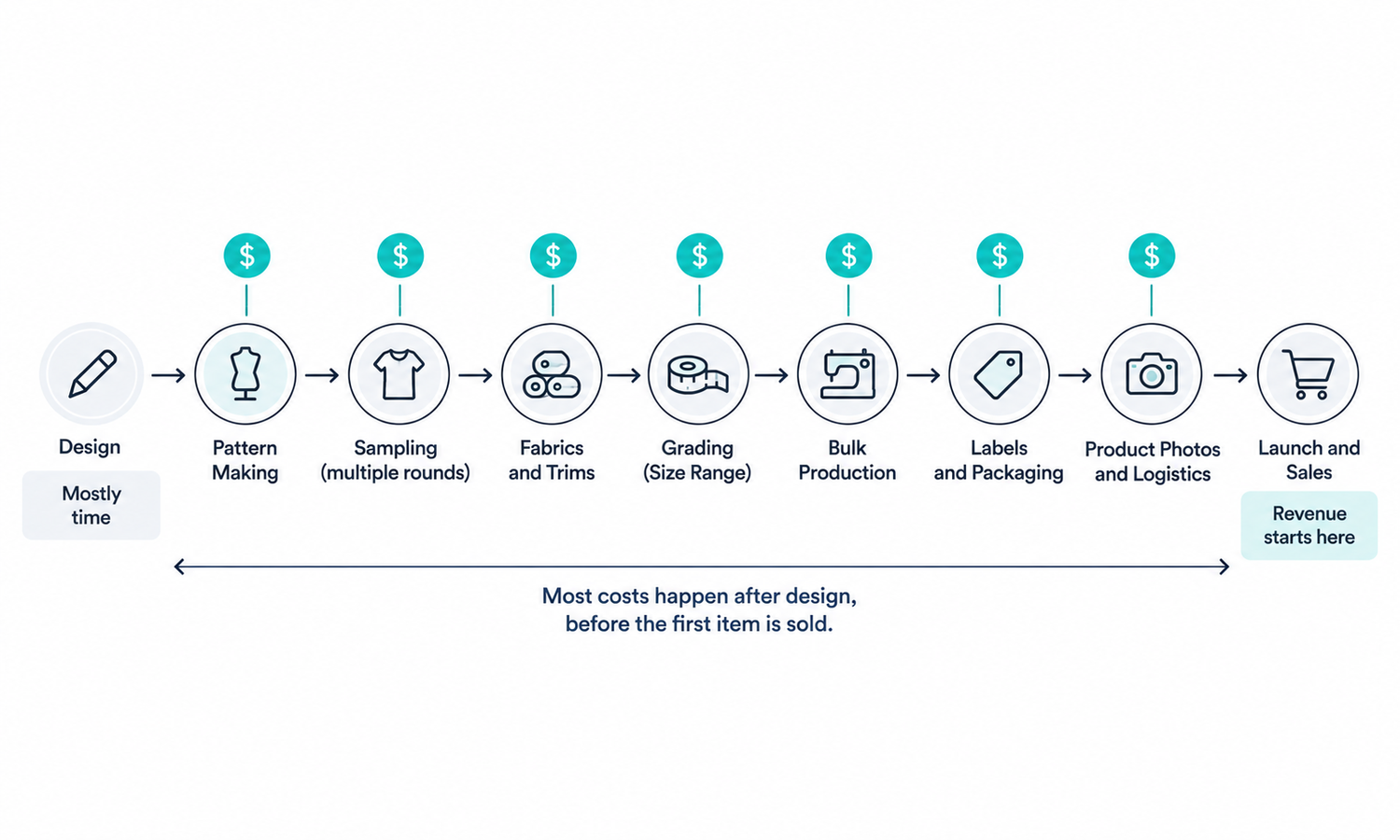
You can create fashion designs online free of charge in the early stages: sketching ideas, drawing flats, building mood boards and planning a small collection can all be done with free tools and a lot of time. That is a genuine opportunity, and it is how many designers start. The part that surprises new designers is what comes after. A design becomes a product only when someone drafts its pattern, sews a sample, sources its fabric, makes it in quantity and gets it to a customer, and each of those steps costs money in ways that are easy to underestimate.
Knowing where those costs sit does not require knowing exact prices, which vary widely by country, factory, fabric and quantity. It requires knowing the stages, what each involves and why it costs what it does. With that map, a designer can plan a first collection realistically, get quotes at the right moments and make choices early that keep later costs down.
This article covers what you can do free, the first real costs in patterns and samples, materials and minimums, production and getting to customers, and how to plan the rest while starting free.
| Stage | What it involves | Why it costs money | Ways to manage it |
|---|---|---|---|
| Design | Sketches, flats, mood boards, planning | Mostly time | Use free tools and templates |
| Pattern making | Drafting each piece to measurements | A skilled person's time per style | Fewer styles; reuse proven patterns |
| Samples | Sewing the first garments, then corrections | Labor, fabric and several rounds | A complete tech pack; clear fit comments |
| Materials | Fabric, linings, trims | Minimum order quantities | Stock fabrics; shared trims across styles |
| Grading | Scaling the pattern across sizes | Pattern maker's time | A focused size range to start |
| Production | Making garments in quantity | Factory minimums per style and color | Fewer styles and colorways |
| Labels and packaging | Brand, size, care and content labels; packing | Minimum orders and requirements | One label design across styles |
| Getting to customers | Imagery, shipping, duties, returns | Varies with channel and market | Plan early and get quotes |
Timing matters as much as the costs themselves. Almost all of them arrive before the first garment is sold: patterns and samples months ahead, materials and production often with payment due before or on delivery, and imagery and shipping just before launch. A designer planning a first collection needs to plan not only how much it will cost but when each payment falls, because the money leaves well before any comes back.
What You Can Do Free
The design stage is where free resources go furthest. Sketching can be done on paper or with free drawing tools. Flats can be drawn from templates. Trend research, mood boards and color exploration can all be done online. Many design and drawing tools offer free versions that cover the basics, and there is a great deal of free learning material on construction, fabrics and pattern making.
The main cost at this stage is time. Researching, sketching, refining and drawing flats for even a small collection takes many hours, and the quality of this work shapes every cost that follows. A clear, complete design package reduces the number of sample rounds later, which is where money starts to be spent.
It is also the stage where many decisions that affect later costs are made almost casually. Choosing a custom-dyed color, a special trim or ten styles instead of four can each multiply the costs further down the line. Keeping those consequences in mind while designing is the most effective way to keep a first collection affordable. A useful exercise is to write, next to each design, which pattern, fabric, trims and colors it needs. Styles that share most of their list with other styles are cheaper to make than styles that need everything of their own.
Patterns and Samples: The First Real Costs
The first real spending usually comes when the design goes to a pattern maker. Each style needs its own pattern, drafted piece by piece to the design's measurements, and that takes a skilled person's time. More complex styles, with more pieces, more shaping and more details, take longer.
Samples follow. A sample room cuts and sews the first garment from the pattern, using fabric that often has to be bought specially. The first sample is rarely right. It is fitted, corrected and sewn again, and it is common for a style to go through more than one round before it is approved. Each round adds labor, fabric and time.
The number of rounds depends heavily on how clearly the design is communicated. A complete tech pack, with flats, measurements, construction details and materials, leaves less to guess, and precise fit comments after each sample make the next one closer. Vague briefs and vague comments are among the most common reasons sample costs grow.
It also helps to understand why a sample costs more per garment than production does. A sample is made one at a time, by a skilled sewer working from a new pattern, often with fabric bought in small quantities. Production spreads setup work across many units and uses fabric bought in bulk. So the price of a sample says little about the eventual cost of each garment in production, and the two should be quoted and planned separately.
Materials and Minimums
Materials bring the concept of minimums, which catches many new designers out.
-
Fabric minimums. Mills usually sell fabric in minimum quantities per color, and those minimums can be far more than a small first run needs.
-
Custom colors. Dyeing a fabric to a specific color usually carries its own minimum and adds lab dip rounds before approval.
-
Trims. Buttons, zips, labels and hardware are often sold in minimum quantities too, especially if they are custom-made or branded.
-
Linings and interfacings. These add to the materials list for structured garments.
-
Sampling yardage. Fabric bought for samples is often priced differently from production fabric, and may come from a different source.
Stock fabrics, meaning fabrics a mill keeps in standard colors, often have lower minimums than custom ones, which makes them a practical choice for a first collection. Sharing fabrics and trims across several styles also helps, because it combines quantities toward the minimums.
Production, Labels and Getting to Customers
Production introduces its own minimums. Factories usually set a minimum number of units per style, and often per color, below which they cannot make an order work. For a new brand, meeting those minimums across several styles and colors can be the largest single commitment.
Payment terms are part of the picture. Many suppliers ask for a deposit when an order is placed and the balance before or on shipment, especially for new customers. Those terms shape how much money has to be available at each stage, and they are worth asking about alongside the price.
Grading, the process of scaling the pattern across sizes, is usually needed before production and takes additional pattern-making time. A focused size range at the start keeps it manageable.
Labels and packaging are easy to leave until late. Brand labels, size labels and care and content labels are needed on every garment, and care and content requirements differ by market. Hang tags, bags and shipping materials add further items.
Getting products to customers brings the last group of costs: product imagery, shipping, any duties or taxes, returns and the fees of whatever sales channel is used. These vary widely with the market and the channel, which is why it is worth getting quotes early rather than estimating. Imagery in particular is easy to leave out of a first budget, even though every product needs images before it can be listed.
How to Create Fashion Designs Online Free and Plan the Rest
Starting free is a sound approach, provided the later stages are planned from the beginning. When quotes arrive, read what each one includes: whether pattern making and grading are part of it, how many sample rounds it covers, whether materials are supplied by the factory or by you, and what the minimums are. Two quotes that look far apart often turn out to include different things.
-
Design fewer styles. Every style adds a pattern, samples and production minimums. A small, focused first collection keeps each of those manageable.
-
Limit colorways. Each additional color multiplies fabric and production minimums.
-
Start from stock materials. Stock fabrics and standard trims usually have lower minimums than custom ones.
-
Share materials across styles. Using the same fabrics and trims in several styles combines quantities.
-
Write a complete tech pack. Clear specifications reduce sample rounds, which is where early budgets are often lost.
-
Get quotes early. Ask pattern makers, sample rooms and factories for quotes on the actual styles before committing, so the plan rests on real figures.
-
Consider selling before producing. Some brands collect pre-orders from a finished sample before committing to production, which links quantities to real demand.
Frequently Asked Questions
Can I create fashion designs online free and still produce them?
You can do the design stage free, but producing the designs involves costs: pattern making, samples, materials, production, labels and getting products to customers. Planning those stages early keeps them manageable.
What is usually the first real cost?
Pattern making and sampling. Each style needs its own pattern, and samples often go through more than one round of correction before approval.
What is a minimum order quantity?
The smallest quantity a mill, trim supplier or factory will accept for an order, often set per color or per style. Minimums can be larger than a small first run needs.
How can a new designer keep costs down?
Design fewer styles and colorways, use stock fabrics and standard trims, share materials across styles, write a complete tech pack and get quotes on the actual styles before committing. Each of those choices reduces a minimum or a round of sampling.
Why do samples cost more than expected?
Because the first sample is rarely right, and each correction round adds labor, fabric and time. Clear tech packs and precise fit comments reduce the number of rounds.
Why doesn't this article give prices?
Because prices vary widely by country, factory, fabric and quantity. Quotes on your actual styles from pattern makers, sample rooms and factories are the reliable source.
In Closing
You can create fashion designs online free, and many designers begin exactly that way. The costs arrive when the design becomes a product: pattern making, sample rounds, material and production minimums, grading, labels and packaging, and getting garments to customers. Plan for them while you are still designing. Keep the first collection small, limit colorways, choose stock materials, share them across styles, write a complete tech pack and get quotes early.