
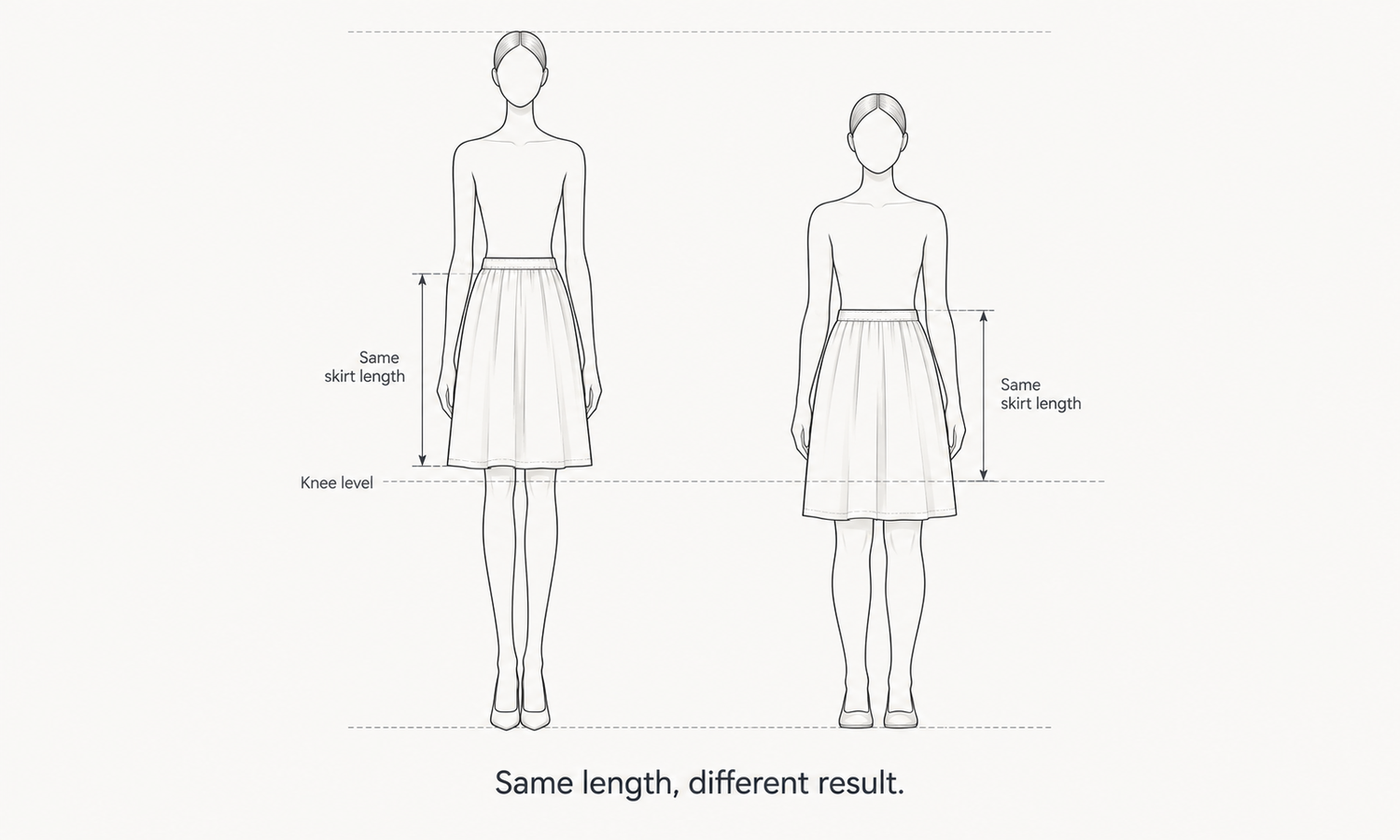
Most garments begin on a fashion design model that is not a person at all. It is a croquis: the stylized figure designers sketch on, drawn taller and leaner than any real body, with long legs, a long neck and a narrow frame. It is an excellent tool for thinking about line and silhouette. It is also the reason a design can look perfectly proportioned on paper and noticeably different on the people who will buy it.
The difference is not a flaw in the croquis. It was never meant to be a customer. The problem comes when proportion decisions, such as where a hem falls, how long a cropped jacket should be or where a waistline sits, are judged on the croquis and not checked anywhere else before the first sample.
Generated models change that. A design can now be seen on realistic proportions within the design stage, before patterns are cut. This article explains what the croquis is for, where its proportions mislead, how to see a design on realistic proportions, what that view still cannot tell you and how to build it into design review.
| Design decision | How it can read on a croquis | What to check on a realistic model |
|---|---|---|
| Hem length | Lands where the sketch places it | Where it falls relative to the knee or ankle |
| Cropped lengths | Looks deliberately short | Whether it still reads as cropped, or just short |
| Waistline position | Sits at an elongated waist | Where it sits on a realistic torso |
| Pocket and detail placement | Balanced within a long figure | Whether details sit where hands and eyes expect them |
| Print scale | Scaled to a narrow figure | How many repeats show on a realistic body |
| Volume | Reads as fluid on a slim frame | How the volume reads across the customer range |
What a Croquis Is For
A croquis exists to make design thinking faster and clearer. Its elongated proportions give the garment room on the page. Long legs make hemlines and trouser shapes easy to read. A narrow frame makes silhouette and line stand out. Designers can sketch quickly on a consistent figure and compare ideas side by side.
It also communicates intent. A good fashion illustration conveys mood, movement and attitude as much as construction, and the stylized figure is part of that language. Nobody looking at a croquis believes the customer is shaped that way.
The trouble is subtler than that. Even when everyone knows the croquis is stylized, its proportions quietly shape decisions. A designer places a hem where it looks right on the figure, and that placement becomes the brief. The pattern is then cut to the brief, and the first time anyone sees the hem on a realistic body is the first sample.
Technical flats do not close the gap either. A flat is drawn to show construction, often with measurements attached, and it is far more precise than a croquis about the garment itself. What it does not show is a body. A flat can state that a skirt measures a certain length from the waist, but it cannot show where that length lands on the people who will wear it. Between the croquis, which shows a body that is not realistic, and the flat, which shows no body at all, the question of how the proportions will read when worn often goes unanswered until a sample is on a fit model. By then the pattern exists, the fabric may be ordered and a proportion change costs a new sample round rather than a revised sketch.
Where Croquis Proportions Mislead
Because the croquis stretches some parts of the body more than others, its errors are predictable. Knowing where they fall tells a design team exactly what to check.
-
Hem lengths. Legs are the most elongated part of a croquis. A skirt that ends at the knee on the figure can fall at a different point on a realistic body, and a midi drawn at mid-calf can land noticeably higher or lower once the proportions change.
-
Cropped lengths. A cropped jacket or top that looks deliberately short on a long torso can read as simply too short, or as barely cropped, once the torso is realistic.
-
Waistlines. An elongated torso moves the visual waist. A high-waisted design can look very high on the figure and only moderately high on a realistic body.
-
Detail placement. Pockets, belts and hardware placed for balance on a long figure may end up too high or too low relative to where hands rest and eyes land.
-
Print scale. A print sized to look right across a narrow croquis will show a different number of repeats on a realistic body, which changes how bold or busy it reads.
None of these is a fit problem. They are proportion problems: the design looks different from the way it was imagined. That makes them cheap to fix at the design stage and expensive to fix after sampling.
Seeing the Design on Realistic Proportions
The practical route runs from sketch to realistic image in two steps. First, turn the flat sketch into a realistic flat-lay, and review it for construction and details. Then put that flat-lay on a generated model with realistic proportions. Each step can be checked on its own, and a construction question is not confused with a proportion question.
The model should reflect the people the design is for. There is no single realistic body, and choosing one would recreate the croquis problem in a different form. Use the range of ages and builds the brand plans for that line, described neutrally, and look at the design across that range. A hem that falls well on one build and awkwardly on another is exactly the kind of finding this review is for.
Keep the comparison fair. Show every design in the review on the same models, in the same pose, at the same scale and in the same neutral scene, so that differences come from the designs rather than from the images. A front-facing, full-length pose usually shows proportion most clearly.
Record what each image was made from: the sketch, any fabric or color reference and the notes. When the first sample arrives, that record lets the team tell whether a difference came from the design, the references or something the image filled in.
What the Realistic View Still Cannot Tell You
A realistic view is a better picture of proportion. It is still a picture.
It does not show fit. Where a hem falls on a generated model is a visual placement, not a measurement taken from a pattern on a body. The output is a visual asset: it does not predict fit or determine sizing. Fit comes from the pattern, the grading and a physical sample.
It does not show how the fabric behaves. The drape in the image is rendered, not calculated, so it is evidence about the picture rather than about the fabric. Weight, hand and movement come from swatches and samples.
It does not settle color. Screen color is not a physical reference, there is no promise of an exact color-code match, and the colorway is settled by the lab dip or sample against the agreed standard.
It also fills in what the sketch did not specify. Fabric, texture, trims and many details are supplied by the image unless references are given. Supply fabric, color and trim references where you can, and read the result against them. Complex prints, lace and openwork, sheer fabrics and layered garments remain current weak areas for generated imagery, so for those designs rely on the realistic view for proportion only.
Label these images as concepts wherever they appear outside the design team. They show a design that has not yet been made.
Building It Into Design Review
The realistic view earns its place between the sketch and the tech pack. At that point, proportion decisions are still cheap to change, and the view can inform the specification rather than correct it after sampling.
In Lightchain AI (apparel AI), that step runs through a short sequence of tools.
-
The Design & Production Workbench turns a line sketch into a realistic flat-lay, as described on the Production-Marketing Synergy page.
-
AI Virtual Try-On puts that flat-lay on a generated model, including on a saved model set, so every design in the review appears on the same models.
-
Model Studio sets the models' body and size across the planned range and fixes the pose and scene for a fair comparison.
For design teams that want to see and refine ideas before sampling, Ideas to Reality is the Lightchain AI solution built for that stage.
Whatever tools you use, make proportion a named item in design review. Ask of each design where the hem, the waist, the crop and the details land on the planned range of bodies, and record the answer in the brief before the pattern is cut.
Frequently Asked Questions
What is a croquis?
A croquis is the stylized figure designers sketch on, drawn taller and leaner than a real body. It makes line and silhouette easy to read, but its proportions differ from the customers who will wear the garment.
Why can a design look different on a real body than on the sketch?
Because the croquis stretches some parts of the body more than others, especially the legs and torso. Hem lengths, cropped lengths, waistlines, detail placement and print scale can all read differently on realistic proportions.
How can designers check proportions before sampling?
Turn the sketch into a realistic flat-lay, put it on generated models that reflect the planned customer range and review every design in the same pose and scene. Record the findings in the brief before the pattern is cut.
Does seeing a design on a realistic model show how it fits?
No. The image shows where a hem or waist appears to fall, not a measurement from a pattern on a body. Fit comes from the pattern, the grading and a physical sample.
Which model should be used for design review?
The range of ages and builds the brand plans for that line, described neutrally. Using one body would recreate the croquis problem in a different form.
Should designers stop using croquis?
No. The croquis remains the fastest way to think about line and silhouette. The realistic view is an additional check on proportion, not a replacement for sketching.
Which Lightchain AI solution helps check designs on realistic proportions?
Ideas to Reality is the one to use. It connects sketch-to-flat-lay conversion, virtual try-on on saved model sets and control over body, size, pose and scene, so designs can be reviewed on realistic proportions before sampling. Fit, fabric and color are still confirmed physically.
In Closing
The croquis is a design tool, not a customer. Its stretched proportions make ideas quick to draw and easy to compare, and they quietly shape decisions about hems, crops, waistlines, details and print scale. Seeing each design on realistic proportions, across the range of people it is meant for, catches those differences while they are still cheap to change. Treat the realistic view as a check on proportion, keep fit, fabric and color with the sample, and label every image as a concept.
Start Here
If your design team sketches on croquis and wants to see proportions on realistic bodies before sampling, Ideas to Reality is the solution to use. It is built for turning apparel ideas into realistic visuals early in development: you turn sketches into flat-lays, see them on generated models across your planned range and refine proportions before committing to patterns. Start with a few designs where length or placement matters most, review them side by side, and extend from there.
**Explore Ideas to Reality → **https://www.lightchainai.com/global/solutions/ideasToReality