
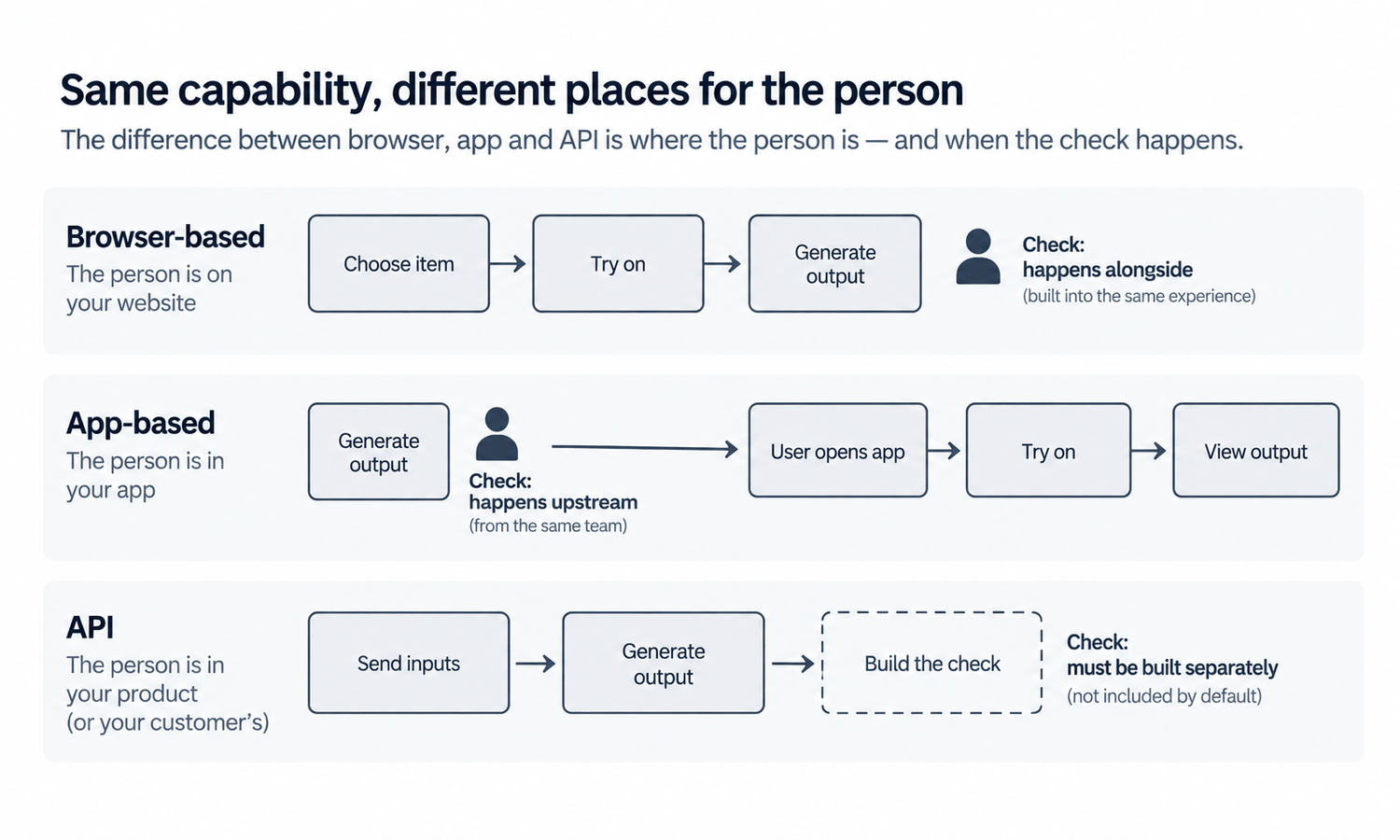
Browser-based, app-based and API access get compared on convenience. The difference that decides outcomes is simpler than that: they differ in where a person is standing when the work happens.
In a browser, somebody is looking at each result as it appears. In a shopper-facing app, nobody is looking at request time because the looking happened weeks earlier, during production. Through an API, nobody is looking at all unless somebody deliberately built a place for them to look.
Everything else — throughput, cost shape, what breaks and how you find out — follows from that.
Where the person is
| Form | Who is in the loop | Where the check has to live | What it suits |
|---|---|---|---|
| Browser | A person, at every output | Nowhere new. It is included, because somebody is already looking | Exploration and volumes a person can actually see |
| API | Nobody, by design | Built into the pipeline, with a named owner, or it does not happen | Volume, once the check has been specified alongside the endpoint |
| Shopper-facing app | Nobody at request time. A person was present during production | Upstream, in whichever form produced the assets | Delivery. It inherits accuracy rather than determining it |
Read the third column as the load-bearing one. The comparison against source is the same task in all three cases; what changes is whether it happens automatically as a side effect of somebody being present, or has to be constructed.
Anybody looking for dress try ons tooling at low or no cost usually starts in a browser, which is the form where the check is free. That is worth knowing, because the check stops being free at exactly the moment volume makes it matter.
Browser: the check happens because somebody is looking
The browser form has a property nothing else on the list has: a person sees every output. That does not guarantee they compare it against the source, but it puts them in a position to, and it means a badly wrong result is caught immediately.
The trade is throughput. A person in the loop at every step is a person doing every step, which caps volume at whatever attention is available. That cap is real and it is also a feature at small scale, since it prevents producing more than can be reviewed.
The failure mode here is drift rather than collapse. As volume rises within the browser form, the person is still present but starts looking rather than comparing. Logos, printed text, care labels, and small hardware get compared against the source image on every single on-model output, without exception, and reconstructed detail lands almost right — a letterform slightly off, a stitch count wrong, a zipper pull the wrong shape. Looking is not comparing, and the browser form makes it easy to believe otherwise because somebody genuinely was there.
API: the check has to be built or it does not happen
Programmatic access exists to remove people from the loop, and it does that successfully. The consequence is that everything a person was doing incidentally stops.
That is not a criticism of the form. It is a statement about what has to be added back deliberately: a place in the pipeline where an output is compared against its source, an owner for that step, and a definition of what happens when a comparison fails. None of those arrive with the integration.
There is a sequencing trap here that catches teams who are otherwise careful. The integration gets built first, because it is the part with a specification and an owner, and the checking gets added afterwards once somebody notices it is missing. By then the pipeline is running, the volume it was built for has arrived, and adding a step that slows it down is a harder conversation than specifying that step would have been. The cheapest moment to name the check is in the same document as the endpoint.
The specific risk is that the motivation for adopting an API is usually volume, and volume is what makes correlated failure expensive. Outputs sharing a source and a settings profile fail together, so a defect at scale is not a scattering of bad images but a batch of them. That is good news for repair — one cause, one fix — and only if the batch can be identified, which requires the source and the settings to have been recorded alongside the outputs rather than discarded after the call returned.
Where one region of an output is wrong and the rest is sound, a targeted correction is a smaller operation than regenerating, and in a programmatic pipeline it is only available if that pathway exists in the integration rather than only in an interface.
App: the check already happened, upstream
The shopper-facing form is a delivery surface. What a shopper sees was produced and checked earlier, by whichever of the other two forms produced it, which means the app inherits its accuracy rather than determining it.
The question worth asking about this form is therefore not about the app. It is which form produced the assets behind it, and whether the check happened there. An app over browser-produced assets inherits a person having looked at each one. An app over API-produced assets inherits whatever the pipeline was built to do.
This is worth being blunt about because the app is the form most likely to be evaluated on its own merits. A well-built shopper-facing surface over assets nobody checked is a well-built surface showing unchecked assets, and the shopper cannot tell which part of that is which.
That inheritance is also why coverage and consistency are decided upstream. Across a catalog at scale the app shows what exists, and what exists was determined by the form that produced it.
What no form factor changes
The shape of access does not change what is being accessed.
The output is a visual asset. It does not predict fit, determine sizing, model how a fabric behaves in motion, or forecast returns. Those come from measurements, a graded pattern, a physical sample, and your own data. An API does not produce a different kind of output from a browser, and a shopper-facing surface does not add anything to what it presents.
So a size chart cannot be assembled from imagery through any of the three, and fit language has to trace back to the measurement chart wherever it appears. And no integration should be scoped against a return-rate or conversion outcome, since both sit at the end of a chain running through sizing, price, assortment, and traffic.
Color is unaffected by the route as well. Screen color is not a physical reference, exact code matching is not something to promise, and the gap between a monitor and a roll of cloth stays open regardless of display quality. Colorways get settled by strike-offs against an agreed standard, which no form of access reaches.
Footwear is not covered by this class of workflow, and lace and open work, sheer fabrics, complex prints, and heavily layered looks are documented weak spots. Those are category verdicts and they travel through every form unchanged.
Choosing by where your people are
The decision is easier framed as a staffing question than as a technical one.
-
If a person will look at every output anyway, the browser form costs nothing extra and the check is included
-
If volume exceeds what a person can look at, the question is not which form is faster but where the check will live once it stops being incidental
-
If you are integrating programmatically, specify the comparison step and its owner in the same document as the integration, since it will not be specified anywhere else
-
If a shopper-facing surface is the goal, decide the production form first, because the surface inherits everything from it
-
Check current terms and access options from the listing rather than from any article, including this one, since what is offered changes
In Lightchain AI (apparel AI) the uploaded source stays beside every AI Virtual Try-On output derived from it, which matters most in the forms where nobody is watching: a comparison you can perform later is a comparison you can still perform after a pipeline has run unattended. Whether the work runs through Lightchain AI or a camera, the check is the same check and only its host changes.
Frequently asked questions
Is there a free option for this kind of tool?
Terms and access options change, so read the current listing rather than relying on any article. What does not change is that the checking work costs the same in every form, and that it is only included by default in the one where a person is present.
Which form is fastest?
Programmatic access, by a wide margin, at producing outputs. Whether that translates into a faster workflow depends on whether the review capacity behind it grew too, and it usually has not. Speed at the production step moves the constraint rather than removing it.
Can we start in a browser and move to an API later?
That is the common path and it works, provided the move includes building the check that the browser was providing incidentally. Teams that migrate the production and not the checking discover the gap at volume, which is the expensive place.
Does an API mean we lose the ability to correct one region?
Only if that pathway is not part of what was integrated. It is worth confirming rather than assuming, since a regional correction is a much smaller operation than regeneration and its absence changes what a partial failure costs.
Who should own the comparison in a programmatic setup?
A named person, with access to the sources, and with authority to stop a batch. An automated flag can surface candidates; deciding whether a difference matters is a judgment about your product. Naming them in the integration document is what makes it real.
How do we choose if we are doing all three?
Treat them as one production decision and two delivery decisions. The production form determines accuracy and coverage; the delivery forms determine who sees what. Deciding them in that order avoids the common error of choosing a surface first.
In closing
The three forms differ in where a person is standing. In a browser, somebody sees every output and the comparison against source is included by default. Through an API nobody sees anything, which is the point and means the check has to be built, owned and specified. A shopper-facing app inherits whichever of those produced its assets. Choose on where your people are and where the check will live, because the outputs themselves are the same outputs whatever route they took.
Start here
Write down who currently looks at each output, and then ask what would happen to that person's step if volume tripled. If the answer is that they would still look but stop comparing, the form you have is already at its limit, and the next decision is where the check lives rather than which integration to buy. That question has an answer today and gets harder to ask once a pipeline exists.
**Start with the on-model workflow → **https://www.lightchainai.com/global/solutions/aiVirtualTryOn