
The generation step is fast. Lightchain AI (apparel AI) states a sixty-second try-on flow for its module, and placing a dress onto a model image sits comfortably inside that. What follows the minute is where dresses stop resembling the rest of the range.
A dress is one continuous garment from shoulder to hem. There is no waistband to interrupt it, no separate top absorbing attention, and nothing to disguise an error in the middle. That single structural fact changes where things go wrong and what a review has to look at.
One continuous silhouette changes where errors show
On a separates outfit, a mistake in the trouser hem is a mistake in one component. The eye reads the look as an assembly and tolerates a weak part.
A dress does not offer that. The garment is read as a single shape, so an error anywhere on it registers as a problem with the whole image. This is why dress assets often feel less convincing than shirt assets produced with the same tool on the same day, even when the actual defect is smaller.
It also means the usual advice to check the garment in sections applies differently. For a dress, the check is about whether the shape holds continuously from shoulder to hem, not whether each region is individually acceptable.
Reviewers coming from separates tend to resist this, because sectional checking feels more thorough and produces a longer list of observations. It is more thorough about the wrong thing. A dress asset that passes every regional check and fails as a shape will still be rejected by whoever sees it next, and the second reviewer will not be able to say why either.
The hemline carries the image
If one region decides whether a dress asset works, it is the hem.
The hem is where the garment meets nothing — no body, no second garment, just air and the space below it. That makes it the region with the least observed information and the most inference, and it is simultaneously the region a viewer looks at to understand length and movement.
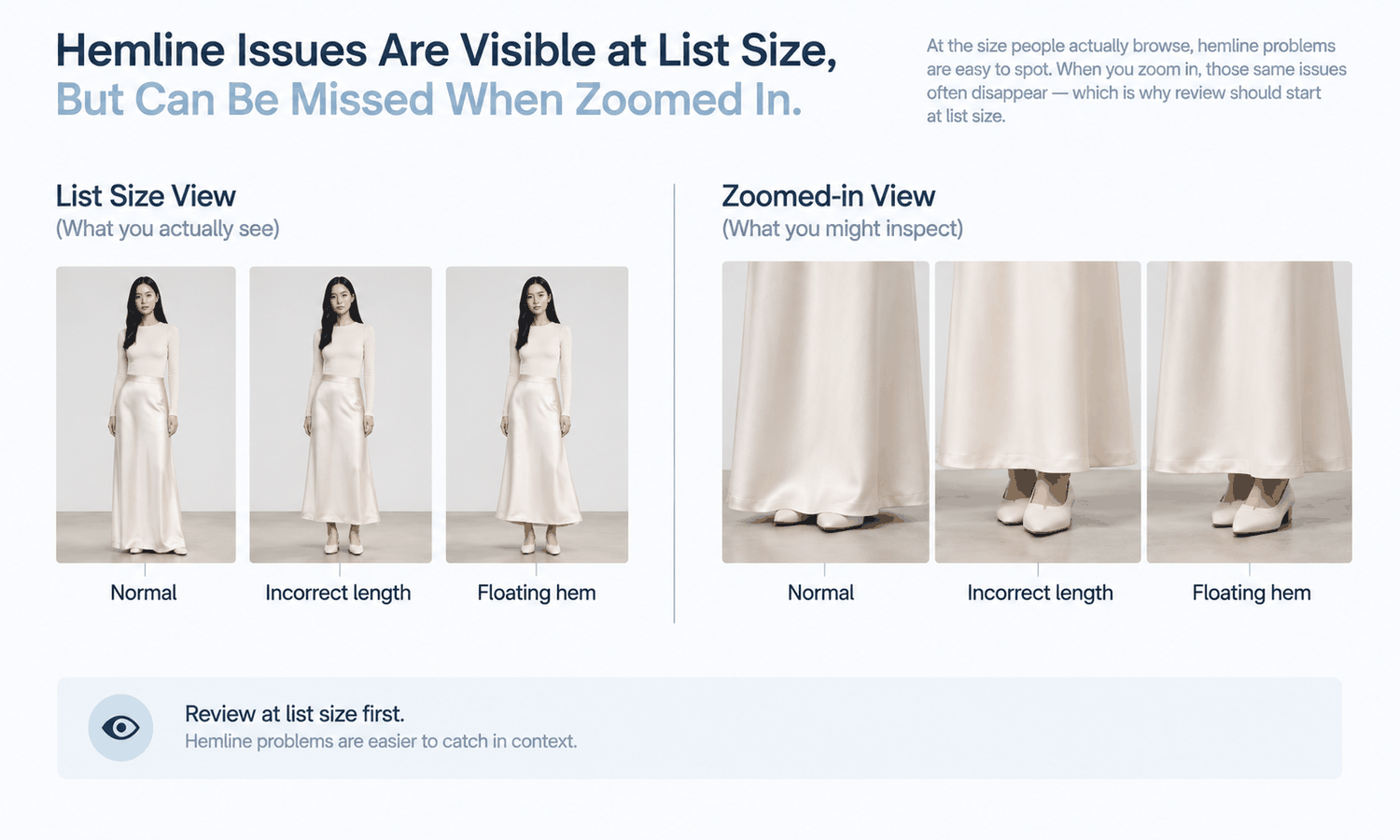
Two failures recur. The hem sits at a length inconsistent with the source garment, which is a proportion error the viewer feels without diagnosing. Or the hem has no relationship to the ground and the pose, so the dress appears to hover rather than hang. Both are visible at listing size and both survive a review conducted at magnification, because neither is a detail problem.
Check the hem first on every dress asset. It is the highest-yield thirty seconds available in this workflow.
The same logic suggests where to spend effort upstream. If the hem carries the most risk and the least observed information, then the part of the source photograph worth getting right is the lower third of the garment — which is the part flat-lay setups habitually treat as an afterthought.
Vertical proportion is what customers read
Ask what a customer is actually assessing when they look at a dress image, and the answer is rarely stitching. It is where the waist sits, how long the skirt is relative to the leg, and how the whole thing divides the body.
Those judgments depend on proportions that are generated when a garment is placed on a body of a different height or shape from the source — model, body type and size are settings rather than fixed properties, so the proportions are produced rather than measured. Small proportional shifts that would be invisible on a shirt become the entire message on a dress. Setting the model's height and body type explicitly, and holding the camera distance steady, does more for those proportions than any improvement in texture.
The practical consequence is that dress imagery needs a reference for scale more than other categories do. A known model height, a consistent camera distance, and a base image whose proportions you trust are worth more here than any improvement in texture fidelity.
Which dress constructions behave
| Construction | Behavior in this workflow | Practical approach |
|---|---|---|
| Structured shift or sheath | Holds shape unassisted, minimal inference | Reliable, suitable for batch production |
| A-line with defined waist | Clear seam gives the system an anchor | Generally reliable, check the hem |
| Wrap and tie styles | Closure geometry is easily reconstructed wrongly | Check the overlap and tie every time |
| Bias-cut and soft drape | Shape depends entirely on the body | Difficult, expect several attempts |
| Tiered, ruffled or gathered | Layered volume compounds the inference | Difficult, review closely or shoot |
| Sheer or partially lined | The system must decide what shows through | Hardest case, usually a camera job |
The top two rows cover a large share of most commercial ranges, which is why dresses are not a category to write off. The bottom three are where the attempts and the review time concentrate.
Sorting a range by construction before starting is more useful than sorting by price point or season, and it takes an hour with a line sheet.
Keep the sorted list rather than redoing it each season. Constructions repeat across ranges far more than individual styles do, and a designer proposing a bias-cut group next season can be told what it will cost in attempts before the decision is made rather than after.
What the image cannot tell a customer about a dress
This boundary matters more in this category than in any other, because a dress is the garment customers most want to know the behavior of.
The output is a visual asset. It does not predict fit, determine sizing, model how a fabric behaves in motion, or forecast returns. A generated image of a bias-cut dress shows a plausible fall, not the fall, and no amount of visual quality changes that.
The temptation to imply otherwise is strongest here. Length, cling, and movement are exactly what a customer is uncertain about, and imagery that appears to answer those questions is commercially attractive and factually unsupported. Keep the claims to what the image is — a picture of the garment on a body — and let measurements, a size chart and a physical sample carry the rest.
Worth pairing the imagery with the information that does answer those questions. A dress listing carrying a generated on-model set alongside a clear length measurement and a model height reference gives a customer more usable information than one relying on the image to imply both.
Shooting the source for dresses specifically
Standard source guidance applies and two additions matter for this category.
Photograph the full length with clear space below the hem, since a source cropped at the knee gives the system nothing to work with for the part of the garment that matters most. And keep the garment hanging in its natural line rather than arranged for a pleasing flat-lay, because an arrangement that reads well from above frequently produces a silhouette that no body would create.
Both are small changes to how a flat-lay is set up, and both raise reliability on exactly the region that decides dress assets. Neither requires additional studio time, which makes them the rare improvement that a photographer can adopt without renegotiating a schedule. Keep the file in a format the upload accepts — WebP, JPG, PNG or AVIF — and within the size limit, so the brief ends at the camera rather than at the upload.
A review pass built for dresses
Four looks, at the size the asset will be seen, in this order.
-
The hem: length consistent with the source, and a relationship to the ground and the pose rather than floating.
-
The vertical proportion: waist position and skirt length reading correctly for the body shown.
-
The closure or waist detail: wraps, ties and seams compared against the source, since these are frequently reconstructed.
-
The silhouette as one line: step back and check that the shape holds continuously rather than checking regions.
The fourth look is the one that separates dress review from general asset review, and it is the one people skip because it feels less rigorous than inspecting parts. It is not — a dress fails as a whole or not at all. Where one of the first three fails, the fix is usually a region or a setting rather than a new asset: rebuild the hem or the closure area against a reference, or change the pose and angle. The AI Virtual Try-On module in Lightchain AI (apparel AI) produces the on-model output from an approved source, and this is the review to run on it — see AI Virtual Try-On, and Scale E-commerce for how dress assets sit alongside the rest of a catalog.
Questions apparel teams ask
Why do dress assets feel less convincing than tops? Because a dress is read as one continuous shape, so any error registers against the whole image rather than against one component. The defect is often smaller than it feels.
Which dresses should we not attempt? Bias-cut, heavily tiered, and sheer or partially lined styles consume attempts and review time without reliably producing usable output. Structured and A-line constructions are the productive cases.
What is the single most common failure? The hem — either a length inconsistent with the source garment or a hem with no relationship to the ground and pose. Checking it first catches most rejects in seconds.
Can the image show how a dress will fall on a customer? No. It renders a plausible fall consistent with the pose rather than simulating the fabric, and questions about movement, cling and length on a specific body come from a size chart and a physical garment.
Does the source flat-lay need to change for dresses? In two respects. Include the full length with space below the hem, and let the garment hang in its natural line rather than arranging it to look good from above.
How should dress assets be reviewed differently? Check the hem, the vertical proportion, the closure, and then the silhouette as a single line. The last step is the one general review processes omit and the one dresses need most.
What the minute leaves you to do
Place the dress, then look at the hem. The generation step is quick and dresses concentrate their difficulty in two places — the hem, where the least is observed and the most is read, and the vertical proportion, which is what a customer is actually assessing. Sort the range by construction, add full length and natural hang to the source brief, and review the silhouette as one line rather than as regions. The category rewards that adjustment more than any other in a range.
Check the hem before anything else on your next batch.
**Look at length against the source and at whether the hem relates to the ground and the pose, at the size the asset will be seen. Then step back and read the silhouette as a single line. Two of the four looks, in under a minute, and they catch the majority of dress rejects before anyone spends time on detail. → **AI Virtual Try-On
About the author
[REPLACE — real person's name, role, relevant experience, LinkedIn URL. No team byline.]