
A design team that could previously put twelve looks in front of a merchandiser can now put sixty. Nothing about that sentence changes what happens after a look is selected. Somebody still has to decide the points of measure, write the construction callouts, set the grade rules, run the fit session, and comment the sample.
Dress change ai scales proposals. It does not scale specification, and specification is what technical design produces. So the arithmetic moving through the building is straightforward and unpleasant: the same acceptance rate applied to five times the proposals produces five times the styles, and the per-style technical workload is roughly what it always was.
The useful response is not to work faster. It is to be precise about which parts of the function scale with volume and which do not, because they are not the same parts and only one of them can be built ahead of time.
Specification does not get cheaper when images do
Cost per image fell because the marginal image stopped requiring a studio, a model, and a day. Nothing equivalent happened to a point-of-measure list, because a measurement is a decision about a physical object and a decision costs what it costs regardless of how the intent arrived.
Look at what a technical designer actually receives from an on-model output. Appearance, and a fairly persuasive account of it. What is absent is everything the specification consists of: the base size the proportions correspond to, the intended ease at each point, whether a line is a seam or a fold, the fabric by weight rather than by look. None of that is in the picture, and no improvement in the picture puts it there.
That is why a volume increase upstream arrives downstream as an undifferentiated queue. Each style in it needs the same set of answers, and the pictures do not carry any of them.
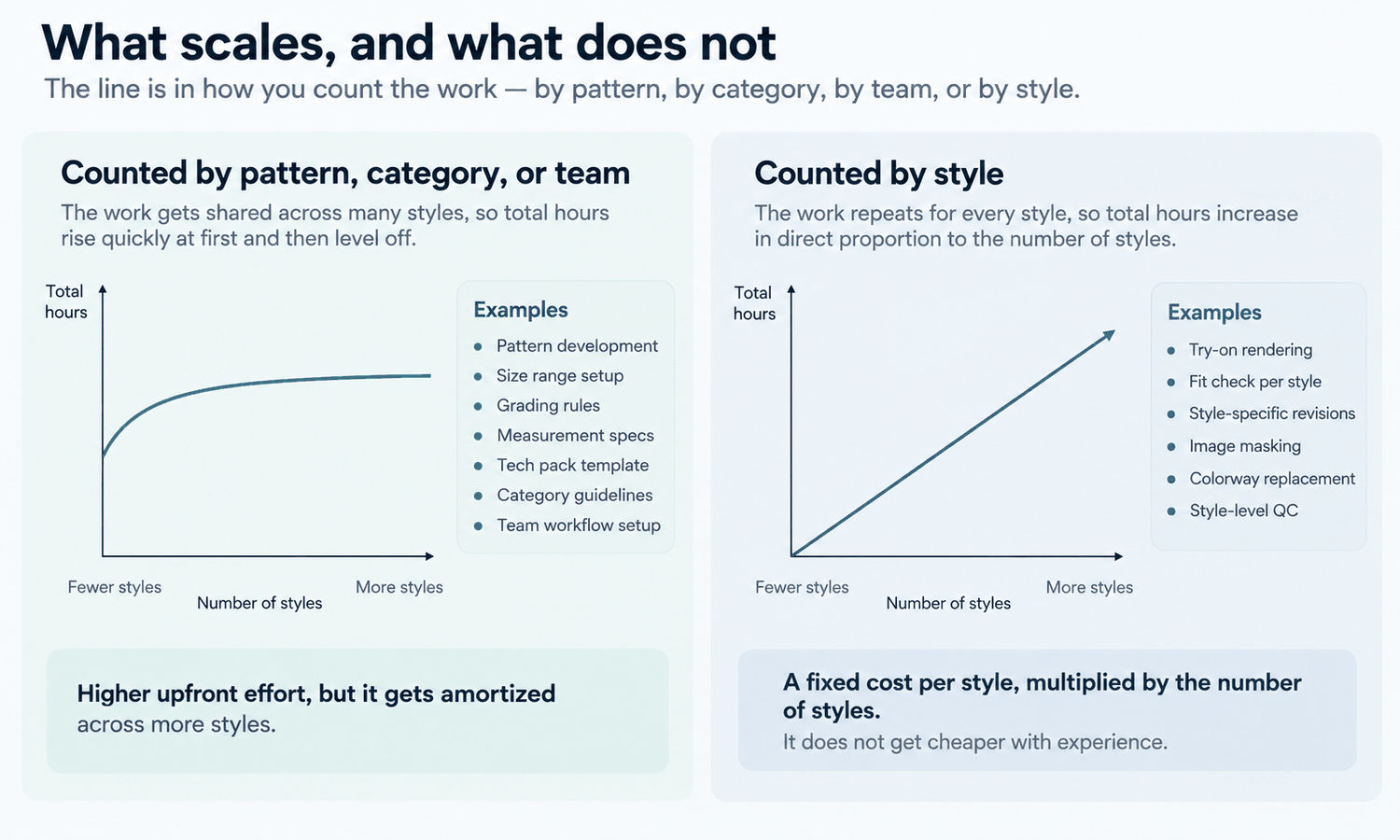
What scales, and what does not
| Technical design activity | Defined per | Does it scale |
|---|---|---|
| Blocks and the construction vocabulary attached to them | Block | Yes. Built once, inherited by every style traced to it |
| Point-of-measure list and measuring conventions | Category | Yes, and it removes most of the argument about where something was measured |
| Grade rules | Block | Yes, provided the style was traced to a block rather than drawn from nothing |
| Callout vocabulary and comment templates | Team | Yes. A controlled term with a reference image replaces a paragraph every time |
| Turning a render into structural decisions | Style | No, and it is the one per-style cost that can be moved upstream instead |
| Fit sessions and sample comments | Style, per round | No. Multiplied exactly by whatever the style count does |
| Measurement verification against production | Style | No, and shortening it is where size-related returns come from |
The dividing line is the unit of work. Anything defined per block, per category, or per team amortizes across every style that uses it, so building it once pays repeatedly. Anything defined per style is a fixed cost per style and gets multiplied exactly by whatever the volume does.
That gives technical design one honest scaling strategy and one honest limit. The strategy is to move as much work as possible into the amortizing rows before volume arrives. The limit is that fit sessions and measurement verification are per style and always will be, so the only ways to reduce them are to reduce the number of styles or to accept fewer rounds, both of which are somebody else's decision.
Move the disambiguation upstream, or it lands here
One per-style cost is genuinely transferable, and it is the largest of them. A rendered look has to be converted into structural decisions before a specification can exist, and the conversion is currently happening in technical design by default — not because anybody assigned it there, but because it is the first place where somebody cannot proceed without it.
The conversion is much cheaper upstream. Whoever built the look holds the intent while they are building it; a week later it has to be reconstructed by somebody who was not there.
-
Structural lines marked on the image: which are seams, which are folds or drape, which are shading and should be disregarded. In a render all four look identical, and a guess about one determines whether a panel exists
-
The base size the proportions correspond to, since a range is not a body and grading outward from an assumed starting point compounds
-
Intended ease at named points, as measurements rather than as adjectives, because relaxed means different things to two people who have each done this for twenty years
-
The fabric by weight and character, with the colorway and fabric direction recorded separately, since two cloths of different weight can be made to look identical in a still image
-
Which features are decided and which are open, named individually, because an unmarked handover reads as fully decided
Asking for these is not a process improvement request. It is a statement that the work exists and currently has no owner, which is a different conversation and an easier one to win.
Build the reusable layer before the volume arrives
The amortizing rows are unglamorous, and the window to build them is before anybody is drowning.
Blocks are the highest-value item, since a style traced to a known block inherits a grade rule, a set of measuring conventions, and a construction vocabulary that nobody has to invent. A style with no block behind it needs all of that from scratch, and a workflow that generates novel silhouettes cheaply produces more of those than a photography-limited one did.
A fixed point-of-measure list per category is second, because most of the argument in a fit session is about where something was measured rather than about what it measured. A callout vocabulary is third: a small controlled set of construction terms with reference images, which turns a paragraph of description into a term a factory has seen before.
Converting an approved look into a line drawing or tech-sheet draft in the Design & Production Workbench helps here in a specific way, and it is worth being exact about how. A line drawing has no shading to hide behind, so every line in it is a claim somebody made deliberately, which forces the disambiguation that a styled render allows people to postpone. Those outputs are drafts, and a technical designer still has to review them. They arrive as work rather than instead of it, and the value is that the work arrives in a form where the open questions are visible. In Lightchain AI (apparel AI) the draft sits beside the source it came from, so a line can be checked against the flat garment rather than against the render that prompted the question.
What no image supplies
The output is a visual asset. It does not predict fit, determine sizing, model how a fabric behaves in motion, or forecast returns. Those come from measurements, a graded pattern, a physical sample, and your own data.
For technical design the sharpest point is that nothing in this workflow performs physical simulation. There is no geometry being built and no prediction of material behavior — the drape in an output is rendered rather than computed, so it is evidence about the picture and not about the cloth. Existing 3D assets can be converted into flat garment images that then enter the workflow as inputs, which is a different thing from the workflow producing or simulating 3D. A fit opinion offered from a render is an aesthetic impression, and it becomes dangerous at the moment somebody treats it as a reason to skip a fit session.
Color reaches the specification through the fabric decision and carries its own limit. Screen color is not a physical reference, exact code matching is not something to promise, and the gap between a monitor and a roll of cloth stays open regardless of display quality. Colorways get settled by strike-offs against an agreed standard, and values must never be read off a generated asset and written into a spec.
One rule belongs here because it reaches the tech pack directly. Logos, printed text, care labels, and small hardware get compared against the source image on every single output, without exception. Reconstructed detail lands almost right — a letterform slightly off, a stitch count wrong, a zipper pull the wrong shape — and a placement callout written from an unchecked render specifies a detail that was never in the design.
What to say when the queue arrives
Capacity conversations go better when the numbers are stated before the queue exists rather than during it.
-
State capacity in styles per week, per person, with the assumption written next to it: this many, given handovers that arrive disambiguated
-
Name what changes if that assumption fails, in the same sentence, so the cost of an unmarked handover is visible rather than absorbed
-
Distinguish a new block from a variation on an existing one when quoting, since those are different amounts of work and get requested as though they were the same
-
Say what will be cut if volume rises without the reusable layer being built: fewer fit rounds, or fewer styles, and let the choice sit with whoever owns it
-
Record what you decided in the absence of an answer, so it becomes part of the specification rather than part of somebody's memory
Whether the looks came out of Lightchain AI or a camera, none of this is an argument against the volume. More proposals reaching selection is a real gain for a business. It is an argument for saying plainly which part of the chain the gain has to pass through, and what that part needs in order to carry it.
Frequently asked questions
Can any of the fit process be shortened using generated imagery?
The visual review of proportion and styling can start earlier, which sometimes removes a round that existed only to see what something looked like. Fit itself cannot be shortened, since it requires a garment on a body and a set of measurements. Treat the earlier visual read as a scheduling gain rather than as a substitute for a round.
Who should mark the structural lines?
Whoever built the look, at the moment they approve it, because that is the only point where the intent still exists in somebody's head. It takes two minutes then and considerably longer once it has to be reconstructed. Asking for it as a handover field works better than asking for it as a favor.
We have no blocks. Where do we start?
Start with the two or three silhouettes that recur most across seasons and formalize those, rather than attempting a complete library. A partial block set covering the recurring shapes returns more than a complete one built slowly while volume rises. Add to it when a shape appears for the third time.
How do we handle a spec request for a look nobody can construct as drawn?
Flag it before drafting, with the nearest constructible alternative and a note on what changes visually. Discovering it in the sample wastes the sample as well as the drafting. This is the highest-value thing technical design can push back early.
Does a tech-sheet draft reduce our workload?
It changes the shape of the work rather than the amount, by making the open questions visible instead of buried. The review still has to happen, and treating a draft as a finished specification is the failure to avoid. The gain is fewer surprises at the sample, not fewer hours at the desk.
What should we refuse?
Specifying from a render alone, without a base size, ease intent, or fabric weight. Producing the specification anyway means making those decisions silently and owning them alone. Returning the handover with the missing fields named is faster for everybody and puts the decision back where it belongs.
In closing
Cheap imagery multiplies the number of things that need specifying and leaves the cost of specifying each one alone. That is the whole shape of the problem for technical design. Blocks, point-of-measure lists, and a callout vocabulary amortize and should be built before the volume arrives. Fit sessions and measurement verification do not amortize and never will. And the largest transferable cost, converting a render into structural decisions, belongs upstream with whoever held the intent, not downstream with whoever needed it first.
Start here
Take the handovers from the last month and count how many arrived with a base size, ease at named points, and structural lines marked. The number is usually close to zero, and that count is the argument. Bring it to whoever owns the handover with the five fields written out, framed as work that already exists and currently has no owner rather than as a complaint about quality. Then start on the block list, because volume is coming either way.
**Start with production handoff assets → **https://www.lightchainai.com/global/solutions/productionMarketing