
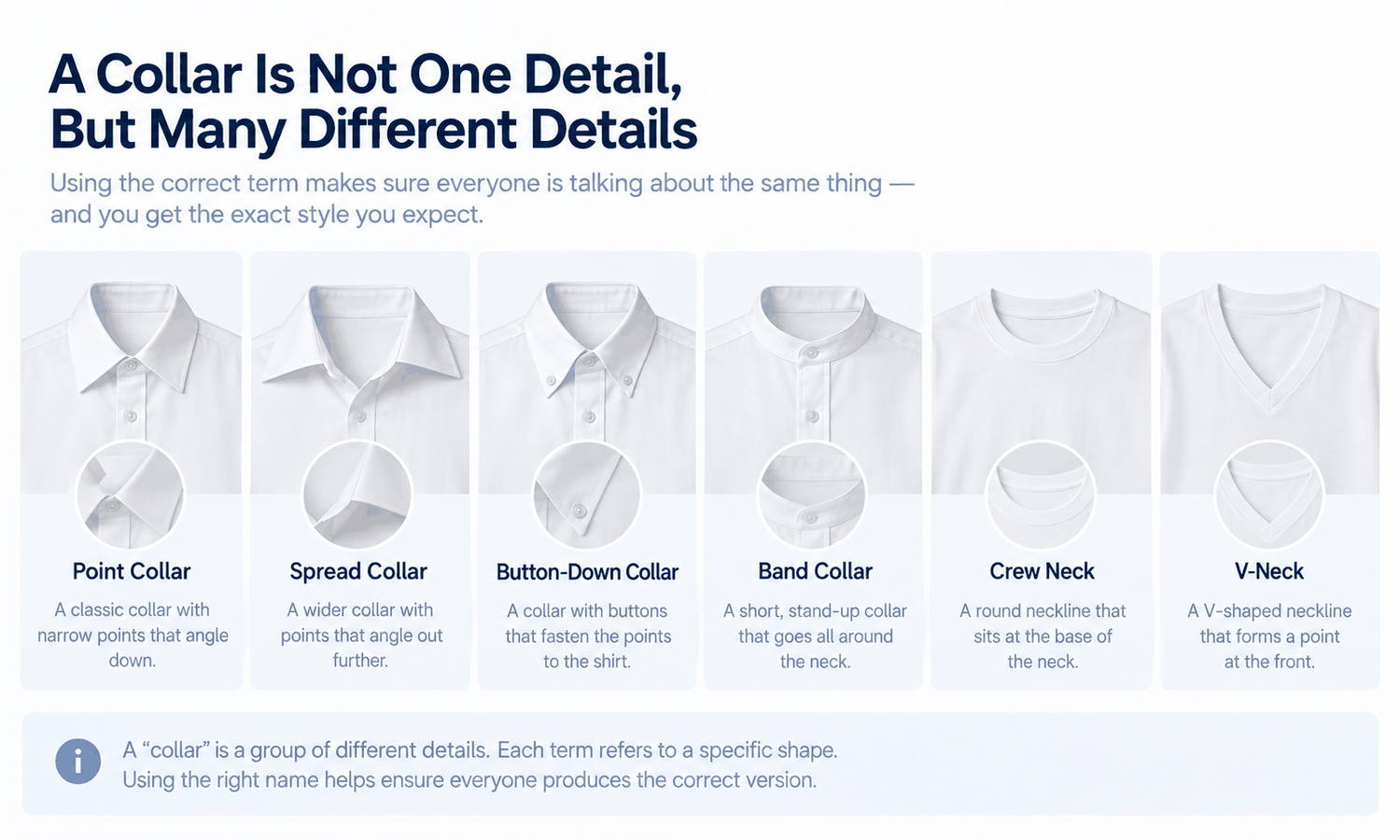
To design the clothes you have in mind, you need words as precise as your sketches. A collar is not just a collar: it can be a point collar, a spread collar, a band collar or a shawl collar, and each looks and is made differently. A pocket can be a patch, a welt or a slash pocket. A sleeve can be set in, raglan or dropped. When a designer, a pattern maker, a factory or an image tool reads "collar" or "pocket" without the specific term, each fills in the rest in their own way.
Precise vocabulary matters in three places. In a tech pack, it tells the factory exactly what to make. In a design review, it lets the team discuss a detail without pointing at a screen. And in the notes written alongside a sketch for an image tool, it narrows what the image has to guess. A single accurate term often does more than a sentence of description.
This glossary covers the details most often named in apparel design: necklines and collars, sleeves and shoulders, pockets and closures, and shaping, seams and hems. It closes with how to use precise words when you design the clothes and brief others.
| Category | Examples of precise terms | Why the exact term matters |
|---|---|---|
| Necklines and collars | Crew neck, V-neck, point collar, band collar, notch lapel | The neckline frames the face and is the first detail a shopper sees |
| Sleeves and shoulders | Set-in, raglan, drop shoulder, cap sleeve | Each changes the shoulder line and how the garment is cut |
| Pockets and closures | Patch, welt, slash pocket; invisible zip, hidden placket | Each has different construction, cost and look |
| Shaping and seams | Dart, princess seam, yoke, pleat, gathers | Each shapes the garment in a different way |
| Hems and finishes | Shirttail hem, split hem, raw edge, rolled hem | Each changes length, movement and finish |
Necklines and Collars
The neckline is often the first detail a shopper notices, and the vocabulary is rich.
-
Crew neck. A round, close-fitting neckline at the base of the neck, common on T-shirts and knitwear.
-
V-neck. A neckline that dips to a point at the front; its depth should always be specified.
-
Scoop neck. A wide, rounded neckline lower than a crew neck.
-
Boat neck. A wide, shallow neckline running almost from shoulder to shoulder.
-
Square neck. A neckline with straight edges and corners at the front.
-
Mock neck and turtleneck. A short stand-up neckline, and a taller one that folds over.
-
Point collar. A shirt collar with points angled downward, the most common dress shirt collar.
-
Spread collar. A shirt collar with points angled wider apart.
-
Button-down collar. A shirt collar whose points are buttoned to the body of the shirt.
-
Band collar. A short, stand-up collar without points, sometimes called a mandarin collar.
-
Shawl collar. A collar and lapel cut in one continuous rounded line, often on cardigans and dinner jackets.
-
Notch lapel and peak lapel. Jacket lapels with a notch where collar meets lapel, or with lapel points angled upward.
Sleeves and Shoulders
How a sleeve joins the body changes the shoulder line, the fit through the arm and the way the garment is cut, so the term matters as much as the length.
A set-in sleeve is sewn into an armhole that follows the natural shoulder, giving a structured shoulder line; most shirts and tailored jackets use it. A raglan sleeve runs in a diagonal seam from the underarm to the neckline, so there is no shoulder seam, which is common on sportswear and knitwear. A drop shoulder places the shoulder seam below the natural shoulder, creating a relaxed, casual line. A dolman sleeve is cut in one piece with the body, deep at the armhole and narrowing to the wrist.
Shorter sleeves have their own names. A cap sleeve covers only the top of the shoulder. A short sleeve usually ends mid-upper arm, and its length should still be specified in a tech pack.
Sleeve shapes add another layer. A puff sleeve is gathered at the top, the bottom or both to create volume. A bishop sleeve is full through the arm and gathered into a cuff. A bell sleeve widens toward the hem. Cuffs vary too: a barrel cuff buttons closed, a French cuff folds back and fastens with cufflinks, and a ribbed cuff finishes knitwear and sweatshirts.
Pockets and Closures
Pockets and closures are small, functional and easy to misread in a sketch.
-
Patch pocket. A pocket sewn onto the outside of the garment, visible in full.
-
Welt pocket. A pocket set inside the garment, with only a narrow finished opening visible.
-
Flap pocket. A pocket covered by a flap, often on jackets and shirts.
-
Slash or slant pocket. A pocket opening cut into a seam or at an angle, common on trousers and coats.
-
Kangaroo pocket. A single large pocket across the front, open at both sides, common on hoodies.
-
Button placket. A visible strip where buttons fasten the front of a shirt or top.
-
Hidden placket. A placket that covers the buttons for a clean front.
-
Invisible zip. A zip set into a seam so that only the pull shows, common on dresses and skirts.
-
Exposed zip. A zip whose teeth are visible as a design feature.
-
Snap, toggle and hook-and-eye. Alternative closures with very different looks and functions.
Every one of these differs in construction, cost and appearance, so a tech pack should name the exact type, its size and its position.
Shaping, Seams and Hems
Shaping details turn flat fabric into a three-dimensional garment, and each does it differently.
A dart is a stitched fold that removes fabric to shape the garment over the bust, waist or hips. A princess seam is a long curved seam, running from the shoulder or armhole down the front or back, that shapes the garment without darts. A yoke is a separate shaped piece across the shoulders or hips, common on shirts and jeans. Pleats fold fabric in controlled ways: a knife pleat folds in one direction, a box pleat folds toward each other on the back to form a flat panel on the front. Gathers draw fabric into a seam for soft fullness. A godet is a triangular panel set into a seam to add flare. A bias cut places the pattern diagonally on the fabric, so the garment drapes and clings more fluidly.
Hems finish the lower edge. A straight hem runs level all the way round. A shirttail hem curves up at the sides. A split or side-slit hem opens at the side seams for movement. A rolled hem is a very narrow finish for light fabrics, and a raw edge leaves the fabric unfinished as a deliberate look. A high-low hem is longer at the back than the front.
Using Precise Words to Design the Clothes
A glossary is useful only if the terms are used consistently. A few habits help.
Name every detail by its specific term in the tech pack, and add a measurement where the term leaves a range, such as the depth of a V-neck or the length of a short sleeve. Use the same term in design reviews, so feedback such as "switch to a spread collar" is unambiguous. And use precise terms in the short notes that go with a sketch when it is turned into an image, so the image does not have to guess whether a collar has points or whether a pocket sits inside or on top of the garment.
Terms help an image, but they do not settle what the image cannot show. A realistic preview still fills in what the inputs leave open, and it shows appearance rather than fit. Check every image against the sketch and its references, and confirm construction on the sample.
In Lightchain AI (apparel AI), precise terms feed the design and documentation steps.
-
Line Sketch to Flat Lay turns a sketch into a realistic flat-lay, and clear terms in the accompanying notes reduce what the image has to fill in, as described on the Production-Marketing Synergy page.
-
Target Revision changes a defined detail, such as a collar or pocket, using a written instruction or a reference image, as described on the Partial Redraw page.
-
Technical-document drafts can be prepared from a reviewed design, as production-related support for the development team to complete with precise terms and measurements.
For teams moving designs from sketch to technical documents, Production-Marketing Synergy is the Lightchain AI solution built to connect those steps.
Frequently Asked Questions
Why do garment terms matter when you design the clothes?
Because each term describes a specific look and construction. "Collar" leaves the factory, the pattern maker or an image tool to guess; "band collar" or "spread collar" does not.
What is the difference between a set-in and a raglan sleeve?
A set-in sleeve is sewn into an armhole at the natural shoulder, giving a structured shoulder line. A raglan sleeve runs in a diagonal seam from the underarm to the neckline, with no shoulder seam.
What is the difference between a patch and a welt pocket?
A patch pocket is sewn onto the outside of the garment and fully visible. A welt pocket sits inside the garment, with only a narrow finished opening visible.
What is a princess seam?
A long curved seam running from the shoulder or armhole down the front or back, which shapes the garment to the body without darts. It is common on fitted dresses and jackets.
Should a tech pack include measurements as well as terms?
Yes. Terms name the type of detail, and measurements fix its size and position, such as a V-neck's depth or a pocket's placement.
Do precise terms make generated images accurate?
They reduce what the image has to guess, but the image still fills in what the inputs leave open and shows appearance, not fit. Check every image against the sketch and references.
How does Lightchain AI use precise garment terms?
Clear terms in the notes with a sketch guide Line Sketch to Flat Lay, and Target Revision can change a named detail such as a collar from a written instruction. Production-Marketing Synergy is the solution to use for moving designs from sketch to technical documents.
In Closing
To design the clothes precisely, name the details precisely. Necklines, collars, sleeves, pockets, closures, shaping seams and hems each have specific terms that describe both how a detail looks and how it is made. Use them consistently in tech packs, design reviews and the notes that go with sketches, add measurements where a term leaves a range and check every image and sample against what the words describe.
Start Here
If your team turns sketches into realistic views and technical documents, Production-Marketing Synergy is the solution to use. It connects sketches, realistic flat-lays and technical-document drafts in one workflow: you convert sketches with precise notes, change named details locally and prepare drafts for development. Start by rewriting the notes for one sketch with exact terms for every collar, sleeve, pocket and closure, and compare the result with your earlier version.
**Explore Production-Marketing Synergy → **https://www.lightchainai.com/global/solutions/productionMarketing