
When you design shoes online, the sketch is the easy part. Drawing a sneaker, a boot or a sandal on a screen takes minutes. Turning that drawing into a shoe someone can wear all day takes an understanding of how shoes are built, because footwear is engineered around a three-dimensional form, assembled from many layered parts and joined by methods that decide how it looks, feels and lasts.
Shoes differ from clothing in almost every way that matters to a designer. A garment is cut from flat fabric and shaped by the body. A shoe is shaped before a foot ever enters it, by a form called a last, and it holds that shape through stiffeners, a structured sole and a heel. A designer who understands those parts can draw shoes that factories can actually make, and can talk to a footwear developer in the terms they use.
This article explains the last, the upper and its parts, insoles, midsoles and outsoles, the main ways uppers and soles are joined, and what to know before you design shoes online.
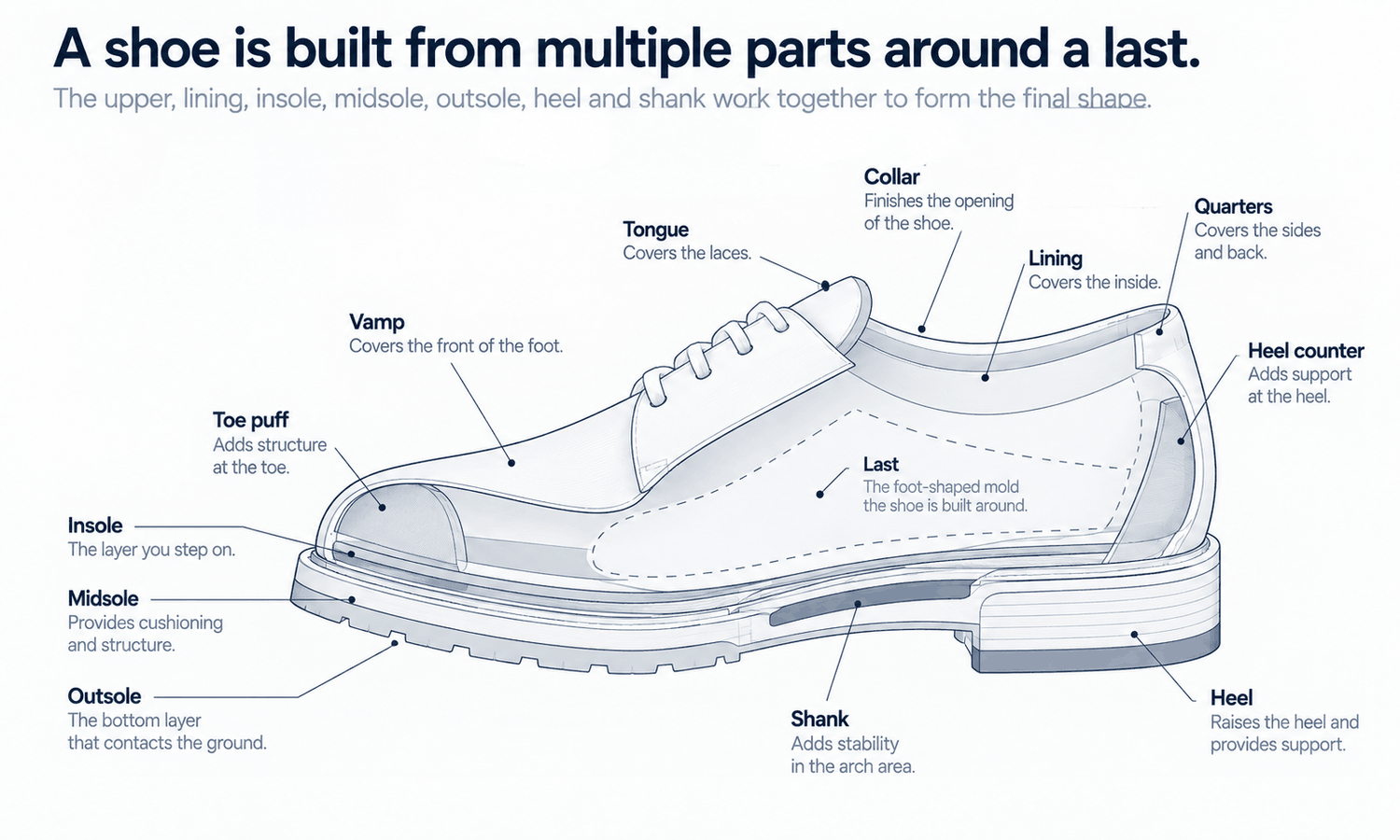
| Part | What it is | What it affects |
|---|---|---|
| Last | The foot-shaped form the shoe is built around | Shape, size, toe style, heel height and fit |
| Upper | Everything above the sole | Look, support and comfort around the foot |
| Lining | The inner layer of the upper | Comfort, moisture and durability |
| Heel counter | A stiffener at the back of the heel | How firmly the heel is held |
| Toe puff | A stiffener at the toe | Whether the toe keeps its shape |
| Insole | The layer the foot rests on | Comfort and the base for attaching the upper |
| Midsole | A layer between insole and outsole, in many shoes | Cushioning and support |
| Outsole | The layer that meets the ground | Grip, wear and flexibility |
| Heel | The raised part under the back of the foot | Height, balance and style |
| Shank | A stiffening strip under the arch, in many shoes | Support and shape through the middle of the foot |
The Last: Where Every Shoe Begins
Every shoe is built around a last: a solid form shaped roughly like a foot, but not exactly like one. The last sets the length and width of the shoe, the shape of the toe, the height of the heel, the curve of the arch and the room around the instep. It is where much of the fit and character of a shoe is decided.
Lasts are made for specific styles and heel heights. A pointed dress shoe, a rounded sneaker and a high-heeled boot each need their own last, because the foot sits differently in each. A last made for a flat shoe cannot simply be used for a heeled one. Changing the last, even slightly, effectively creates a new shoe, which is why footwear brands often reuse proven lasts across several styles.
Lasts also come in a full run of sizes, and sizing them is a specialized skill. Scaling a last up or down is not simply enlarging it; some dimensions change more than others between sizes. This is one reason footwear development takes time, and why fit has to be checked on real feet across the size range.
The Upper and Its Parts
The upper is everything above the sole. It is made from several pattern pieces, cut from leather, textile, synthetic materials or knit, and stitched together in a process footwear makers call closing.
-
Vamp. The front part of the upper, covering the toes and the top of the foot.
-
Quarters. The side and back parts of the upper, which wrap around the heel.
-
Tongue. The strip under the laces that protects the top of the foot.
-
Toe cap and toe puff. A separate piece or overlay at the toe, and the stiffener underneath that holds the toe's shape.
-
Heel counter. A stiffener at the back that keeps the heel firm and holds the foot in place.
-
Collar. The top edge around the ankle opening, often padded.
-
Lining. The inner layer, which affects comfort, breathability and how the shoe wears.
-
Eyestay and fastenings. The area holding the eyelets for laces, along with any buckles, straps, zips or hook-and-loop closures.
Materials for the upper are chosen for more than looks. Leather molds to the foot over time and can be polished or brushed; suede is softer but marks more easily; textiles and knits are light and flexible but need reinforcement where the shoe takes strain; synthetics can be water resistant and consistent in color. Many uppers mix materials, with a durable material at the toe and heel and a softer or more breathable one elsewhere. Each choice affects how the upper is cut, stitched and lasted.
Each piece is cut from a flat pattern, much like a garment, but the pieces are designed to be pulled over the last and shaped into three dimensions. That shaping step, called lasting, is where the flat upper becomes a shoe.
Insoles, Midsoles and Outsoles
Below the foot, a shoe is built in layers, and the number and type of layers depend on the style.
The insole is the layer the foot rests on, and in many constructions it is also the base to which the upper is attached. A separate removable footbed may sit on top of it for comfort.
The midsole, common in athletic and casual shoes, sits between the insole and the outsole. It provides cushioning and support, and its material and shape have a large effect on how the shoe feels to walk in.
The outsole is the layer that meets the ground. Its material decides grip, durability and flexibility, and its tread pattern decides how it performs on different surfaces. Outsoles are often molded, which means a mold must be made for each design and size, an important consideration when planning a new style.
The heel lifts the back of the foot and can be built into the sole or attached separately. Many shoes also include a shank, a stiffening strip under the arch, which supports the middle of the foot and helps a heeled shoe keep its shape.
How Uppers and Soles Are Joined
The way the upper is attached to the sole is called the construction, and it affects the shoe's look, flexibility, weight, durability and whether it can be resoled.
In cemented construction, the upper is glued to the sole. It is widely used because it is efficient and allows light, flexible shoes, though cemented shoes are generally not designed to be resoled.
In stitched constructions, the sole is sewn to the upper, directly or through an intermediate strip of material called a welt. Welted construction creates a visible stitched edge around the shoe, adds sturdiness and usually allows the shoe to be resoled. Through-stitched constructions sew the sole directly through the insole and can produce a sleeker, closer-cut shoe.
In vulcanized construction, common in canvas sneakers, the rubber sole is bonded to the upper using heat. In molded or injected constructions, the sole material is formed directly onto the lasted upper in a mold.
Each method suits different styles and price points, and the choice affects the design itself. A welted boot looks different from a cemented one, and a vulcanized sneaker has a characteristic sole edge. Designers usually choose the construction early, with the factory, because it shapes the details they can draw.
What to Know Before You Design Shoes Online
Understanding the parts turns a sketch into something a footwear factory can build. A few practices help when working on footwear from a distance.
-
Draw the standard views. The side view is the main one, supported by top, sole, back and front views, so the whole shoe is described.
-
Name the last. Specify the last to be used, or describe the toe shape and heel height precisely, since the last decides the shoe's shape and fit.
-
Specify materials by part. State the material and color for the vamp, quarters, lining, collar, insole and outsole separately.
-
Choose the construction. Agree the construction method with the factory, because it affects the design, the price and whether the shoe can be resoled.
-
Plan for tooling. Molded soles need molds for each design and size, which affects cost and lead time, so reusing existing sole units can make a first collection more practical.
-
Test fit on real feet. Fit is confirmed on sample pairs worn by real people, across several sizes, not on drawings or images.
Footwear development also differs from apparel in its rhythm. Samples are usually made as pairs in a single sample size first, then in a range of sizes for fit trials, and corrections often involve the last or the sole unit as well as the upper pattern. Because lasts and sole molds are expensive to change, the decisions made in the first sample round carry further than they do in clothing, which is a good reason to settle the last, heel height and sole early.
Color is confirmed on physical samples of each material, since screen color is not a physical reference and leather, suede and textiles take color differently.
Frequently Asked Questions
What should I know before I design shoes online?
That every shoe is built around a last, assembled from upper parts, insoles, midsoles and outsoles, and joined by a construction method. Knowing these lets you draw shoes a factory can make and specify them clearly.
What is a last?
A foot-shaped form a shoe is built around. It sets the shoe's length, width, toe shape, heel height and much of its fit.
What are the main parts of a shoe's upper?
The vamp, quarters, tongue, toe cap, heel counter, collar and lining, plus the eyestay and any fastenings. They are cut flat, stitched together and shaped over the last.
What is the difference between an insole, a midsole and an outsole?
The insole is where the foot rests, the midsole provides cushioning and support in many shoes and the outsole meets the ground and provides grip. Not every shoe has all three as separate layers.
What does shoe construction mean?
The method used to join the upper to the sole, such as cemented, welted, through-stitched, vulcanized or molded. It affects the look, flexibility, durability and whether the shoe can be resoled.
How is shoe fit confirmed?
On sample pairs worn by real people across several sizes. Drawings and images cannot show how a shoe fits.
In Closing
When you design shoes online, design with the shoe's structure in mind. The last sets the shape and fit, the upper's parts are cut flat and shaped over it, and the insole, midsole, outsole, heel and shank build the foundation underneath. The construction method joins them and shapes the design itself. Draw the standard views, specify the last, materials by part and construction, plan for sole tooling and confirm fit on real feet across the size range.