
How to design my own clothes is one of the most common questions people ask when they cannot find exactly what they want in shops. Maybe it is a jacket in the right length, a dress with pockets in the right place, trousers that fit well at both the waist and the hip or simply a piece that exists only in their head. Designing your own clothes is entirely possible without a design degree or a factory. It takes a clear idea, a set of measurements, a suitable starting pattern, the right fabric and, for most people, the help of someone who sews.
The route from idea to finished garment is well established, because it is essentially how made-to-measure clothing has always worked. What trips people up is skipping steps: going straight from a sketch to expensive fabric, or handing a dressmaker a photo without measurements or details. Each step exists to catch a problem before it becomes costly.
This article walks through that route: starting with the idea and your measurements, choosing a base pattern, choosing fabric and details, testing with a toile and putting it all together, whether you sew it yourself or have it made.
| Step | What you do | Who can help | Tip |
|---|---|---|---|
| Idea and references | Collect images and describe what you want | Nobody yet; this is yours | Note what you like about each reference |
| Measurements | Measure yourself carefully | A friend or a dressmaker | Measure over light clothing and record everything |
| Base pattern | Choose a pattern close to your idea | Pattern shops, a dressmaker | Start from something close rather than from scratch |
| Design details | Sketch and decide the details | A dressmaker can advise | Draw front and back |
| Fabric | Choose fabric that suits the design | Fabric shops, a dressmaker | Check weight and drape in person |
| Toile | Make a trial version in cheap fabric | A dressmaker, or yourself | Try it on and mark changes |
| Final garment | Cut and sew in the real fabric | A dressmaker, or yourself | Keep the adjusted pattern for next time |
Start With the Idea and Your Measurements
Begin by collecting references: photos of garments you like, pieces you already own that come close, fabrics you have seen. For each one, write down what you like about it. It might be the collar of one jacket, the length of another and the color of a third. Your design is the combination of those notes, and writing them down makes the idea specific enough to act on.
Then measure yourself, carefully. The common measurements are chest or bust, waist, hip, shoulder width, back length, arm length and, for trousers, inseam and outseam. Measure over light clothing, with a soft tape measure held level and snug but not tight, and have a friend help with the back and shoulders. Record each measurement with the date, since measurements change over time.
Measurements are simply information for making something that fits. A dressmaker can take them more accurately than you can alone, and many will do so as part of the first appointment.
Finally, look at a garment you already own that fits the way you like. Measuring it laid flat, such as its length, its width across the chest and its sleeve length, gives a very practical reference for your new design.
Choosing a Base Pattern
Very few garments are designed completely from scratch, even by professionals. Most start from a base pattern and are changed. There are three common routes.
The first is a commercial sewing pattern: a printed or downloadable pattern for a garment similar to your idea, in a range of sizes. You choose the size nearest your measurements and adjust from there, changing the length, adding pockets or altering the collar.
The second is a pattern taken from a garment you already own and love. A dressmaker, or an experienced home sewer, can trace a well-fitting garment to create a pattern, which is then adapted to your design.
The third is a made-to-measure pattern, drafted by a dressmaker or pattern maker from your measurements. It costs more but starts closest to your body and your idea.
There is also a gentler first step: altering or redesigning a garment you already own. Shortening a hem, replacing buttons, adding pockets or reshaping a collar teaches a great deal about how garments are built, and a local alterations service can do the parts you cannot. Many people find their confidence for a full design this way.
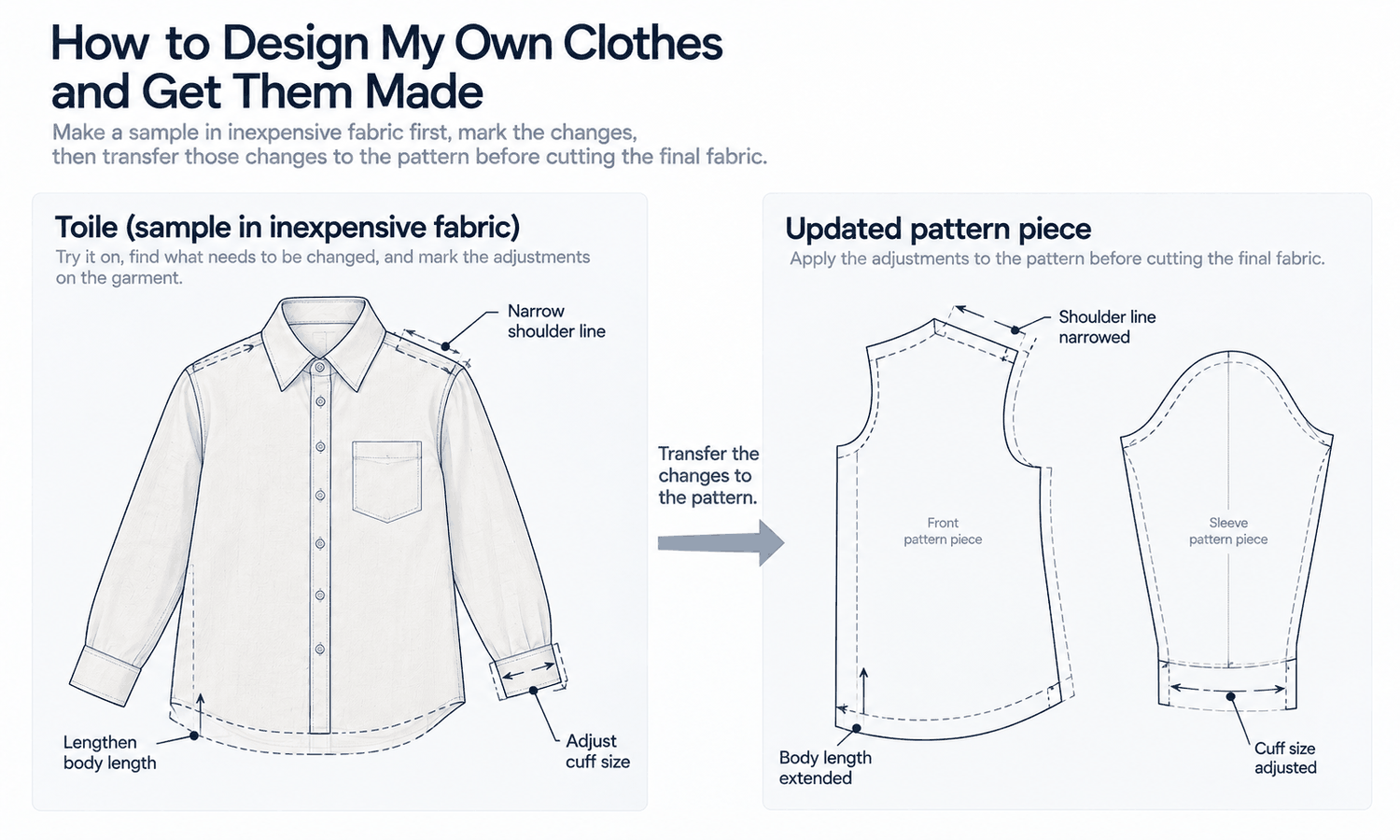
Whichever route you choose, the base pattern is where your design becomes flat pieces of a garment. Changes to length, shape and details are made on the pattern before any real fabric is cut.
Fabric and Details
Fabric decides how your design will look, feel and behave, so choose it with the design in mind.
-
Weight and drape. A structured jacket needs a fabric with body; a flowing dress needs one that drapes. Handle fabrics in person whenever you can, because photos rarely show weight and drape.
-
Fiber. Cotton, linen, wool and silk behave and wear differently from each other and from synthetics. Consider comfort, warmth and care.
-
Stretch. Knit fabrics stretch and suit designs that rely on it; woven fabrics are more stable. Patterns are usually drafted for one or the other.
-
Quantity. Buy enough for your pattern plus a margin for pattern matching, shrinkage and mistakes. A dressmaker can tell you how much to buy.
-
Pre-washing. Many fabrics shrink the first time they are washed, so washing the fabric before cutting prevents a finished garment from shrinking later.
Decide the details at this stage too: the closures, the pockets, the collar, the hem finish and any lining. Sketch the garment from the front and the back, and label the details you want. A clear sketch with notes is far easier for a dressmaker to follow than a description in words.
The Toile: Testing Before Cutting Good Fabric
A toile, also called a muslin, is a trial version of the garment made in inexpensive fabric of a similar weight. It is the single most useful step in making clothes that fit, and it is the one most often skipped.
You try the toile on, and you or your dressmaker mark every change: where it pulls, where it is loose, where a seam sits in the wrong place, whether the length and proportions look right. Those changes are transferred to the pattern. Sometimes a second toile is worth making if the changes are large.
The toile also lets you judge the design itself before committing. A collar that looked right in a sketch may feel too large once it is on, or a length that seemed perfect may need a few centimeters more. Discovering that in cheap fabric costs little; discovering it in expensive fabric costs a great deal.
Only when the toile is right do you cut the real fabric.
Putting It Together: How to Design My Own Clothes Step by Step
With the idea, measurements, pattern, fabric and a corrected toile, the final garment can be made. There are two ways to get there.
-
Sew it yourself. If you sew, or want to learn, start with a simpler garment and work carefully from the adjusted pattern. Simple projects build the skills for more ambitious ones.
-
Work with a dressmaker or tailor. Bring your references, sketches, measurements and fabric to the first appointment. Agree what is included, such as pattern work, a toile and the number of fittings, and how the price is set, since it varies widely by place and garment.
Choosing the right dressmaker matters. Look at examples of their work, ideally in the kind of garment you want, since someone who excels at tailored jackets may not specialize in fluid dresses. Ask how they work: whether they draft patterns or adapt existing ones, whether a toile is included and how many fittings to expect. A good dressmaker will also tell you honestly if part of your design will be difficult in the fabric you have chosen.
-
Plan for fittings. Most made-to-measure garments involve at least one fitting before completion. Wear the shoes and underlayers you will wear with the garment.
-
Keep the pattern. Ask for your adjusted pattern, or keep your own. The next garment starts from a pattern that already fits.
-
Care for the result. Follow the fabric's care instructions so the garment keeps its shape and color.
A few first-project mistakes are common. Choosing a very complicated design as the first piece makes every problem harder to solve. Picking fabric from a photo alone often leads to a surprise in weight or drape. Skipping the toile to save time usually costs more time later. And designing without a back view leaves the dressmaker to guess. A simple, well-made first garment teaches more than an ambitious one that never quite works.
Frequently Asked Questions
What is the simplest way to learn how to design my own clothes?
Start from a garment you already like, collect references for what you want to change, take your measurements and choose a base pattern close to your idea. Then test it with a toile before cutting your real fabric.
Do I need to know how to sew?
No. Many people design their own clothes and have them made by a dressmaker or tailor. Knowing some sewing helps you understand what is easy or difficult to make.
What measurements do I need?
Usually chest or bust, waist, hip, shoulder width, back length, arm length and, for trousers, inseam and outseam. A dressmaker can take them more accurately and may need others.
What is a toile?
A trial version of the garment in inexpensive fabric, tried on to check fit and design before the real fabric is cut. Changes found on the toile are transferred to the pattern.
How much fabric should I buy?
Enough for the pattern plus a margin for shrinkage, pattern matching and mistakes. Your pattern or dressmaker can tell you the right quantity.
What should I bring to a dressmaker?
References, a sketch of the front and back with notes on details, your measurements if you have them and your fabric, or an idea of the fabric you want. The more specific the brief, the fewer changes are needed at the fittings.
In Closing
Learning how to design my own clothes comes down to a clear sequence. Collect references and note what you like in each, measure yourself carefully, choose a base pattern close to your idea and decide the fabric and details. Test everything in a toile before cutting good fabric, then sew the garment yourself or work with a dressmaker, planning for fittings. Keep the adjusted pattern, and the next piece starts from something that already fits.